
In recent years, Korean contemporary art has witnessed a remarkable surge in popularity and recognition on the global stage. This rise can be attributed to several key factors that have propelled Korean artists and their work to the forefront of the international art scene.
One of the main reasons behind the ascent of Korean contemporary art is the unique blend of tradition and innovation found within the art pieces. Korean artists skilfully incorporate elements of their rich artistic heritage, such as calligraphy, traditional painting techniques, and cultural symbolism, while also pushing the boundaries of experimentation and modern artistic expression. This fusion of the old and the new creates a sublime visual language.
Korean Art London 2023, as mentioned in our previous article (Part 1), has brought over thirty emerging and established artists to exhibit their work at the Mall Galleries. After speaking to Vittoria, the curator of the West Gallery, and the artists – MeME and Anikoon – we also had the chance to have a quick chat with SUU (West Gallery), J Ryu (North Gallery), Ha Jin Lee (North Gallery), Seulki Yoo (the curator of the North Gallery), and Rok Hee Hwang (director of the exhibition).

Firstly, let’s concentrate on SUU’s art. SUU’s work is truly mesmerising; she beautifully captures the essence of vibrant living through her “acrylic-on-canvas” creations, and, in addition, she uses traditional Korean silk materials to make some of her art. SUU’s work is influenced by Cubism, and it comes to life with mosaics of bright colours that bring to mind stained-glass windows. Although she draws her inspiration from the Cubist movement, SUU’s art incorporates fragmented geometric shapes and forms. That said, her interpretation takes on a contemporary twist, infusing the compositions with a modern and playful flair. Unlike the didactic and spiritual purpose of traditional stained-glass art, often seen in cathedrals and churches, SUU’s paintings offer a celebration of life itself: its beauty and joy.
“You know, I have been drawing since I was a child. And the only time I had [artist’s block] was when I took a gap year from university. However, there were some [art] events along the way, and that’s when I started to draw again”, SUU confessed, then pointed at her work, explaining that the art that is exhibited at the Mall Galleries is inspired by “my life itself. My art comes from my personal experiences, and that’s what I wanted to show to the public”.

“Although you might think that my art is inspired by Picasso, each piece on the canvas is distorted and connected like a puzzle. I would say that Neo-Cubism is more of my influence [rather than Picasso] himself. In addition, each piece represents the colour of my mind. I wanted to tell the audience that each day is like a piece of art, and I wanted to represent that [through my work]”, SUU added.
Blue Sky (mixed media on canvas) and Life is colouring (silk, mixed media on canvas) are two of her works that truly captivated my soul.
“Blue Sky was inspired by the Bible, Genesis chapters 1-9. And I titled it myself as Heaven”, SUU explained candidly, then added that “Life is colouring was mainly made out of traditional silk materials. The reason why I chose to use silk tissues was because I don’t want people to cry and give up on everything, even after having bad days, we should get up and move on. And butterflies represent a beautiful scent, or rather an aura, so people around them could be easily attracted to them”.
SUU’s work invites us to reflect on life; it also reminds us to pause amidst the chaos of life and appreciate the small moments of joy and wonder that often go unnoticed, and to embrace the vivid pictures of experiences and emotions that fill our lives with colour.

In the North Gallery, on the other hand, I was greeted by Seulki Yoo, a curator responsible for this particular wing. Prior to chatting with Ha Jin Lee and J Ryu, I was taken on a short tour where Seulki discussed the artists behind the paintings.
“The big theme of the North Gallery is how seven different artists express their inner or outer world through colour. Colours are the main thing; for instance, Ji Young Hong uses a thermal camera to develop an alternative viewpoint”, Seulki explained, then continued, “Although her art is abstract, it is still figurative, and the series that you see here is called Epidermis of Love. She wanted to express the epidermis of the human body and the communication of love between people through bodily movements. Hong believes that true beauty lies not in superficial differences but in the shared humanity that connects us all”.
In her Love series, Hong aims to highlight the universal nature of love and the essential need for human warmth and closeness. Regardless of our differences, she reminds us that we all crave and deserve love and connection.
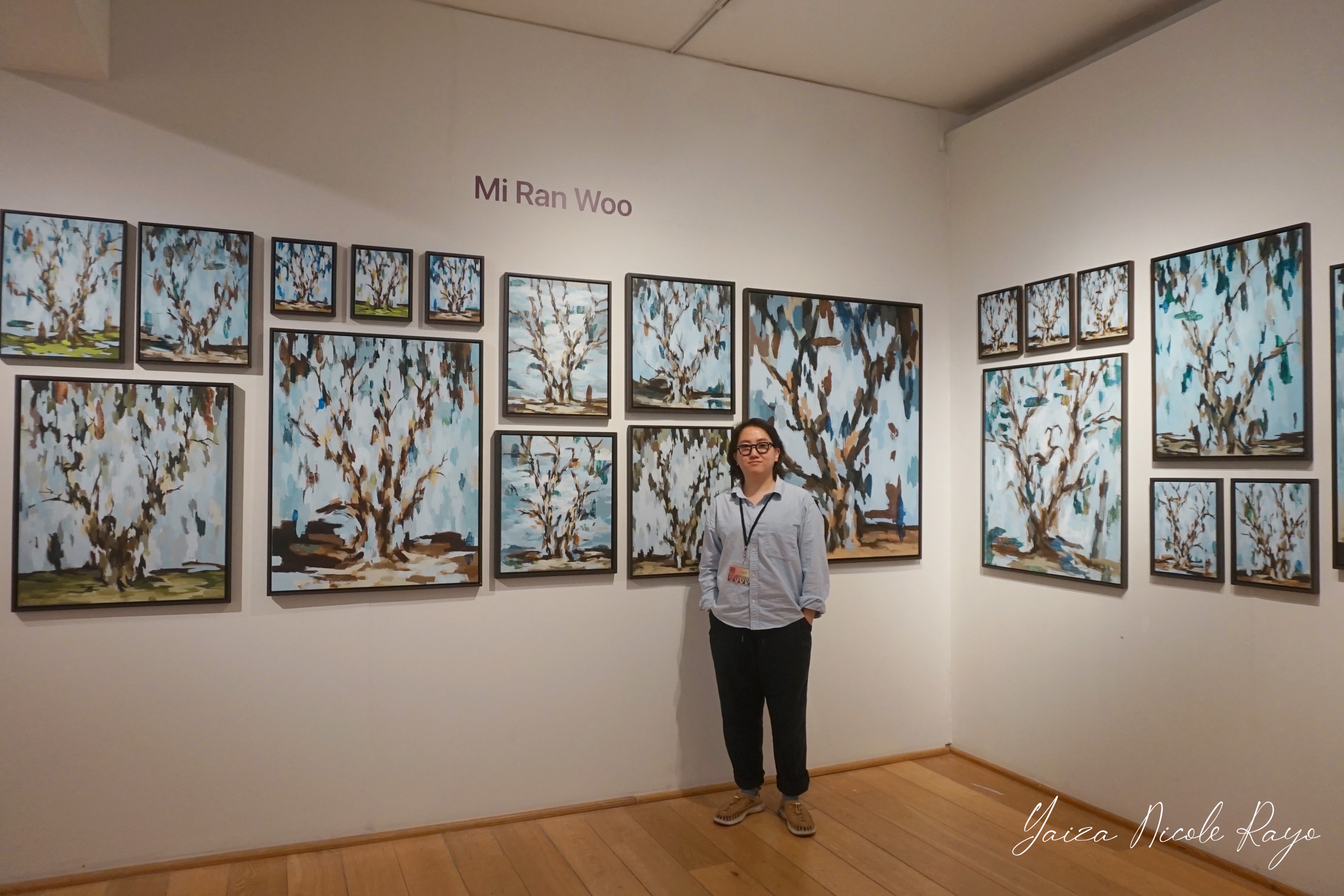
Image © Yaize Nicole Raya
Woo Mi Ran, on the other hand, is heavily influenced by “ideas developed in perceptual psychology. She dives into the concept of ‘action space’, which refers to how we understand our surroundings through spatial information gathered while actively moving and interacting within our environment”, Seulki told me while pointing at Woo’s art.
For Woo, the artistic process is as crucial as the final piece itself. “She views sketching and note-making as fundamental components that inform and shape the eventual artwork. Through these preliminary stages, Woo not only refined her technique but also deepened her understanding of the object she wishes to portray”, the curator added. It is worth adding that this emphasis on process allows the artist to capture the essence of the subject in a more profound and nuanced manner.
Woo’s work poses thought-provoking questions about the basis of all beings, urging viewers to contemplate their place in the world. Through her art, Woo offers a visually stunning and philosophically engaging experience that expands our perception and deepens our understanding of the world around us.

Lee Ha Jin, a former sculptor turned painter, also brings a unique perspective to her artwork.
“With a deep appreciation for touch and balance, Lee pays meticulous attention to the pose, hands, and feet of her subjects. Her current body of work is heavily influenced by a transformative visit to Tula, a town near Mexico City, where the intense light and desert landscape have left an indelible mark on her artistic vision”, Seulki told me, then added that, “Through her paintings, [the artist] finds solace and escape from the mundane, carving out a space of inspiration and reflection”.
In addition, Lee’s previous experience as a sculptor significantly shapes her approach to painting.
“One day, I just started to draw and paint; I found it easier to use other mediums. Painting is the most intuitive form of art. And the inspiration behind the paintings [as the curator mentioned] was my time spent in Tula. I lived there for two years”, Lee explained, then continued, “Tula’s people, their beautiful [human connection with each other], their culture, the country’s sunshine, everything that I have experienced, I still remember. So, all of this proved to be a [profound source] of inspiration.”
“The intense light of the region concentrates the desert landscape into a vibrant ochre palette, which captivated her artistic sensibilities”, Seulki added.

It is undeniable that through her paintings, Lee seeks to capture the essence of Tula’s powerful visuals and translate them onto the canvas. The artist’s paintings seamlessly blend realism and imagination. While she pays careful attention to capturing the physicality of her subjects, her artistic interpretation infuses each piece with a touch of the surreal. By blending the real and the imagined, Lee creates emotional depth in her work.
“I think the biggest challenge while preparing this series was the time I spent on paintings. I had to compromise when it came to big and small paintings. While some took between a few weeks to a month, Cactus (acrylic on canvas) took almost one year to complete”, Lee confessed.
By focusing on the human form, Lee infuses her artwork with a tangible sense of physicality and a deeper connection to our bodies. Her fusion of realism and imagination creates a visually engaging and emotionally resonant body of work that lingers in the mind and ignites one’s imagination.

J Ryu, similarly to Lee, was also influenced by Mexico’s vibrant life, colours, and atmosphere.
“[My artistic journey took an interesting turn] after spending nearly a decade living abroad. When I finally returned to Seoul, I was really shocked by the comparative lack of bright colour in the city. The grey sky filled with dust, people wearing [dark, almost depressing] clothes, and a lack of colourful cars made me want to transform Seoul’s visual landscape”, J Ryu explained, then continued, “Mexico left an indelible mark on my artistic sensibilities. The vibrant and lively nature of the country resonated deeply within me, inspiring me to incorporate sunny yellows and rich ochres into my work”.
J Ryu’s paintings emanate warmth as if each brushstroke invites viewers to partake in the celebration of life. The artist also said that she finds inspiration in various sources, and, recently, she has been captivated by Kim Young Ha’s sci-fi novel, Goodbye. This literary work presents the idea that life’s beauty and value lie in its brevity. Ryu embraces this notion, considering life to be a precious gift precisely “because it is finite”. Her paintings serve as a reminder to cherish each moment and find beauty in the transience of existence.
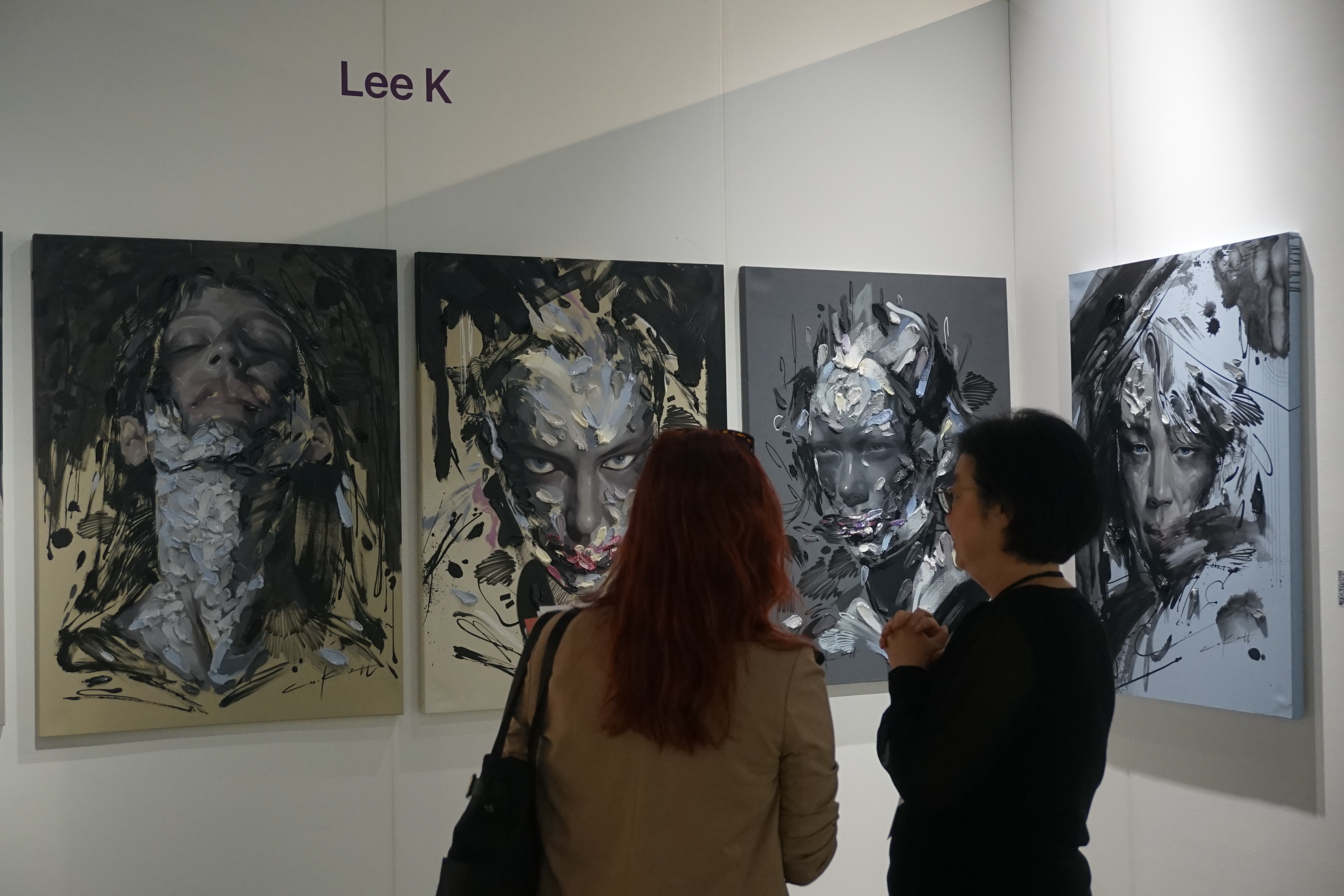
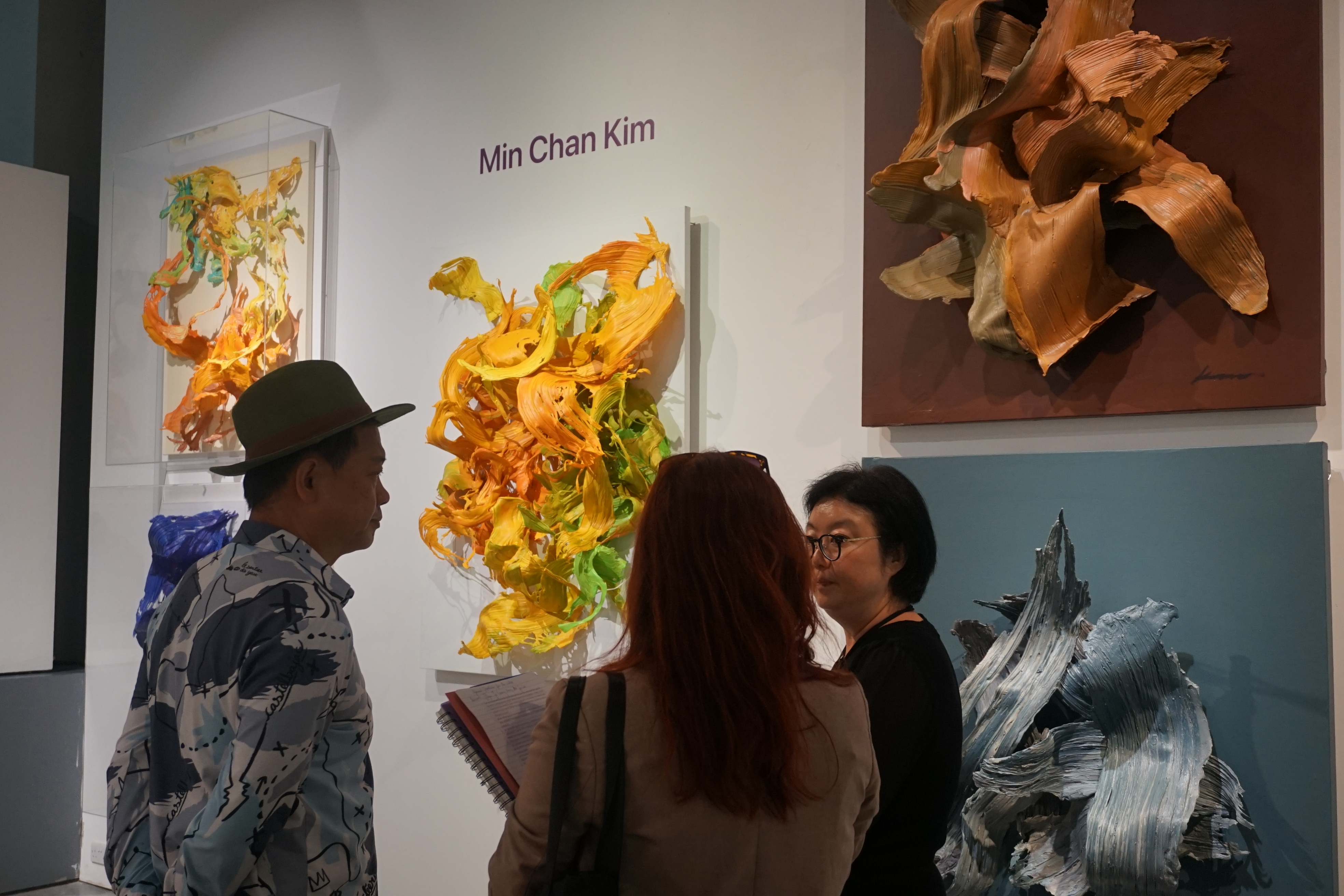
The East Gallery also contains remarkable art, including the works of Min Chan Kim, Lee K, and Nam Sang Woon. Lee K delves into the complexities of human emotions, driven by a belief that language falls short in expressing the depths of our innermost feelings.
“Lee K’s artworks delve into the limitations and complexities of human connection, acknowledging the frequent occurrence of misunderstandings and emotional pain in communication. By incorporating distorted mouths in their paintings, the artist challenges traditional forms of expression. This deliberate choice prompts viewers to face the barriers that impede genuine understanding, while also encouraging them to contemplate the intricate nature of language and the challenges it poses in fostering true connections between individuals,” Rok told me while describing the artist’s work.
“Also, in Lee’s work, meticulous attention is given to rendering the eyes in a photorealistic manner, captivating the viewer’s gaze and establishing an immediate connection. However, a striking transformation takes place when it comes to the depiction of the mouth. It is either concealed and filled with flowers or obscured by expressive and chaotic brushstrokes, creating a blur of painterly movements that obscure the lips. This intentional alteration of the mouth evokes a sense of frenzy and disrupts conventional representation, inviting us to explore alternative interpretations and question the limitations of visual communication.”, Rok explained further.
Looking at Lee’s paintings, one can see the visual representation of the artist’s belief that emotions transcend the limitations of verbal communication. By employing vibrant flowers and expressive brushwork to fill the mouths, Lee K suggests that emotions can be conveyed through non-verbal means and abstract symbolism.
Although I didn’t manage to speak to all of the artists, I wanted to present at least a few of them. With unique art from over thirty artists, Korean Art London should become an annual event as Korean contemporary art continues to captivate and inspire, leaving an indelible mark on the global art scene.
The exhibition runs until July 22nd at the Mall Galleries in London. Tickets are available on Korean Art London’s website.
Written by Maggie Gogler

 VIEW OF THE ARTS