
Warning: Spoilers ahead.
A fantastical orchestral piece plays over a black screen. The opening credits introduce us to Making Of before throwing us into a rain-doused action scene. Without looking at the blurb one might’ve easily assumed this was the movie they were watching, but before too long, a cameraman is angrily pushed away and demanded to get out of the shot. The man stumbles over equipment, a voice yells ‘Cut!’, and the rain ceases.
Making Of, a film by Cédric Kahn, is a self-praising ode to the working class. There are a lot of parallels between the film we’re watching and the film Simon (Denis Podalydès) is directing, in which factory workers are put out of work and assemble to reclaim the factory and their livelihoods. The crew behind the latter is shown increasingly struggling as production goes on, and everyone involved in the project is left working til the last penny runs out. There’s an obvious link between Simon’s persistence to truthfully depict the ‘people crushed and humiliated by brutal capitalism’ and the very situation he and his team are about to face. We get an excruciatingly real scene for anyone who cares about artistic integrity; Simon is fighting for his original script’s ending, true to the story though bleak, to be preserved instead of a happy ending that’ll make more money.

The film also nicely ties a few things together by the end; young aspiring director Joseph (Stefan Crepon) becomes Simon’s rebirth of sorts, who decides to quit filmmaking in order to straighten his life out. It does, however, have its flaws. We don’t see much of a conclusion at the end to Joseph’s plot of filming behind the scenes – rather it is just something we are forced to presume he completed before moving on to his next project. Making Of could have benefitted from wrapping up that storyline a bit more neatly; as viewers we are almost led to believe the making of will become the more successful film of the story, so it’s anticlimactic to see this primary plot wither away at the end.
Making Of is presented in three distinct forms: the ultra-wide dimension during the “film” scenes, the slightly cropped “reality”, and the even squarer “behind the scenes” footage captured by Joseph’s camera. This editing decision is basic and effective at what it does, however, it’s not particularly necessary as viewers should be able to distinguish perspectives without.
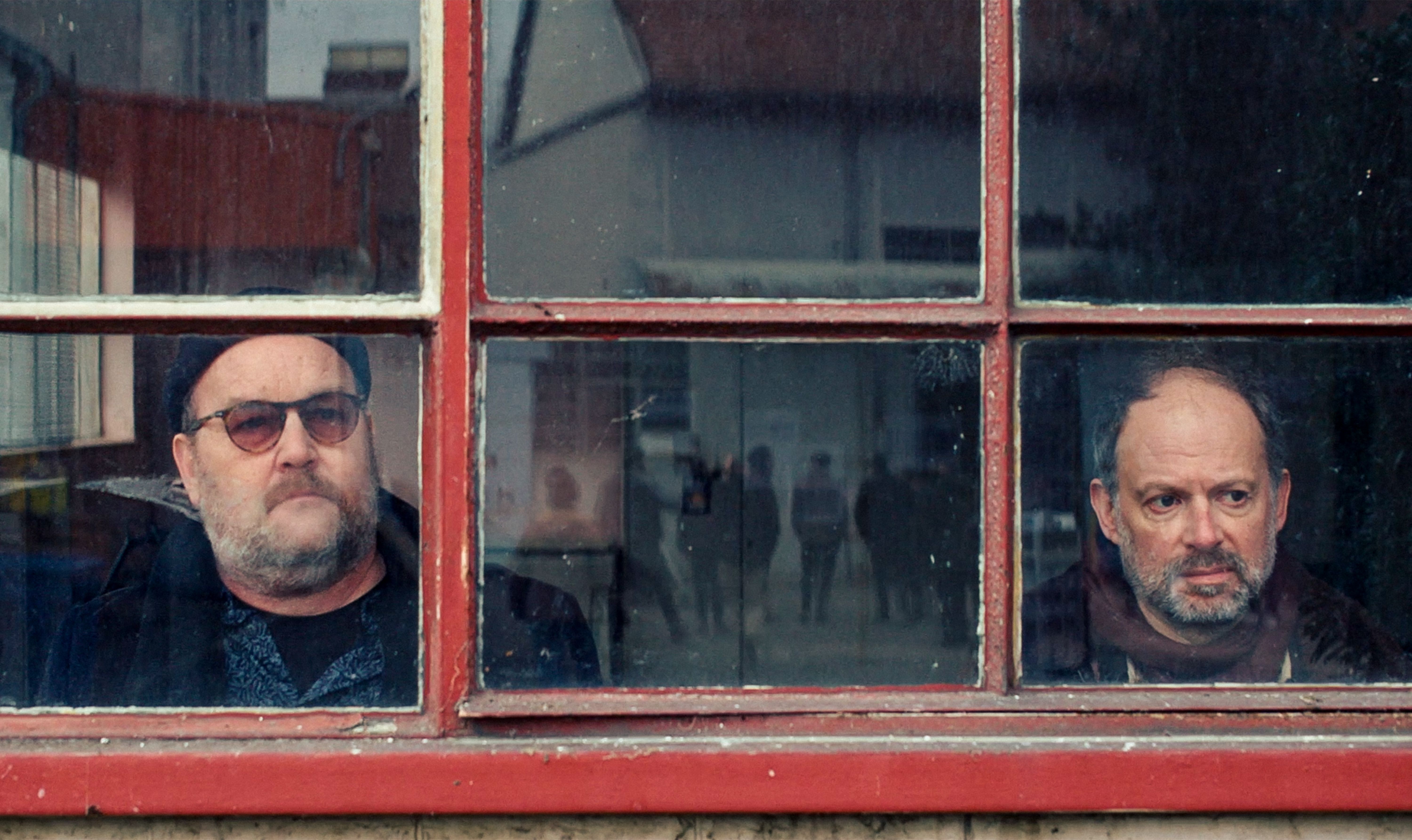
One of the film’s strengths is its beautiful cinematography. We received lots of elegantly angled shots – with the occasional far-out bird’s-eye view – matched with subtly stunning colour grading. Interestingly, it’s as if the Wes Anderson scale is turned up to 1% whenever the character of Joseph is on screen. Often, as in the scene where he is giving Nadia (Souheila Yacoub) a ride on his motorbike, he is centred in a symmetrical, straight-on shot with the world surrounding him. This may be interpreted as many things: his unease over an uncertain future in a vicious industry, the freedom he attains when backed with support figures like Simon and Nadia, and his increasing presence as the “true” protagonist. Another interesting shot of note is during a conversation between Simon and Marquez (Xavier Beauvois); the two are shown standing behind three windows with an empty one in the middle, showing their divide in opinions.
We get some incredible performances from the aforementioned actors as well as Jonathan Cohen, who nails the subtleties between character and character within film and delivers some enthralling scenes. While not perfect, Making Of’s multiple layers all contribute to a point about sticking to one’s principles that is painfully clear. It’s a comfort to the victims of a system that constantly works against them: to those who refuse to cave and retreat from their values, despite knowing the future is uncertain.
Rating:
Written by Maddie Armstrong
View of the Arts is a British online publication that chiefly deals with films, music, and art, with an emphasis on the Asian entertainment industry. We are hoping our audience will grow with us as we begin to explore new platforms such as K-pop / K-music, and Asian music in general, and continue to dive into the talented and ever-growing scene of film, music, and arts, worldwide.

 VIEW OF THE ARTS