
When it comes to creating the perfect mood and atmosphere for award-winning films and television series, South Korean music composer Jung Jae-il stands as a true maestro. Jung Jaeil’s adventure with music began at a young age. He sat at a piano for the first time when he was just three years old, and by the age of nine, he had picked up the guitar, further expanding his musical horizons. His passion for music led him to graduate from the prestigious Seoul Jazz Academy and in 2003, he released his first solo album titled Tear Flower. And throughout his career, Jung Jaeil collaborated with various artists and bands, including his role as a member of the band Puri for their second album in 2007.
One of Jung Jaeil’s most notable achievements came in 2021 when he received the Hollywood Music in Media Awards for his outstanding scores for the television series Squid Game. The artist has also contributed his musical talents to a wide range of films, including Sea Fog directed by Shim Sung-bo, Okja and Parasite directed by Bong Joon-ho, and Koreeda’s Broker. The future holds even more promise for Jung Jaeil as he is set to collaborate with acclaimed director Bong Joon-ho once again for the upcoming film Mickey 17, slated for release in 2024.
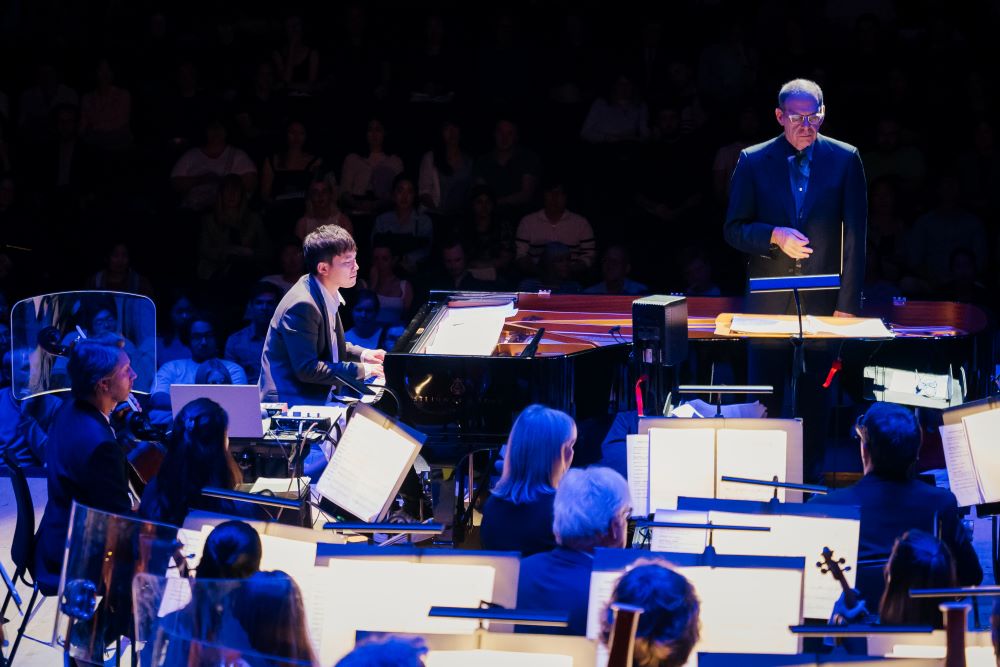
On October 1st, the Barbican Centre’s stage was set as the iconic London Symphony Orchestra prepared to accompany Jung Jae-il. And I can tell you one thing, the concert was a musical spectacle. The evening commenced with an exquisite performance from the composer’s album Listen – the ethereal piece titled Ocean Meets the Land. With the London Symphony Orchestra providing the perfect backdrop, Ocean Meets the Land‘s gentle melodies flowed smoothly throughout the auditorium.
As the applause settled, Jung Jae-il effortlessly moved into another piece from Listen called Esthesia. The orchestra continued to complement his contemporary compositions, creating a juxtaposition of classical and modern elements. I absolutely loved the synergy between Jung Jae-il and the London Symphony Orchestra. This union of classical excellence and contemporary innovation let me experience music in a unique and profound way.
The focal point of the evening came as Jung Jaeil delved into his work from the internationally acclaimed Korean Netflix series, Squid Game. The Medley from the series, a compilation of several tracks, almost bewitched me. Notably, during Round I, Jung Jae-il picked up his electric guitar, presenting his musical versatility. Way Back Then followed, known for its child-like tune featuring drums, recorder, tuba, and bells. However, it was Pink Soldiers that truly transported me into the world of Squid Game. With my eyes closed, I was immersed in the gripping and haunting melodies that captured the essence of the series.

What made this concert truly exceptional was the opportunity to witness Jung Jae-il perform both his personal compositions and those created for film. His unconventional yet delicate and powerful piano-playing style was on full display. When combined with the orchestral accompaniment, it sent shivers down my spine and brought tears to my eyes.
Between performances, Jung shared stories about his compositions, such as Memorare and Listen, which touched on themes of human tragedy and the importance of listening and considering one another and the Earth’s creatures.
Memorare began with angelic choir-like voices, transitioning to the powerful tones of the tuba and the gentle force of the piano. The piece conveyed a sense of desperation and a call to those who suffer in the world, with a grand finale that left a deep impression on me. Listen started with a piano solo, reminding me of composers like Wojciech Kilar and Zbigniew Preisner.
The second part of the concert transported me to the world of Koreeda’s Broker. Jung Jaeil played two pieces, To Be A Bird and, creating an indescribable emotional journey. When the orchestra joined in, it felt as though one was soaring among the clouds, becoming one with the world and nature.

The concert reached its zenith with music from the Academy Award-winning film Parasite. Jung Jaeil performed seven pieces from the film’s score, leaving me enchanted once again. For the grand finale, Jung Jae-il invited three Korean musicians to join him. They performed traditional Korean Folk Opera, also known as Pansori, while also playing traditional instruments, including the channgo drum. The mixture of Pansori with classical orchestration was truly mesmerising, offering a glimpse into Korea’s rich cultural heritage.
The evening’s encore was a solo release by Jung Jaeil, set to be unveiled at the end of the year. In the end, the concert by Jung Jae-il and the London Symphony Orchestra was more than just a musical performance; it was a sublime experience that beautifully merged classical and modern tunes, allowing me to embark on an emotional journey that words can hardly capture. The opening night for the K-Music Festival showed that music, regardless of the genre, can touch hearts and bring different cultures together.
Rating:
Written by Maggie Gogler
View of the Arts is a British online publication that chiefly deals with films, music, and art, with an emphasis on the Asian entertainment industry. We are hoping our audience will grow with us as we begin to explore new platforms such as K-pop / K-music, and Asian music in general, and continue to dive into the talented and ever-growing scene of film, music, and arts, worldwide.

 VIEW OF THE ARTS