
Contemporary art has always offered a wonderful space for innovation and expression. Jingshi Wang, a talented artist with a very interesting background, offered insights into her artistic growth – from studying printmaking in China to earning a Master of Fine Arts at Goldsmiths, University of London. Her distinctive mix of printmaking, traditional arts, and stained glass shaped a narrative that brings something new into the art.
Wang’s exploration of traditional arts at the Prince’s Foundation School of Traditional Art, following her printmaking endeavours, adds more beauty to her already stunning work. Working within various disciplines has also created her current identity as a visual artist and stained-glass maker. Wang’s art, presented at the Saatchi Gallery for the StArt Art Fair, offered a visual feast of symbolic elements and personal imagery. Exploring the themes and symbolism ingrained in her work, Wang shared that her narratives are often misunderstood by viewers.
Wang’s incorporation of medieval symbolism draws from different sources, including poetry, illuminated manuscripts, and folklore. And during our conversation, the artist not only explained the inspiration behind her work but also talked about the symbiotic relationship between her artistic pursuits and the impact they have on her creative process.
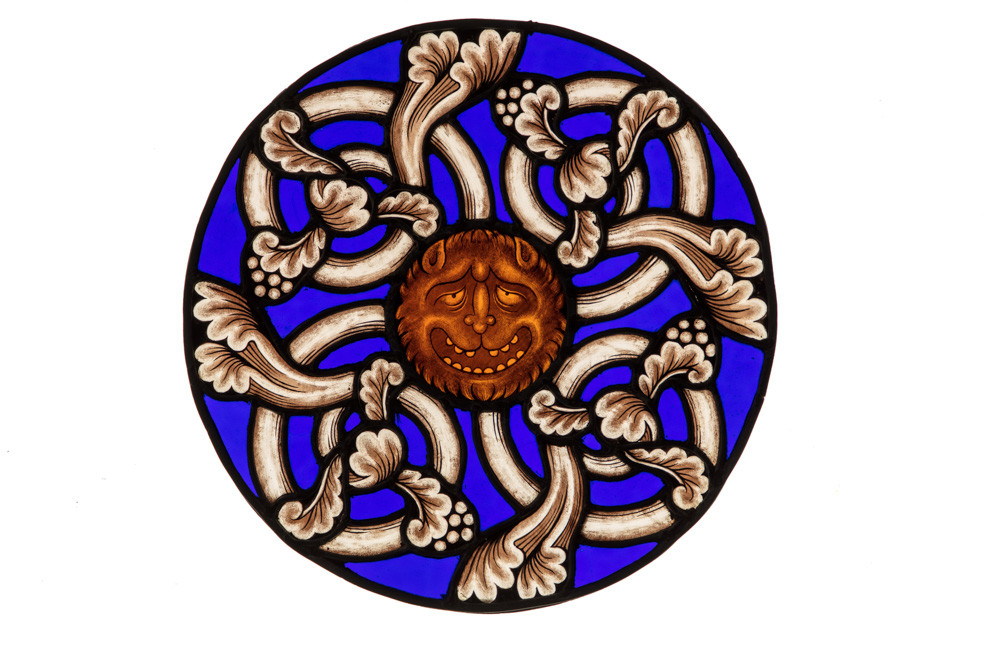
Stained glass panel, metal oxide, silver stain on antique cathedral glass, soldered with lead
View of the Arts: Could you tell us about your artistic journey and how you transitioned from studying printmaking in China to pursuing a Master of Fine Arts at Goldsmiths, University, London?
Jingshi Wang: I studied printmaking at the Central Academy of Fine Arts in China. After finishing my bachelor’s degree, I came to London to pursue my MFA in Fine Art at Goldsmiths. During this period, my interest in handicrafts led me to study traditional arts at the Prince’s Foundation (now King’s Foundation) School of Traditional Art.
VOA: Your background in both printmaking and traditional art is intriguing. How do these diverse artistic disciplines influence your current work as a visual artist and stained-glass maker?
JW: I think it was my interests that led me to these art disciplines, so in some ways, they are closely related. To me, there is little difference between them. In terms of techniques, printmaking and stained glass are very similar, both being very indirect media, and materials give me a lot of restrictions.
VOA: Winning the 2022 Prince’s Foundation School of Traditional Art Ciclitira Prize is a significant achievement. How has this recognition impacted your artistic career and the themes you explore in your work?
JW: This is a great encouragement for me, both financially and psychologically. Being a stained glass artist is more challenging than being a painter, requiring more space, expensive and toxic materials, fewer exhibition opportunities, and work that is difficult to sell. Winning this award has given me the chance to continue doing what I want to do. I’m very grateful to the Ciclitira couple.
VOA: Your art often incorporates symbolic elements and personal fragmented images. Could you share some insights into the themes and symbolism you explore in your pieces exhibited at the Saatchi Gallery for the StArt Art Fair?
JW: The themes and symbolism are covered in detail in two PDF profiles of my work. Here, I would like to share an often misunderstood symbolism in my work. There are many bodies in my work, which some people think is a feminist porn metaphor, but it’s not. The body is here as a vehicle for perceiving the world, which is also a very medieval symbol: The head leads to thought, the skin to clothing, the bones to burial customs, and the feet to travel.
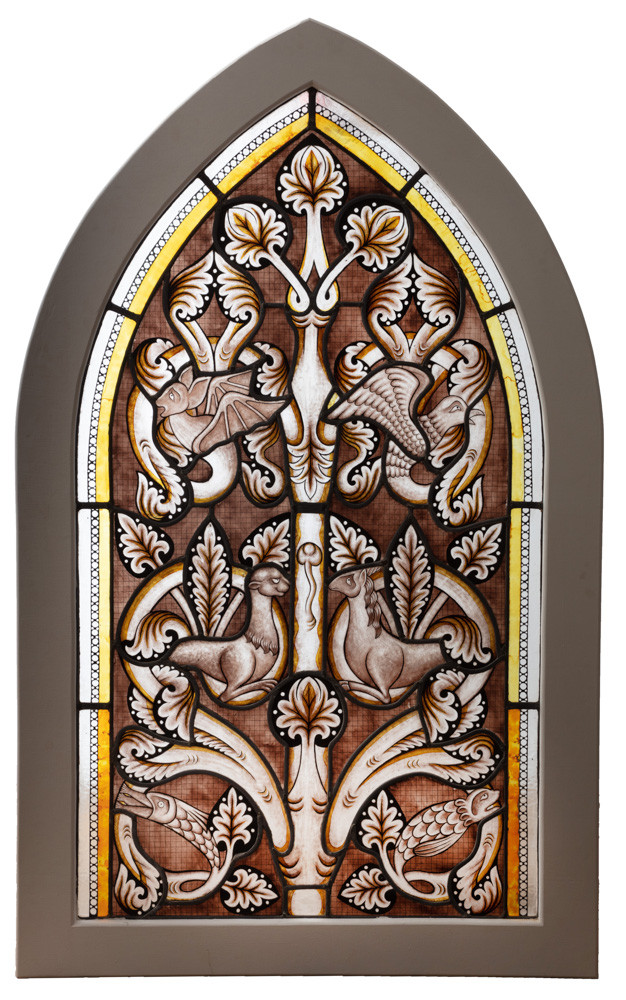
Stained glass panel, metal oxide, silver stain on antique cathedral glass soldered with lead and zinc
177cm x 110cm
VOA: Many artists find inspiration from various sources. Could you elaborate on how poetry, illuminated manuscripts, and folklore have influenced your creative process and the art you create?
JW: I have always been interested in medieval narrative structure, which I think is a kind of pictorial narrative rather than a literary one. That’s why fables and symbols were so widely used in medieval literature. François Rabelais is definitely my favorite writer, and I was deeply influenced by the folk culture of humor in his literary works. If religious culture represents the divine side and folk culture represents the human side, they are like two ends of utopia. Regarding illuminated manuscripts, I think it’s an art form very similar to stained glass. Gold and light are the materials I often use, representing created light and uncreated light, respectively.
VOA: Your work seems to resonate with medieval narrative structures and handicrafts. How do these historical elements play a role in the contemporary art you produce, especially in a digital age?
JW: This is a question that has troubled me for a long time because I have observed that many historical elements have been reproduced entertainingly, appearing in our lives and visual experiences in a simulated way. However, their symbolic meanings have long been altered. As an artist, I grapple with this interpenetration of reality and simulacra when incorporating historical elements into my work.
Take, for example, the ‘卐’, a common symbol in Hinduism, Buddhism, etc., representing holiness, good fortune, and sometimes immutability. Unfortunately, it became a taboo symbol after being misappropriated by the Nazis. This poses a tricky problem because if the artist responds to this kind of simulacra, then in another way, it reinforces and identifies with this simulacra. Whether the artist intends to or not, using this symbol means they are already responding to its simulacra.
The digital age has not only altered the way people see but also how they perceive it. I was born in the 1990s, a period when computers and the World Wide Web were just beginning to spread, I witnessed a time when individuals learned about new things through their five senses, not Wikipedia. This shift in cognitive mode has led to a loss of a certain material consciousness.
Crafts remain a significant topic in contemporary art, with the concept of craft strategically employed to address issues of gender, and global development, and to take a stand against artistic academicism. Artists engage with making processes, some distinctly archaic, to suggest the abject and the everyday. Craft activism, or craftivism, introduces a new political purpose for handmade creations. In this context, the manual content becomes less important; what holds significance is its participation in the discussion of labor politics in an ideological manner.
However, if the craft is detached from its essence as a product of labour, merely viewed as a commodity, I believe it cannot maintain its status as an ideology. Unfortunately, I haven’t found an effective way to respond to this challenge. Consequently, in my work, I adopt a nostalgic approach to circumvent this question.

Drawing on paper
VOA: The StArt Art Fair at the Saatchi Gallery is a prestigious platform for artists. What does it mean to you to have your art exhibited here, and what can visitors expect from your exhibit?
JW: First of all, it makes my resume look better. Secondly, I think it’s a good opportunity to meet other artists and see their amazing works.
VOA: Your journey from China to London is fascinating. How has your multicultural background influenced your artistic perspective, and do you see this reflected in your art?
JW: In fact, when I was in China, the art education I received was also based on Western art history, so I didn’t receive much influence from Chinese art in terms of visual cues. However, I was deeply influenced by it on a cultural level. Therefore, I am particularly fond of pre-Renaissance art, from which I see a common denominator that is very similar to Eastern culture. For example, in medieval art as well as in Eastern art, the concept of beauty is not visual, but moral. For example, you can find many similar proportions, motifs, and patterns in many Gothic buildings, Islamic buildings, Chinese buildings, etc. They are considered beautiful in all different cultures because they are functionally harmonious, and they are connected to the laws of the universe and nature (For example, the orbit of Venus is related to the pentagram).
VOA: What projects or themes are you currently exploring or planning to explore in your future work, and how do they connect to your artistic journey thus far?
JW: In terms of painting, I hope I can continue to complete the work of the City of Truth that I exhibited in the exhibition. I’m making a handmade book for this story, and in the exhibition, I present the first 10 pages, which I hope to finish. Regarding stained glass, I have some experimental ideas about connecting stained glass with video and hope to have time to complete them. I feel like I want to do too much and have too little time.
Written and interviewed by Maggie Gogler
Featured image © View of the Arts
View of the Arts is a British online publication that chiefly deals with films, music, and art, with an emphasis on the Asian entertainment industry. We are hoping our audience will grow with us as we begin to explore new platforms such as K-pop / K-music, and Asian music in general, and continue to dive into the talented and ever-growing scene of film, music, and arts, worldwide.

 VIEW OF THE ARTS