
NAKTA, a visionary artist hailing from South Korea, is well-known for his metamorphic touch on reality through the colourful lens of digital art. During our conversation, NAKTA shared insights into his creative process, revealing the influences that flow through his imaginative work. From the emotional power of colours to the delicate balance between web design and digital art, NAKTA candidly expressed his passion for his profession and opened up about the “mosaic” of his “colourful imagination”.
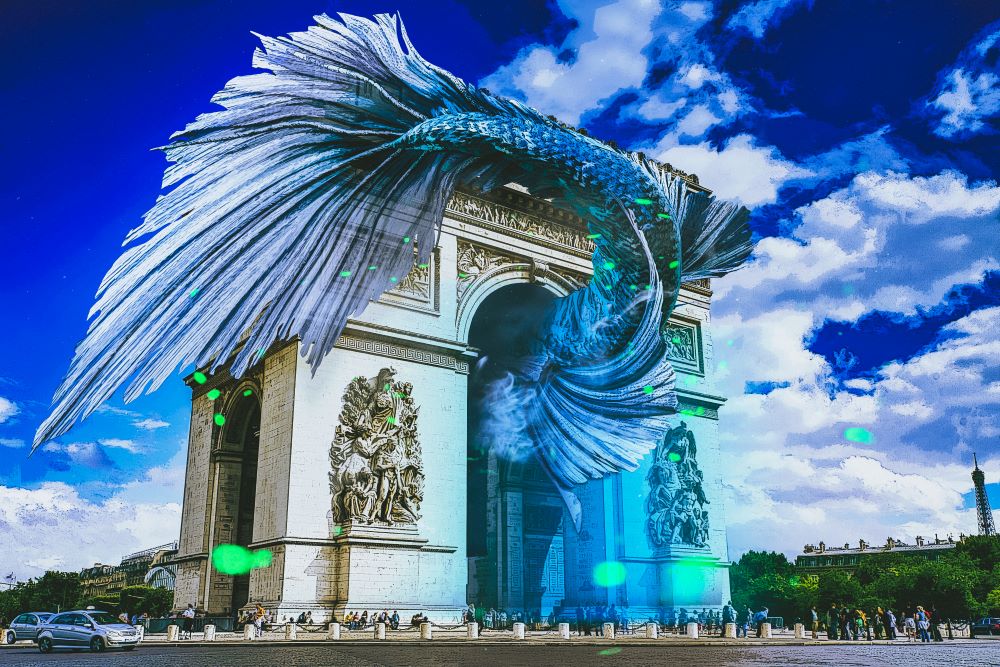
View of the Arts: How do you approach the process of changing and reassembling the order of the real world in your digital artwork to create various imaginary worlds? Can you provide examples of specific techniques or elements you often employ to bring this transformation effectively?
NAKTA: Typically, I structure the content I aim to convey in my artwork by drawing inspiration from my thoughts. I abstract the mental image, considering different imaginative scenarios, and then organise and finalise the desired visual representation. The required images are either captured firsthand or gathered from various sources. These image elements are subsequently reassembled and perfected using the digital collage approach, a technique frequently employed in the process.
VOA: What made you pursue digital art?
NAKTA: Before going into digital art, my background primarily involved web design and photography. Given my frequent use of digital tools in those fields, digital art became the area where I excelled the most and provided the quickest entry point for me.
VOA: Your sources of inspiration include travel, daily life, and emotions. How do these diverse experiences influence the themes and elements you choose for your digital collage works? Can you give us an example of a specific piece where these inspirations played a significant role in shaping the final composition?
NAKTA: I typically draw inspiration from travel, daily life, and my thoughts and emotions. Sometimes, it’s sparked by observing a stable composition or a distinctive landscape in visual information. To achieve this, I don’t just pass by familiar scenes or roads; instead, I keenly observe and pay attention to them. I also enjoy taking walks, using this time to organise my current emotions and thoughts. These experiences help me establish stable compositions in my artwork or identify established rules in the real world, break them down, and freely combine them on the screen. Additionally, the emotions I contemplate and organise become the focal point of my artwork. The piece titled SPACE serves as a message to reflect on past moments of self-doubt and encourages the creation of one’s own world with freedom and confidence.
VOA: One of your works, CONNECT, was presented at the StART Art Fair at Saatchi Gallery last October. How important do you think this kind of art fair is when it comes to emerging artists?
NAKTA: The work that was able to be exhibited through Saatchi Gallery was CONNECT. I don’t know if I can say that art fairs are actually important for new artists. However, rather than the fact that participation is important, I think it is more paramount to identify your own problems and strengths and improve yourself through the experience gained by participating in various exhibitions and art fairs. Also, rather than aiming for fairs and exhibitions like this, I think it is better to find the driving force to work continuously and aim to create good works. Although I was not able to attend the StART Art Fair in person this time, participating in the exhibition was a good experience that indirectly reminded me once again that I need to work harder.

VOA: Digital collage techniques are a distinctive aspect of your work. Could you tell me more about your process of distorting and reordering elements from the real world to create a colourful imaginary world? What considerations and decisions guide you as you manipulate these elements digitally to achieve your artistic vision?
NAKTA: First, I utilise unaltered photos or real-world images as my primary materials. I extract the essential image components from these photos, enhance them according to my style, and incorporate them into a new canvas. Subsequently, I introduce alterations by distorting buildings, inverting cityscapes, or melding disparate elements to evoke a fantastical ambiance. This involves playful endeavours like altering sizes or shapes and blending diverse elements. Throughout this process, meticulous attention is given to details, ensuring clarity, and maintaining the integrity of image outlines. We also assess the overall image, continuously verifying stable composition, contrast, colour, tone, and more. To convey the ambiguous boundaries that generate unreal landscapes using real-world elements, I tend to strike a delicate balance, avoiding excessive modifications.
VOA: The concept of expressing a “colourful imaginary world” is intriguing. How do you approach the use of colour in your artwork to convey specific emotions or atmospheres? Are there particular colour palettes or combinations that you find yourself drawn to, and if so, what emotions or messages do they typically evoke in your work?
NAKTA: In my artistic process, I place significant emphasis on the colour scheme of my work. Colour correction is applied during the image element retouching phase, and even after amalgamating these elements into a cohesive artwork, I fine-tune the colours and adjust the tone to achieve the desired outcome. When venturing into my imagination, I often incorporate shades of blue and purple to bring a dreamlike ambiance. As the artwork nears completion, I carefully determine the overall colour tone that best describes the intended emotions, making diverse corrections to achieve the optimal colour balance. Adhering to the concept of a ‘colourful imagination,’ I usually favour high colour saturation. While I don’t strictly adhere to a specific colour palette, I often find myself drawn to purple and blue. These colours resonate with me, influencing their recurrent use in my works. Given my keen focus on colour, I sometimes execute revisions to ensure that the finalised colours align with my envisioned aesthetics, following no rigid frameworks or rules except for using colours that convey a dreamy atmosphere and opting for high saturation.
VOA: As both a web designer and a digital artist, how do you navigate the creative and technical aspects of these two roles? Are there specific challenges or advantages that arise from wearing both hats and how do you balance the requirements of both in your projects?
NAKTA: Actually, I used to work in corporate web design before going into digital art. While my current focus has shifted away from producing many websites, the field of web design continues to grow, demanding ongoing exploration of diverse technologies, such as coding, to enhance expression. Although my involvement in web design has somewhat slowed, its visual nature sustains my interest, prompting me to explore various websites for learning opportunities. Unlike digital art, web design entails consideration of numerous factors like a stable layout, client specifications, information delivery, and UI/UX. It requires the creation of visually appealing images while balancing these aspects. On the flip side, digital art provides a greater degree of creative freedom, involving careful consideration of how to effectively convey intended messages. Despite the differing concerns between the two fields, the common thread lies in the creation of beautiful and high-quality images. Exploring and analysing various images in both domains serves as a valuable experience and contributes to my growth.
VOA: Are there specific artists, digital or otherwise, who have had a significant influence on your work and creative approach?
NAKTA: No specific artist holds a remarkably significant sway over my work. Initially, I began editing photos I took with the simple intent of pursuing my creative desires. However, as I went deeper into my craft, I became enamoured with the works of Erik Johansson, compelling me to think, ‘I must strive harder to produce such marvellous pieces.’ Rather than exerting a direct influence on my work, I would characterise it more as a source of abundant inspiration. My appreciation spans a variety of artists, and their diverse work inspires and propels me to put in greater effort. Lately, I’ve found immense enjoyment in the artwork of James Jean. His unique style of depicting beautiful colours and objects resonates with me, and I find it exceptionally cool.

VOA: Walk us through your typical creative process. How do you begin a new project, and what steps do you take to bring your digital artwork to completion?
NAKTA: When presented with a topic, I arrange diverse thoughts aligned with the subject and build a mental image. The first step involves clearly defining the message intended for the topic. In the absence of a specific topic, I generate an image based on the inspiration received. Even if the initial images are abstract, repeated visualisation and mental organisation help strengthen the desired expressions for the artwork. Then the essential image elements are collected, with the option to capture photos if needed. Following the image collection phase, I apply retouching to the gathered images in my distinct style. After establishing the overall background, the retouched image elements are strategically placed on the screen. Subsequent adjustments involve modifying contrast and details to ensure seamless integration of the placed images. Further refinements include the diverse expression of colours and personalised tone corrections. If the project extends to video work, the image is finalised first, followed by animation planning. The required images are then redistributed, and the animation phase is initiated.
VOA: How would you describe your artistic style, and how has it evolved over time? Are there specific themes or subjects that consistently appear in your work?
NAKTA: When I began my work as a digital artist, I didn’t have a predetermined artistic style in mind. My journey began naturally as I revisited photos captured during my travels, thinking how the scenes could have been enhanced for greater beauty and atmosphere. In the initial phase, my work focused on photo collages. However, as I focused on the creative process, the idea of creating imaginary worlds began. I always wish to show diverse and vibrant worlds in a bold and flamboyant manner, emphasising the concept of “Colourful Imagination.” This concept evolved into my current style, characterised by intensified vividness and higher saturation. In my artworks, I engage in the unrestricted rearrangement of existing reality elements. For instance, I employ techniques like dramatically altering building sizes, twisting architectural structures, or relocating aquatic creatures from water into the sky above the city. My artwork mostly presents nighttime scenes, where underwater creatures venture beyond their watery world. Natural elements like trees and flowers are recurrent, and their bright colours serve to instil hope in dystopian settings.
VOA: What are your current artistic goals? Are there specific themes or projects you are keen to explore in the future?
NAKTA: Primarily, my overarching ambition is to sustain a lasting career in my artistic venture. At the same time, I’ve set smaller goals aimed at refining my expressive abilities and bringing diverse skills to improve my artwork. Continuous introspection is crucial, in contemplating the messages and stories I wish to bring through my work. The ultimate aim is personal development that ensures the longevity of these artistic pursuits. Moving forward, I want to explore a variety of themes, including social narratives, deeper explorations of human connections and emotions, and the creation of imaginative worlds inspired by both Eastern and Western cultures, architecture, and history, all filled with a sense of freedom and enjoyment.
Written and interviewed by Maggie Gogler
View of the Arts is an online publication that chiefly deals with films, music, and art, with an emphasis on the Asian entertainment industry. We are hoping our audience will grow with us as we begin to explore new platforms such as K-pop / K-music, and Asian music in general, and continue to dive into the talented and ever-growing scene of film, music, and arts, worldwide.

 VIEW OF THE ARTS