
Although Who Will Stop The Rain is Su I-Hsuan’s feature film debut, it is not the director’s first film. This goes to her award-winning television film Where the Sun Don’t Shine (Taiwan Public Television Service, 2018) which documents the life of a murderer, Dong, after his release from prison, and the difficulties of rehabilitation for those who live at the margins of society. Su also worked on the television series, Detention (Netflix, 2020), loosely based on the video game (Red Candle Games, 2018) and subsequent film (John Hsu, 2019), set during the White Terror period.
Like Detention, Who Will Stop The Rain focuses on a pivotal and traumatic time in Taiwan’s history, and the drive for democracy as spearheaded by students. Set in 1994 in the aftermath of the Wild Lily student movement at a time when student activism took on more local issues. The film concerns the entanglement and inseparability of the personal and the political as well as demonstrating the many layers of intergenerational trauma. At the same time, it engages with gender politics of the time when women were making their voices heard as demonstrated by the Anti-Sexual harassment parade which took place on May 22nd of that year. Later that year, two high-school students committed suicide in a hotel, an act which some have ascribed to the oppression of LGBTQIA+ identities in Taiwan at the time (although it needs to be pointed out whether the girls’ act was as a result of struggling with their sexuality or as a result of a struggle against generalised gender oppression).

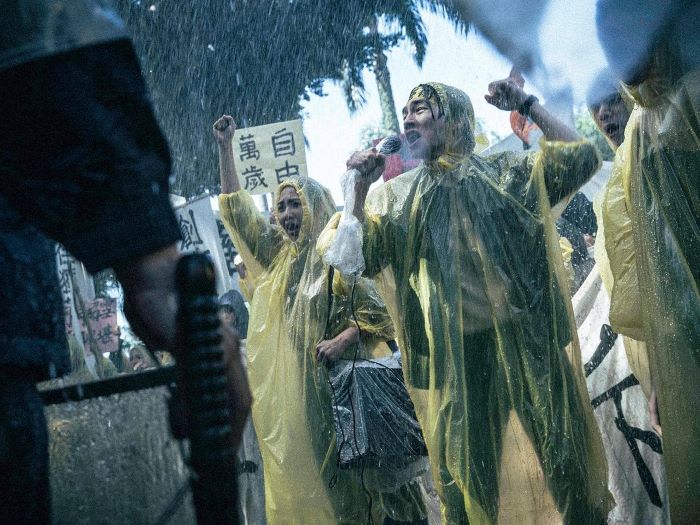
The credit sequences which show a crowd of students in yellow raincoats protesting as rain pours down, flanked by police officers, also could be seen as an oblique reference to Hong Kong’s recent battles for self-determination in the light of the One China movement wherein the yellow umbrella has become a signifier of resistance. This though is the film’s past, with Chi-wei’s (Lily Lee) voice-over providing continuity between that and the film’s presentness, while being applicable to the state of politics in our current world and the move towards authoritarianism: “[W]e still believed a tiny flame could burn down a forest”. Immediately following this we meet Chi-wei as she arrives with her mother eager to start her degree at the Chinese Culture University, Department of Fine Arts. There she meets Kuang (Roy Chang), the leader of the student resistance, and his girlfriend, Ching (Yeh Hsiao-fei), and soon finds herself embroiled both in the resistance and a love triangle motivated by Chi-wei’s desire for Ching, which is at first not reciprocated. The student’s protests over creative freedom and freedom of expression was the longest running strike in Taiwan’s history of student activism. And it is only after the student protests are successful, that Ching allows herself to love and to be loved, suggesting that without political freedom, personal self-determination cannot exist.
As an LGBTQIA+ coming-of-age film, Who Will Stop The Rain, depicts the growing relationship between the two women with care and consideration and can be understood as paralleling the fight for democracy with the fight for self-determination in terms of one’s sexual identity. It is perhaps no coincidence that Chi-wei shares her name with the first person to come out on television in 1986 during the AIDS crisis. In 2020, Chi Chi-wei was recognised for his gay rights activism in Time Magazine’s 100 Most Influential People in the World. Indeed, it is not Kuang who is the barrier to the women’s relationship but rather Ching’s own repressed feelings as inscribed through her bodily mutilation as a form of traumatic expression, considering herself unable to feel love for anyone including herself. The piano in her apartment is used as a metaphor for this repression; it stands unplayed and ignored until Ching spends the night with Chi-wei. In the morning Ching plays the piano, signifying that she has found her voice in a return to the body.
The performances of Lily Lee and Yeh Hsiao-fei are outstanding, especially given their young ages and the complexity of the identities that they have negotiated. This is especially true for Yeh, as this is her feature film debut. Blue dominates the cinematic palette, reflecting the emotional intensity of the girls’ coming-of-age journey. Neither the camera nor Thomas Foguenne’s score is intrusive, allowing the authenticity of the performances to shine through.

Who Will Stop the Rain is an excellent debut by a talented director whose ability to interweave the personal and political issues produces a film that uses human rights concerns in the past to comment on those in the present. Taiwan’s identity as a nation state is intimately connected to trauma through multiple colonisations starting with the Dutch in the seventeenth century. Remembering democratic movements and the sacrifice of those who participated in them is as important now as it has ever been. In a world that seems to be embracing authoritarianism, we need to be reminded of what can be achieved through grassroots movements wherein a tiny flame can ignite a fire.
Rating:
Written by Dr Colette Balmain
38th BFI FLARE: LONDON LGBTQIA+ FILM FESTIVAL 2024 Takes Place 13 – 24 March at BFI Southbank and on BFI Player
View of the Arts is an online publication that chiefly deals with films, music, and art, with an emphasis on the Asian entertainment industry. We are hoping our audience will grow with us as we begin to explore new platforms such as K-pop / K-music, and Asian music in general, and continue to dive into the talented and ever-growing scene of film, music, and arts, worldwide.

 VIEW OF THE ARTS