
The Asian Art Biennial, conceived by the National Taiwan Museum of Fine Arts in 2007, was envisioned as a space to explore the diverse perspectives shaping our shared contemporary reality. This Biennial examines how these varying viewpoints have come to influence our world, a world marked by complexity and uncertainty, yet rich with potential. In this shifting landscape, the dynamic realities of Asia have not only expanded but deepened, offering fresh insights into the region’s artistic traditions and practices.
As Asia’s economic influence continues to captivate global attention, its cultural and aesthetic foundations have increasingly become focal points within the international art discourse. Asian contemporary art, enriched by this multiplicity of artistic perspectives, has flourished, evolving to meet the changing aesthetic needs of our time. The National Taiwan Museum of Fine Arts, as a vital platform for artistic exchange between Taiwan and the international art world, remains dedicated to nurturing intercultural dialogues through the universal language of art. It is through these exchanges that we deepen our collective understanding of contemporary Asia and its ever-changing creative pulse.

For the 9th edition of the Biennial, running from November 16, 2024, to March 2, 2025, a distinguished international curatorial team – Fang Yen Hsiang from Taipei, Taiwan, invited four international curators to join: Armenian-born, Paris-based curator Anne Davidian; Filipino artist and researcher Merv Espina; Singapore-based South Korean curator Haeju Kim; and Istanbul- and Paris-based curator and writer Asli Sevenhas crafted a concept under the title How to Hold Your Breath. This phrase suggests the act of deliberately suspending a vital function, creating a moment of tension and anticipation. A twist on the familiar saying, “don’t hold your breath” – which warns against expecting immediate change – here becomes an invitation to embrace a latent hope, suggesting that transformation, though slow, is always on the horizon.
To introduce this significant event in both Asian and global contemporary art, we spoke with the curators of this year’s Biennial. They shared insights into the project’s concept, the underlying ideas, the featured artists and their works, as well as the selection process for the exhibition.
View of the Arts: Could you please introduce yourselves as the curatorial team for the Asian Art Biennial 2024?
Curators: The curatorial team for the 2024 Asian Art Biennial was convened by independent curator Fang Yen Hsiang from Taipei, Taiwan, who invited four international curators to join: Armenian-born, Paris-based curator Anne Davidian; Filipino artist and researcher Merv Espina; Singapore-based South Korean curator Haeju Kim; and Istanbul- and Paris-based curator and writer Asli Seven. Together, we span diverse backgrounds and expertise, living and navigating between multiple cities and languages. Our practices range across art, curation, education, research, performance, and writing. This diversity of perspectives informed our commitment to collective, non-hierarchical decision-making, refusing a strict division of curatorial labour. Through this process of decentralisation, where no single voice dominates, we seek the convergence of ideas, allowing personal curatorial signatures to emerge not despite the collective, but within it. We embrace the risks of this curatorial experiment, treating it as a microcosm of the world we inhabit.
VOA: This year’s theme is titled How to Hold Your Breath. Could you elaborate on the concept behind this title and share the overarching direction for this edition?
Curators: The title How to Hold Your Breath flips the familiar English phrase “don’t hold your breath,” which suggests that change is unlikely or slow, and reclaims it as a gesture of latent hope. It evokes the act of pausing a vital function, creating a state of anticipation. Holding one’s breath anchors us in the present moment, inviting us to realign with metabolic rhythms and to listen to what has been rendered inaudible. This act serves both as a withdrawal from systems of visibility and violence and a gesture toward transformation, making space from which new forms of agency can emerge, rooted in relationality, reciprocity, and response-ability.
VOA: Could you briefly outline your creative and research processes as a curatorial team?
Curators: Our curatorial process revolved around collective, iterative discussions. Regular online meetings allowed us to identify intersections between our individual perspectives and practices. Fang Yen Hsiang suggested an initial framework as a starting point, but the process quickly became an open exchange, with each curator contributing themes, areas of focus, and artist proposals. This collaborative dialogue shaped the framework organically, culminating in the thematic lines and title, How to Hold Your Breath, as a result of shared authorship.
Our research trip to Taichung in March 2024 was the only time we worked together in person. Exploring the city, visiting exhibitions, and meeting artists collectively, we developed an intuitive map tracing intersections of labor, trade, craft, visible and hidden rivers, and spiritual practices. These insights informed our selection of artists and artworks for the exhibition and public programs. Decisions were made collectively, from finalising the artist list to shaping the public and screening programs. Starting with an extensive list, we prioritised works that resonated with the exhibition’s themes and fostered connections across practices and contexts. This approach, informed by our diverse cultural and geographical situatedness, ensured the Biennial reflected a plurality of voices.

VOA: In the context of curatorial work and the contemporary art scene, what does “holding one’s breath” signify for you? How do you interpret and explore the notion of “breath” through the works selected for this year’s Biennial?
Curators: The exhibition emerged from a collective sense of breathlessness in response to a troubling year marked by geopolitical conflicts, wars on civilians, ethnic cleansing, and the tightening grip of autocratic regimes. Holding one’s breath is not the theme of the Biennial but its starting point – a shared condition of suspended agency and powerlessness that became a prompt to explore breath as both a survival mechanism and a tool for imagining change. Drawing on the ancient practice of breath retention, How to Hold Your Breath interprets the act as a means to shift perception and access altered states. Suspending such a vital function becomes a deliberate physical, spiritual, and political exercise to prepare ourselves for transformation.
The metaphysical act of breath-holding emerges as a way to recompose and imagine worlds anew, evoking creation amidst collapse. Installed at the entrance hall of the Museum, Yoshinori Niwa’s neon piece “Unavoidable Work to Keep Us Alive” opens up a field of polysemy to reflect on breath as labor to sustain life, while Pak Sheung Chuen’s Breathing in a House materializes the act of breath, resonating deeply with the exhibition’s themes. The works presented in the Biennial propose alternate imaginaries and practices of world-making, challenging notions of linear progress and revealing how histories are tied to specific places, people, and positions. By tracing the entanglements of colonial violence within ongoing imperial politics and new social systems that govern life, they open spaces for alternative liberatory futures.
VOA: Could you describe the selection process for the artworks? What essential qualities or criteria guided your choices for this exhibition
Curators: We did not confine our selection to a fixed, geographical notion of Asia. Instead, we sought to explore classical geographical definitions by investigating the diverse historical and cultural contexts across the region, including colonial histories that link Asia to the Indian Ocean, Africa, and the Caribbean, as well as migration and globalized capitalist movements. Works such as Tao Leigh Goffe’s Black Pacific Chinese Atlantic traces her grandfather’s homecoming from Jamaica to Hong Kong, Hwayeon Nam’s 2 entangles time and place in the stories of two female modernist choreographers and their colonial experiences in Taiwan and Korea, Gary Zhexi Zang’s The Tourist on the Zanzibari Revolution and the uneasy marriage of Afrofuturism and Sinofuturism, Nathalie Muchamad’s Breadfruit, Mutiny, Planetarity on food and colonial displacements, and Mashinka Firunts Hakopian’s speculative futures of SWANA communities imagined through feminist algorithmic predictions reflect this expanded conception of “Asia.”
The Biennial’s core themes and the selection of works mutually informed each other throughout the curatorial process, creating a dialogical framework where thematic threads sometimes intersect or run parallel. Kiri Dalena’s Erased Slogans, Cici Wu’s Belonging and Difference (in collaboration with Yuan Yuan) touches on the open wounds of Hong Kong’s Anti-Extradition Law Amendment Bill Movement and the Blank Paper Revolution in China, and Woosung Lee’s paintings of public protests and scenes from daily life in various cities collectively address resistance, suggesting new forms of solidarity.
Works by Ri, Fang Wei-Wen, Natalia Papaeva, Kirill Savchenkov, and Emre Hüner reimagine fragmented bodies in relation to landscape, language, and violence, emphasising how new forms can emerge even from ruins. The relationship to land and place is central to works by Noor Abed, Hit Man Gurung, Chu Hao Pei, Cetus Kuo Chin-Yun, Aziza Shadenova, and Sharon Chin, emphasizing ecology, displacement, and political entanglements. Jasmin Werner, Pulang Pergi, and Nil Yalter engage with migrant workers’ experiences in Taiwan, Indonesi,a and Europe, respectively. Andrius Arutiunian, Saodat Ismailova, Nefeli Papadimouli, and Apichatpong Weerasethakul destabilise dominant ways of ordering the world and engage with liminal states, such as meditation, sleep, and dreams, which serve as portals to alternate perceptions and possibilities.
VOA: What types of works and media will be on display at the Biennial, and what particularly stands out for you?
Curators: The exhibition features over 90 works, including 19 new commissions and iterations, presented across a wide range of media: painting, textiles, video, sound, installation, performance, photography, objects, and reading sessions. Even within the same medium, such as video, the works employ diverse creative approaches. For example, Saodat Ismailova presents a hallucinogenic cinematic installation, Marwa Arsanios challenges private land ownership through a video essay, and documentary and language instruction videos feature in the collective project Pulang Pergi developed by Julia Sarisetiati with Ary “Jimged” Sendy, Budi Mulia, Deasy Elsara, Dwi Wicaksono Suryasumirat, Fiona Cheng, Hyphen – (Grace Samboh & Rachel K. Surijata), Indra Fachru Syobary, Liemena Sapriya Putra, Nissal Nur Afryansah, PERTAKINA Indonesia, and Teguh Safarizal.
Performance videos by Yoshinori Niwa, Natalia Papaeva, and the AFSAR (Asian Feminist Studio for Art and Research) with DAVRA collective, Andrius Arutiunian’s installation featuring a ‘possessed’ synthetic pipe organ, Yehwan Song’s video installation commenting on digital colonisation through the form of a cardboard theater, and Nefeli Papadimouli’s wearable sculptures – simultaneously paintings and performance costumes – illustrate the range of experimentation on display.
Many works transcend medium specificity, fostering audience engagement and collective inquiry. For example, Marwa Arsanios and Mashinka Firunts Hakopian extended their installations by creating “Meeting Points” – spaces designed for reflection and sharing research and reading resources with visitors. Marwa’s collaborative approach also inspired the Taiwanese artist collective Kuantiann Studio to initiate reading groups with farmers and agricultural researchers in Tainan, while Nathalie Muchamad collaborated with aboriginal artists in Taiwan on breadfruit’s culinary and textile uses, culminating in a workshop. Nil Yalter’s 1992 video installation I AM (Circular Rituals) inspired a collaboration with a Filipino migrant hip-hop band, resulting in a new sound piece. Through these works and initiatives, the Biennial aspires to create enduring alliances, extending the impact of the exhibition beyond its temporal and spatial limits
VOA: Lastly, what is the central message of the curatorial vision you hope to convey to Biennial visitors?
Curators: Our central concern was to reframe hope as a collective practice. Moving beyond the weight of individual responsibility, hope, much like grief, is something to be processed, nurtured, and shared. In a world in permanent crisis, hope becomes a ritual cultivated in public space – through acts of solidarity and communal care. The Biennial is not a guidebook but a shared breath – an invitation to inhabit moments of anticipation and transformation, imagining new possibilities for collective action.
Written and interviewed by Sara Simić
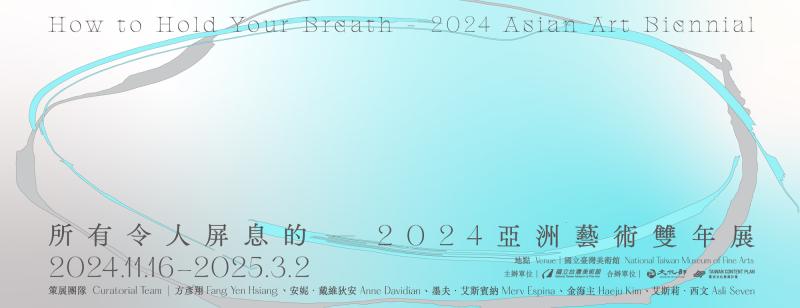
Featured image courtesy of the Asian Art Biennial
More details on the Asia Art Biennial
How to Hold Your Breath – 2024 Asian Art Biennial
Exhibition Period|16 November 2024 – 2 March 2025
Venue|National Taiwan Museum of Fine Arts (2, Sec. 1, Wuquan West Road, Taichung)
Facebook|www.facebook.com/aabntmofa
Instagram|https://www.instagram.com/asianartbiennial
View of the Arts is an online publication dedicated to films, music, and arts, with a strong focus on the Asian entertainment industry. With rich content already available to our readers, we aim to expand our reach and grow alongside our audience by delving deeper into emerging platforms such as K-pop and Asian music more broadly. At the same time, we remain committed to exploring the vibrant and ever-evolving global landscape of film, music, and the arts, celebrating the immense talent and creativity that define these industries worldwide.

 VIEW OF THE ARTS