
Seven years after the release of the critically acclaimed Village Rockstars (2017), filmmaker Rima Das revisits the vivid terrain of Kalardiya to continue the subtle narrative of Dhunu (Bhanita Das). Now on the cusp of adulthood, 17-year-old Dhunu confronts the complex realities of life in her small Assamese village, a world shaped by cyclical floods, economic hardship, and the inexorable passage of time.
Although she carries her guitar from time to time, Dhunu’s dreams of rock stardom have quietly faded, replaced by the harsh realities of tending to the land and the emotional weight of her mother’s (Basanti Das) failing health. Her days are defined by exhausting labour and the unspoken responsibility of keeping her family together. Yet, beneath her growing strength lies the echo of the free-spirited child who once climbed trees and dreamed fearlessly. Caught between the innocence of youth and the demands of adulthood, Dhunu embodies quiet endurance, walking a fragile line between hope and hardship.
Through her perceptive observational style, Rima Das captures this difficult evolution with a realism that effortlessly mixes fiction and documentary, presenting a subtle exploration of identity, cultural heritage, and the understated courage woven into daily survival. In Village Rockstars 2, Dhunu’s journey moves beyond the traditional coming-of-age narrative, evolving into a universal reflection on the poignant shift from innocence to maturity.
In Village Rockstars 2, Rima Das’ cinematography and editing is integral to the film’s powerful narrative. Her role as cinematographer allows her to shape the visual language of the film with a deep sense of place, often framing the intimate, everyday moments of Dhunu’s life with the backdrop of Assam’s stunning yet harsh landscapes. The camera’s slow, deliberate movements allow the viewer to truly immerse in the world, observing the beauty of rural life without any rush. Das’ sensitivity to light, composition, and natural elements serves not only to depict the physical beauty of the land but also to underline Dhunu’s connection to it. The shots of the lush fields and the towering trees bring a sense of both the character’s vast emotional landscape and the physical environment that shapes her existence.
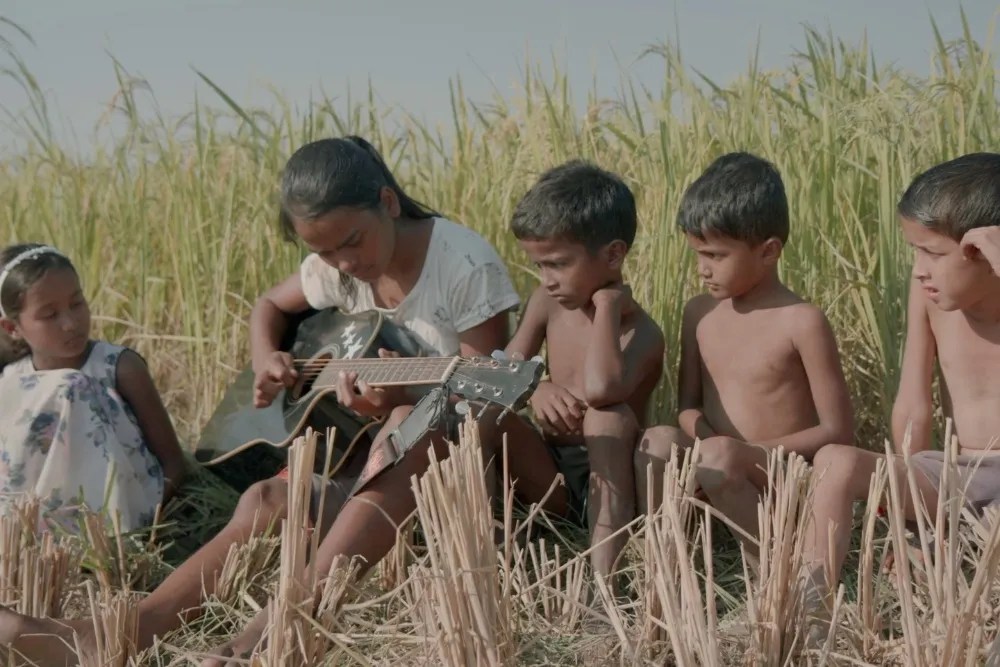
The film’s pacing is deliberate, often leaving the camera to linger on moments of stillness, allowing the viewer to feel the weight of time passing and the silent struggles Dhunu faces. Das’ editing, equally restrained and thoughtful, keeps the narrative grounded in realism, drawing attention to the minutiae of life – actions, expressions, and sounds – rather than flashy plot developments or fast-paced cuts. This style elevates the film to a meditative experience, echoing the flow of life itself, with its undulating rhythm of highs and lows, joy and sorrow.
Pallab Talukdar’s music beautifully complements the film’s cinematography and editing, enhancing its emotional impact. In moments of serenity, his music lifts the atmosphere with a gentle yet profound resonance, while in moments of emotional tension or loss, his score deepens the sense of heaviness without overwhelming the naturalistic tone of the film. The music complements the visual storytelling, allowing the audience to feel the ebb and flow of Dhunu’s emotional journey, from the youthful dreams she once had to the harsh realities of adulthood that she now confronts.
Village Rockstars 2 is a delicate, contemplative continuation of Dhunu’s story that remains faithful to Rima Das’ minimalist storytelling approach. Its slow pace and observational narrative demand patience, offering no dramatic climaxes or conventional resolutions. This specific style may not appeal with all audiences, as it defies mainstream expectations of plot progression. However, its quiet beauty and emotional depth provide a moving meditation on the inevitability of growing up, gently reminding viewers that sometimes, reality overtakes the dreams we once held dear. It’s a lovely film that captures the bittersweetness of life with authenticity and grace.
Rating:
Written by Maggie Gogler
View of the Arts is an online publication dedicated to films, music, and arts, with a strong focus on the Asian entertainment industry. With rich content already available to our readers, we aim to expand our reach and grow alongside our audience by delving deeper into emerging platforms such as K-pop and Asian music more broadly. At the same time, we remain committed to exploring the vibrant and ever-evolving global landscape of film, music, and the arts, celebrating the immense talent and creativity that define these industries worldwide.

 VIEW OF THE ARTS