
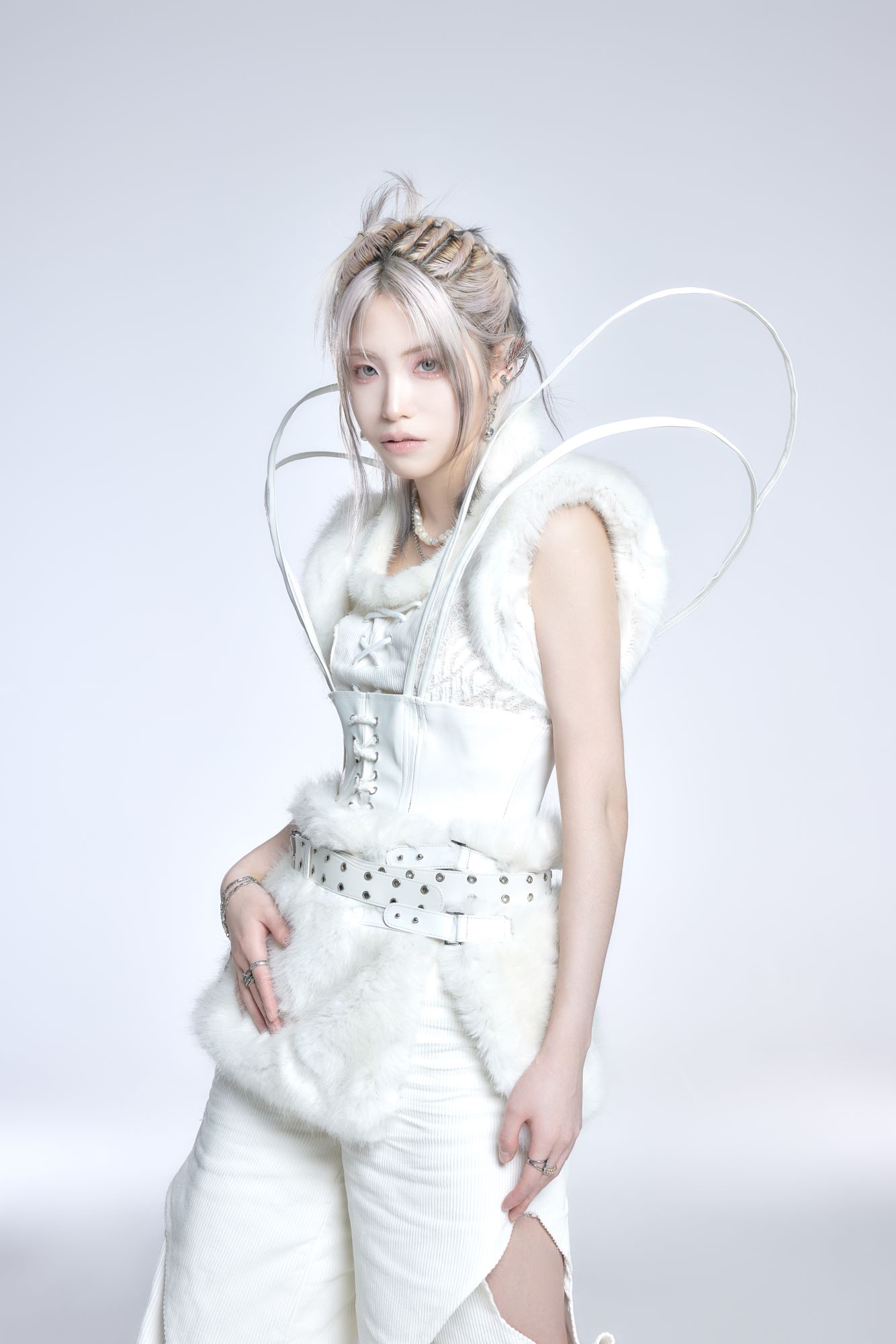
ID:Earth is a visionary artist whose work combines cinematic soundscapes, electronic textures, and stunning human storytelling. Her recent single UTOPIA explores themes of love and the evolving relationship between humanity and technology, creating a sonic universe where analogue values and futuristic progress coexist. The track is part of a larger narrative that will be revealed in her upcoming mini-album, reflecting her ongoing exploration of what humanity truly desires in a rapidly changing era.
We had the privilege of speaking with ID:Earth for an in-depth interview with View of the Arts, where she shared insights into the creative process behind UTOPIA. She discussed everything from the detailed production and orchestration to the philosophical and personal inspirations that influence her work.
ID:Earth also explained how making UTOPIA was an exercise in patience and philosophical reflection. The track and its visuals – created through hand-drawn storyboards and enhanced with AI tools – capture the delicate balance between human creativity and technological possibility. While many may disagree with the use of AI, the singer explained that she was initially against it but has since found a way to use it in support of her artistic vision.
I may have my own intentions, but interpretation is always free. We all walk through the same time, but each country sees different numbers on its clock. As long as we can feel the era we live in together through music, that’s enough for me.

View of the Arts: UTOPIA is a return after some time since your last release. How did the period between projects shape the creative process for this single?
ID:Earth – Actually, UTOPIA was first sketched back in January. The same goes for the other tracks I’ve been working on. I’ve always believed that when you try to document an era through music, timing also matters. At some point, though, I started to feel constantly chased by time, which created anxiety and even mild obsession. The opening line of the lyrics reflects exactly that feeling.
But then I realized what truly matters is not rushing, but moving in the right direction. It made me ask myself what kind of ideal life I’m really dreaming of, and that became the essence behind this song.
VOA: UTOPIA explores the question: “What is the utopia humanity dreams of?” Can you describe the personal or philosophical vision behind this concept?
ID:Earth – The Utopia I present in this album is not a simple ideal world. It’s a dimension where analogue preservation coexists with the technologies essential for the future, a world where language barriers disappear, and fundamental values are preserved like seeds for future generations of Earth. Love also belongs to that ideal realm. I wanted to ask whether we, as humans, can take responsibility for whichever path we choose, whether it follows the laws of nature or the curiosity within us. Advanced technology should be a tool that supports the spirit and the value of life, not something we depend on. That’s why the song poses the question: “How can humanity evolve with technology while still preserving its essence?”
VOA: Multilingual passages and reversible phrases feature prominently on UTOPIA. How do these experimental elements contribute to the story you’re telling?
ID:Earth – The way I see Utopia, it’s a world without language barriers. And a society that begins with respect. I wanted to express a world free from prejudice, regardless of race, way of life, or existence itself, a place where freedom is respected, and even if the order of things differs, everything still makes sense within that harmony. Humanity has infinite potential to create new worlds, after all. That’s why I included lyrics that still make sense when read backward, as well as the ancient phrase “Sator Arepo Tenet Opera Rotas,” which means “The Creator holds and turns the axis of the universe.” At the same time, since order must exist for society to function, I placed that sense of balance in the bridge, where things change overall, but the underlying rhythm remains constant.
VOA: Love, nature, and responsibility are central themes in UTOPIA. How do you hope listeners will interpret these ideas in relation to their own lives?
ID:Earth – I may have my own intentions, but interpretation is always free. We all walk through the same time, but each country sees different numbers on its clock. As long as we can feel the era we live in together through music, that’s enough for me. If someone listens and begins to wonder, “What is my own utopia?” and that question sparks self-realisation, then I’ve accomplished my goal.
Whether the era feels chaotic or peaceful, I’ll always try to capture and document it through sound, because the emotions of people living today will become the proof of our time.
I believe that the people who truly understand the message I’m trying to convey feel it through a sense of trust. That’s why I’m deeply grateful to the fans who believe in me. I find it so meaningful that they can grasp my intentions, and I genuinely think they’re remarkable individuals for that. I see trust as another form of responsibility, and that applies to love, society, and nature alike. There are many kinds of love. I get frustrated when I see people have children simply because they want to, without taking responsibility for them. The same goes for relationships and even influence. My idea of an ideal life is built on belief and hope for humanity. That’s where my vision of Utopia comes from.
VOA: Your work has always combined cinematic soundscapes with pop structures. How did you evolve this sonic language for UTOPIA?
ID:Earth – I think that combination has become my color. Sonically, it’s a meeting of orchestration and electronic elements. My music has always been centered on storytelling and the sharing of realization, which is probably why it naturally comes out that way. The ever-turning world, and the loops that evolve within it, I expressed that through synth bass loops, creating patterns that hold even as chord roots change. In the drums as well, the fills, hi-hats, ride patterns, along with various synths, APs, and EPs, I combined acoustic and electronic sounds together to express the theme’s balance of nature and technology.
VOA: Can you share a moment during production when the concept of utopia became particularly clear or transformative for you as an artist?
ID:Earth – Yes. Compared to my previous works, this one felt more minimal and closer to my true style. I actually thought it might be less mainstream, but people found it more accessible, which really surprised me. That helped me let go of a lot of my perfectionism.
VOA: This single sets the stage for your upcoming mini-album. Without giving too much away, how does UTOPIA hint at the broader narrative you’re building, and when can we expect the release of the mini-album?
ID:Earth – I’m planning to release it around March next year. UTOPIA serves as the prologue to that larger story.
The Utopia I present in this album is not a simple ideal world. It’s a dimension where analogue preservation coexists with the technologies essential for the future, a world where language barriers disappear, and fundamental values are preserved like seeds for future generations of Earth.
VOA: How does your background in film composition influence the storytelling and emotional layering in your music?
ID:Earth – Honestly, I don’t think my major directly affects my work, but it does help positively. It gave me technical and theoretical understanding: genre sense, performance possibilities, historical context, and sound vocabulary. Those elements support my storytelling but don’t define it.
VOA: You appeared as a featured opening act for DJ Alan Walker’s Korea concert, and you’re also preparing a new collaborative single. How do these upcoming projects connect with the themes and energy of UTOPIA, and what can fans expect from this next phase of your work?
ID:Earth – Yes, I performed on the day UTOPIA was released, my first collaboration in the EDM genre. The song, ON&OFF, is set to release in late October. I’d say the connection lies in the bridge of genre, expanding my sonic world. It was quite different from my usual live shows. A lot more energy and movement, but it was incredibly fun.
VOA: Your new music video appears to incorporate AI-generated visuals. What inspired you to use AI in this project, and how did it help realise your artistic vision?
ID:Earth – When I started production, AI was taking over social media. I’ve always wondered why romance seemed to be disappearing from our era. Technology kept evolving to shorten our working hours. But ironically, it only made people work more. For example, when the washing machine was invented, it gave us extra time, but instead of resting, we began to fill that time with other tasks. As technology advances, our methods become increasingly unified, and we end up doing multiple things simultaneously. Of course, there are still certain clothes that are better washed by hand, which, in a way, serves as an analogy for the value of analog methods. As more technologies emerge, we gain the ability to do many things at once. However, it also means that having just one skill is no longer enough. The standard has shifted. Now, people are expected to be proficient in several areas from the very beginning. That made me reflect on what a truly healthy future means. Perhaps it’s because we’re losing the time and space necessary to nurture creativity.
Actually, I was one of those who initially had a negative perception of AI. However, I believe it’s wrong to criticise something without truly understanding or trying it first. Everyone knows that this technology represents the current era, and I felt I had to capture that as well. Whether it’s good or bad doesn’t matter. I simply wanted to capture the world as it is. That became the reason behind it.
So, I studied the tools, how they work, and how rapidly they evolve. There were many different methods. Each person has their own way of describing things. It felt almost like explaining something to someone who cannot see. To achieve the envisioned result, I believe human creativity must come first. It’s not about leaving it up to AI, but about humans creating the original and then developing it further.
VOA: There’s growing discussion about AI’s environmental impact and its effects on human creativity. How do you reconcile using AI as a creative tool while remaining conscious of these concerns?
ID:Earth – I decided to take on this project together with the director I’ve been working with on my previous music videos, and another director who had served as the art director. We approached this project like a traditional film production: story meetings, hand-drawn storyboards, set and prop design, facial expressions, costumes, and everything was planned the analog way first.
The project lasted five months, starting in May. We designed the hot-air balloon, animal interactions, fingerprint reincarnation device, building structures, and even the aquarium glass. Everything was treated as if we were physically shooting it. Then we used AI to expand on what we couldn’t physically achieve, based on our original designs and storyboards. As we progressed, we even incorporated professional camera terminology, describing in detail how the camera should move downward and writing out the setup parameters with almost scientific-level precision.
The main character was developed from my profile photo, then refined through Photoshop, choosing from over a hundred faces before enhancing it through AI. Because it’s almost impossible to find a space in real life that perfectly matches the world we imagined, using AI in that aspect turned out to be quite useful. For the parts that didn’t come out exactly as we envisioned, such as the details of trees or forests, we repeatedly refined them through secondary editing in Photoshop.
Each single shot took an incredible amount of time, and through that process, I realised that achieving the exact look of our storyboard requires someone with a high level of professional skill and technical knowledge. Simply typing in a few words to generate images is something anyone can do, but those results often carry a distinctly “AI-like” feeling. That’s where the difference in detail truly begins.
AI isn’t art. It’s a tool, and it depends on how we hold the scalpel of technology. Technology should help humans transcend limits, not replace imagination. The problem arises when people surrender their ego and originality to it. Many new technologies will come, but I hope the most fundamental, analog roots will always coexist, because originality is the root of creation itself. The term “AI Artist” doesn’t mean AI is the artist; I think it means an artist who uses AI as a tool.
The final scene, where sand rises from the hot-air balloon and flips the hourglass, symbolises that progress always returns to its origin depending on our perspective and direction. In the end, understanding the true essence of creativity and evolution is what will lead us to our own Utopia.
Written and interviewed by Maggie Gogler
Featured image courtesy of blue_um
View of the Arts is an online publication dedicated to films, music, and the arts, with a strong focus on the Asian entertainment industry. With rich content already available to our readers, we aim to expand our reach and grow alongside our audience by delving deeper into emerging platforms such as K-pop and Asian music more broadly. At the same time, we remain committed to exploring the vibrant and ever-evolving global landscape of film, music, and the arts, celebrating the immense talent and creativity that define these industries worldwide.

 VIEW OF THE ARTS