
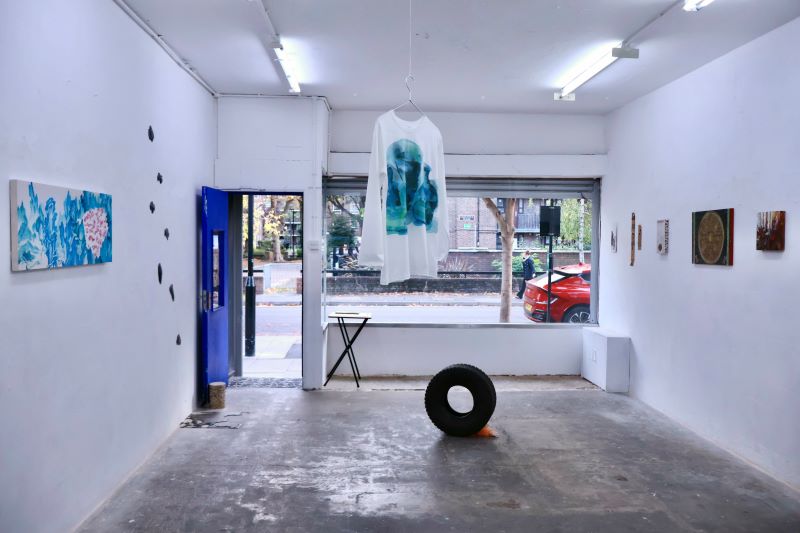
A Way From Home, a fine art and installation exhibition curated by Jia-yi Zhu (Grace), held its private opening on 3 November at Filet, N1 7QP, london, before officially opening to the public from 4 to 5 November. Bringing together sixteen works by fourteen artists, the show broadens the spectrum of diaspora narratives from pan-Asia to the wider West, exploring themes of colonisation, misclassification, and cultural appropriation. Moving through the space draws you into the innermost layers of each nation’s identity – every piece distills the essence of its culture, whether conveyed intuitively or contextualised through curatorial framing.
The largest work in the room is a 100 × 150 cm acrylic on canvas titled The Wind Remembers by Sammie Yao, inspired by the flag of the Republic of Taiwan (blue background with yellow tiger). Its references to Taiwanese culture – from phonetic notations to its chosen palette – are so nuanced that outsiders to the culture may not fully grasp or translate them at first glance. Yet, they are instantly legible to anyone attuned to its cultural pulse. A similar sensibility shapes The Sacred Tree by fellow Taiwanese artist Jamie Chung, a work that gestures toward the history of Japanese logging in Alishan during the colonial period, when sacred trees were felled to build torii in Japan.
Two works, The Breathing Mureung and Stolen Light, by South Korean artists Namhee Kong and Bowyi Song, draw attention to histories of cultural dispossession. Both depict artefacts whose ownership remains contested between Korea and Japan – a Buddha statue in one case, and the 20-metre painting Mongyu Dowondo (Dream of Strolling in Peach Garden) in the other.

Another work by Kazakhstani artist Naira Yessengaliyeva, Emptied (Not on Display), depicts a kumis jug, with traditional ornamental monograms drawn only along the sides of the canvas, invisible when viewed head-on. The jug itself corresponds to an artefact in the British Museum, where it has been misclassified as part of the Middle Eastern collection. Although the object was discovered in Kent, its path to the UK remains unknown. This displacement echoes the drifting, nomadic rhythms embedded in Kazakh material culture, yet here the jug’s journey feels pushed to an extreme: it arrives in a place far removed from its origins, stripped of context and misread for something it is not. In this misrecognition lies a quiet metaphor for the condition of being foreign or peripheral within the UK.
The exhibition carries a quiet confidence, balancing clarity and creativity. In the broader conversation about identity, these works manage to hold onto the cultural textures they come from, even when created from places of distance or uncertainty. Grace’s curatorial approach feels precise yet effortless; the selection is small but intentional, giving space to voices often left outside dominant cultural frames. Though the artists come from different backgrounds, their works meet on common ground, built on similar feelings of estrangement and longing.
Written by Jane Wei
Images courtesy of Jane Wei
View of the Arts is an online publication dedicated to films, music, and the arts, with a strong focus on the Asian entertainment industry. With rich content already available to our readers, we aim to expand our reach and grow alongside our audience by delving deeper into emerging platforms such as K-pop and Asian music more broadly. At the same time, we remain committed to exploring the vibrant and ever-evolving global landscape of film, music, and the arts, celebrating the immense talent and creativity that define these industries worldwide.

 VIEW OF THE ARTS