
Social realism is the name of the game in Mongolian filmmaker Zoljargal Purevdash’s debut feature If Only I Could Hibernate. Over the past few weeks, the Un Certain Regard title has been widely celebrated as the country’s first film ever in the Cannes official selection. To be accurate, however, Hibernate is the first Mongolian feature-length film at the French festival since the former honour goes to Lkhagvadulam Purev-Ochir’s Mountain Cat which was in the short film competition in 2020.
“Are you trying to kill me, you fucking cunts?” The startling, expectation-thwarting opening sequence of Hibernate starts with a black screen and these words, which are not particularly shocking on their own but for the voice that shouts them. Then we see a four-year-old with his trousers down and body pinned on a bed by his three older siblings. Their mother stands towering above them, holding in her hand a syringe with flu medication. The scene takes place inside a ger or yurt but once the camera steps outside, the locale is revealed to be the outskirts of the capital city of Ulaanbaatar, rather than the steppes that most viewers might expect from a Mongolian film at an international festival.

Hibernate focuses on fifteen-year-old Ulzii and his family. In the two years since they moved from the countryside to the city, his father has died and his mother (Ganchimeg Sandagdorj) has turned to the bottle. Ulzii (Battsooj Uurtsaikh) is discovered as a physics prodigy by his new teacher – inviting inevitable passing mentions of Good Will Hunting – and starts advancing through the rounds of a national competition that could lead to a full scholarship at a prestigious high school. When his mother, struggling to find a (well-)paying job in the city, decides to relocate back to the rural regions with her youngest and foul-mouthed son, Ulzii chooses to stay behind with his two other siblings. Relying on government handouts and resorting to burning scrap tires, the three siblings try to pull through the harsh Mongolian winter. Hence, the impossible wish is conveyed in the title.
Zoljargal, who cites the social realist works of British filmmaker Ken Loach as an influence, is determined to show a version of Ulaanbaatar that you do not often see but one that most locals are painfully all too familiar with. Hibernate sheds light on not only the rural-urban divide but also the socioeconomic gap within the metropolis. While helping his neighbour on an errand, Ulzii goes to high-rise apartment complexes with fancy names such as Luxury Village and Crystal Town. The comfort and convenience of these condos offer a sharp contrast to the yurt districts that have neither running water nor heating systems.
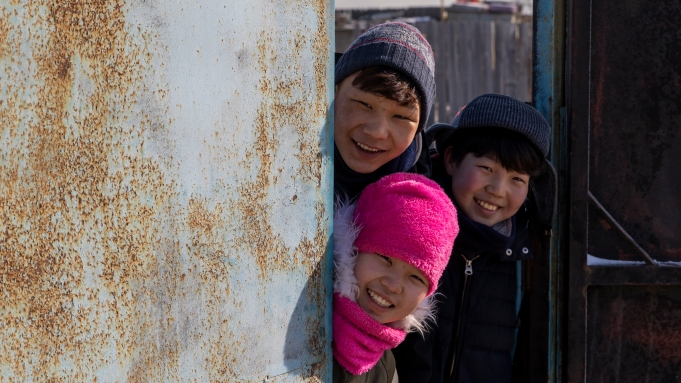
If these suggest unmitigated sentimentalism, you are in for a surprise. There are a few emotionally charged moments throughout the film but Zoljargal’s semi-autobiographical story proves candid and touching, rather than maudlin and heavy-handed. The narrative is quite straightforward and true to the lived reality in the yurt districts where surviving comes far before living. However, the transition moment for Ulzii in the final act feels rather rushed and could have been extended to show the character’s development more vividly.
The performances of the cast members, many of whom are non-professionals or first-timers, are of various quality. The biggest highlight is Nominjiguur Tsend who offers a wholeheartedly natural portrayal of Tungaa, Ulzii’s sister. While the pain and intensity in Battsooj Uurtsaikh’s Ulzii is so poignantly clear to one’s eyes, his delivery of lines comes off as rather stiff, and his expressions blank at certain otherwise emotional moments.

There’s little to write home about in terms of technical aspects, except for Johanni Curtet’s music. Although this is the French ethnomusicologist’s first time scoring a film, his ethnic string instrumentals of doshpuluur and mouth harp during scenes in the yurt districts blend in inventively with beatbox in the city settings and throat singing in the countryside. Davaanyam Delgerjargal, who lensed Zoljargal’s short film Yellow Bus with an acute eye for visual metaphors, opts for a plainer but more polished shot this time around, which arguably proves more appropriate for the director’s restrained approach to the story.
Ultimately, Zoljargal’s If Only I Could Hibernate is a candid social drama with a local focus, a universal appeal, and a lot of heart.
Rating:
Written by Amarsanaa Battulga

 VIEW OF THE ARTS