
The Boys is the final film in Chung Ji-young’s “true story trilogy” which began in 2012 with Broken Arrow (also known as Unbowed) later followed by Black Money in 2019. The three films deal with social issues and in particular focus on prosecutorial and police misconduct within the South Korean justice system and the ordinary people who become caught up in a web of deceit; some paying for the sins of others with their deaths. Broken Arrow is based on the Kim Myeong-ho controversy.
Kim Myeong-ho was a mathematics professor who was unfairly sacked from his job. When his appeal was dismissed by Judge Park Hong-woo in the Civil Court, Kim went to the Judge’s house armed with a cross-bow and ended up shooting the Judge during a scuffle. On his release from prison, while jobless, Kim became a symbol of resistance to the ordinary people of an unfair judicial system that privileged the rich. The second film in the trilogy, Black Money, is loosely based on a financial scandal centred around Lone Star (a US-based private equity firm) which acquired the Korean Exchange Bank in 2003, making a profit of 4.9 trillion won by the time it exited Korea. Black Money centres around the sale of the fictional Daehan Bank well below market value and the death of a young woman, Park Soo-Kyung, who was witness to its sale. A fictional prosecutor, Yang Min-hyeok, takes on the case of the woman’s death and during his investigation, he discovers that this so-called suicide, was actually a murder, uncovering financial corruption within the government and the justice system in the process.
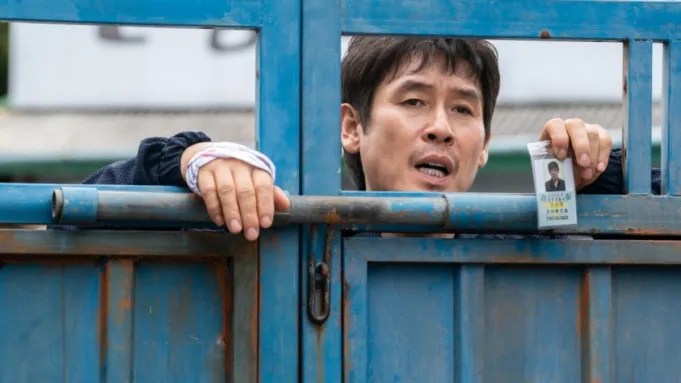
The Boys is less fictional and more factional than its immediate predecessor. The miscarriage of justice that is retold by the film is the imprisonment of three boys, one of whom had learning disabilities, as a result of forced confessions, for the murder of a 77-year-old woman during a robbery at the Nara Supermarket in Samyne in 1999. During a second trial in 2016, the boys who were now men, and had served their time, were found not guilty of the murder. As in the other films in the trilogy, The Boys works within the binary of good versus evil. Here good is represented by Hwang Jun-cheol (Sol Kyung-gu), a police officer, who undertakes an investigation into the boys’ presumed guilt, and the bad by Choi Woo-sung (Yoo Jun-sang), also a police officer, but whose status has risen as a consequence of his solving the ‘Samyne’ robbery and homicide case.
The young boys found guilty of the crime are juxtaposed against the real perpetrators, young men who spent their time getting trashed with drink and drugs. While this sounds simplistic, the boundaries between good and evil are subverted in the court scene with which the film ends, when the real killer confesses to his crime and asks for forgiveness. This belief in the value of confession through which redemption takes place is particularly Korean. Much of justice in the West is modelled after “an eye for an eye” which is most clearly demonstrated by the US’s death penalty. Having said that, this is a film that has global resonance within a world where class divisions are continually widening and where the ordinary person is often a victim of a system that lacks compassion and understanding.

Although the runtime is slightly over 2 hours, The Boys does not feel as if it outstayed its welcome. This is partly due to strong performances by actors in the leading roles. Sol Kyung-gu is excellent as “Mad Dog” Hwang Jun-cheol, a police officer who is willing to sacrifice his career for the sake of justice. One of South Korea’s most experienced actors, Sol Kyung-gu brings heart and depth to the character, making the audience root for him even when he is living up to his nickname. His opponent, Choi Woo-sung, played by Yoo Jun-sang, a regular from Hong Sang-soo’s films, is well cast as the obsequious police inspector, whose only loyalty is to himself and advancing his career. The film switches between the past and present, rather than merely presenting the events linearly. This helps to generate sympathy for the innocent boys, as well as building up tension, around who the real culprits of the murder were. The investigative elements of the film are contrasted by fast-paced action sequences, which work to vary the narrative tempo as well as maintain the viewer’s interest. The use of high-angled and birds-eye shots creates variation during such scenes while insisting on the film’s fictional status.
While the ending felt slightly over-melodramatic, especially through the use of rousing music, and a criminal confessing to a crime in court and begging for forgiveness is unrealistic, it is impossible not to feel empathy towards the young men and share their happiness when they are pronounced not guilty.
The Boys is an example of a social issue film that South Korea does so well and in which the voice of the voiceless is returned to those on the margins of society and/or those who are oppressed by the system weighted in the favour of the privileged. It is hard to deny the importance of such films in raising issues surrounding human rights by putting a spotlight on a cruel and oppressive justice system. In a survey done by the group Good Law after the second film in the trilogy, 77% of the participants agreed that court trials were unfair (Cho, 2012).
The Boys demonstrates director Chung’s ability to tell a story that engages the audience while critiquing systems of oppression and by doing so, placing a spotlight on the stories of those whose voices have been silenced.
Rating:
Written by Dr Colette Balmain
View of the Arts is an online publication that chiefly deals with films, music, and art, with an emphasis on the Asian entertainment industry. We are hoping our audience will grow with us as we begin to explore new platforms such as K-pop / K-music, and Asian music in general, and continue to dive into the talented and ever-growing scene of film, music, and arts, worldwide.

 VIEW OF THE ARTS
Excellent review. Perhaps a little sentimental/unrealistic in places, but definitely worth your time.