
Warning: Spoilers ahead.
Parasite star Choi Woo-shik is a righteous serial killer in Netflix’s latest whack at prompting viewers into questioning the meaning of true justice. A Killer Paradox, directed by Lee Chang-hee and based on the webcomic by Ggomabi, is grittier than the average Korean drama, gentler than American thrillers, and honest with its intentions. Set over the course of several months that feel like an eternal winter in the backdrop of Daejeon, we follow a young man lost in life as he turns to a peculiar outlet for purpose.
A Killer Paradox is one of those dramas that’s just impossible to predict the ending of. You’re given a set of morally grey main characters, none of which you can be sure will have a positive ending, especially when the meaning of justice is as firm as wet paper. The viewers are also not forced to root for any one of the main “heroes”, rather, it’s optional — prompted to us by Lee Tang’s (Choi Woo-shik) words in the first and last episodes: “My life isn’t an essay question. It’s multiple-choice.” The series disorients you with justifications and elaborate backstories such that the lines between right and wrong become blurred; Tang is a hero for brutally killing, but bad for committing lesser acts like theft and adultery.
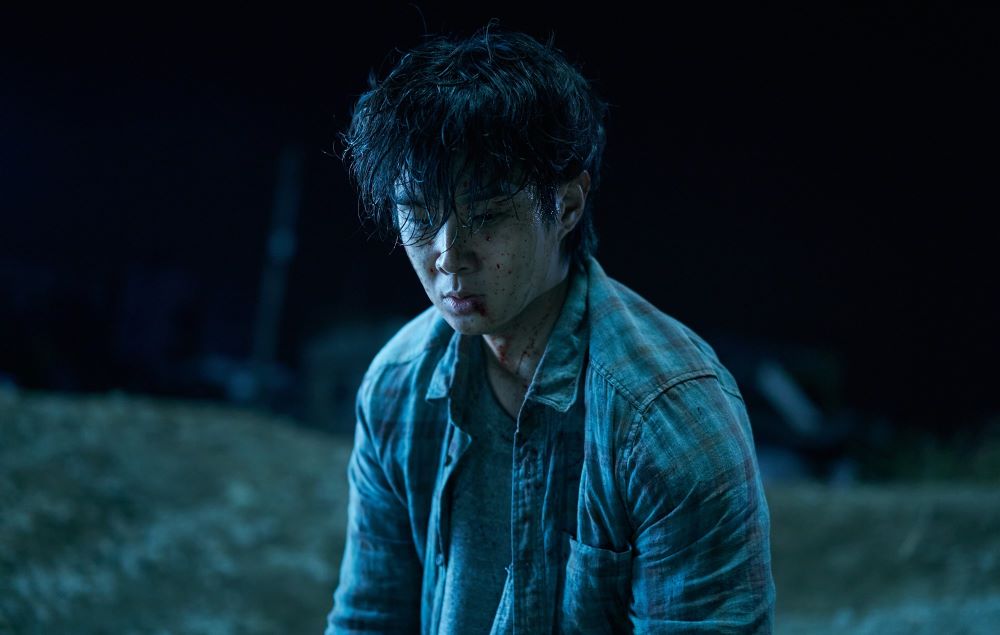
There’s subtle humour here and there, with Jang Nan-gam’s (Son Suk-ku) name literally meaning “toy”, as well as the odd scene for comic relief. The main characters are all portrayed incredibly well; Choi Woo-shik nails minute changes as Tang tries to hide his emotions, and Roh Bin (Kim Yo-han) has the constant deadpan expression of a man who’s planning to sacrifice himself later down the line. Nan-gam and Song Chon (Lee Hee-joon) both express intense emotions outwardly; the former weakly suppresses his fury, while the antagonist’s face contorts into a pained grimace every time he laughs. Not only are the characters believable, but each one of them at times is downright frightening.
Dalparan’s musical score is spoon-fed, but when it’s there, it’s necessary. Park Se-seung’s cinematography, on the other hand, is almost like a character in itself. The pans and zooms on characters’ faces are ever so Wes Anderson-esque at times: blunt and invasive, as if we’re viewing them through binoculars. This framing choice is no accident; at times it adds an unsettling air to the scene, gifting the viewer with a slight discomfort as you half-expect them to jump at the camera. Often, the camera work is simply gorgeous, saturating dreamier sequences such as cuts between Gyeong-ah’s (Lim Se-joo) desperate reality and a scene of her standing against a zingy blue seascape, whipped up by the air as she meets a critical moment in the real world. We’re also graced with a beautiful shot of Tang leaving a burning building, with the orange blaze framing his silhouette.

There are a lot of paralleling themes that occur throughout the series, which make no effort in being subtle. On the night of Tang’s first murder, the strike of a hammer against his victim’s head is substituted with his nailing a wall to hang a painting. There’s also a huge subplot around Nan-gam’s father being taken off life support — its counterpart being a dog that faces euthanasia. These mirroring themes exist to further push the uncertain boundary between right and wrong; by the end, we’re questioning, are Tang’s just corrections and Song Chon’s vicious attacks any different to one another?
Throughout, characters’ lives are observed closely, fleshing them out in areas other shows perhaps might not bother doing, from Tang’s provoking hallucinations to Nan-gam’s nonchalant, gum chewing habit that withers out as the case grows heavier. The superhero fanaticism would’ve been reason enough for Roh Bin to adopt the “hero’s sidekick” lifestyle, but the writers decided to elaborate on his life, perhaps even to an unnecessary extent, with a superhero origin story of his own.
We watch as it all ends in fire — but it’s not one of pain and destruction. It’s the ultimate cleansing ritual to set Tang on a new cycle; with his freedom maintained and the death of his loyal sidekick, he’s now certain in his path as an executor of retribution. One might not consider it to have a happy ending, but neither does it leave a particularly sour taste in the mouth. By the end, you’d be forgiven for agreeing with Gyeong-ah, who uttered the defeated words: “Just living an ordinary life seems to be the best of all.”
Rating:
Written by Maddie Armstrong
View of the Arts is an online publication that chiefly deals with films, music, and art, with an emphasis on the Asian entertainment industry. We are hoping our audience will grow with us as we begin to explore new platforms such as K-pop / K-music, and Asian music in general, and continue to dive into the talented and ever-growing scene of film, music, and arts, worldwide.

 VIEW OF THE ARTS