
Best known as a member of Kis-My-Ft2, Kento Senga has spent over twenty years entertaining audiences through music, dancing, and acting. But behind the pop idol image is a thoughtful artist whose work, as well as creativity, goes beyond one’s imagination.
Born in Nagoya, Senga began dancing at the age of three, inspired by the energy and work of Michael Jackson. After joining Johnny & Associates in 2003, he trained rigorously before debuting with Kis-My-Ft2 in 2011. Celebrated for his well-executed choreography, Senga helped create the group’s style and even worked with acts like Travis Japan. He later turned to acting, receiving praise for his roles in TV dramas and films such as the psychological thriller Bi-location (2014). But it’s through art that Senga seems to have found his purest form of expression. He never expected that the sketches he quietly made in the dressing room to deal with frustration would grow into a full artistic world called FiNGAiSM.
The main concept behind this character is love and memory, to love others, to share emotions, and to connect people. Through this character, I want to remind people of the warmth that comes from those feelings and the importance of emotional connection.
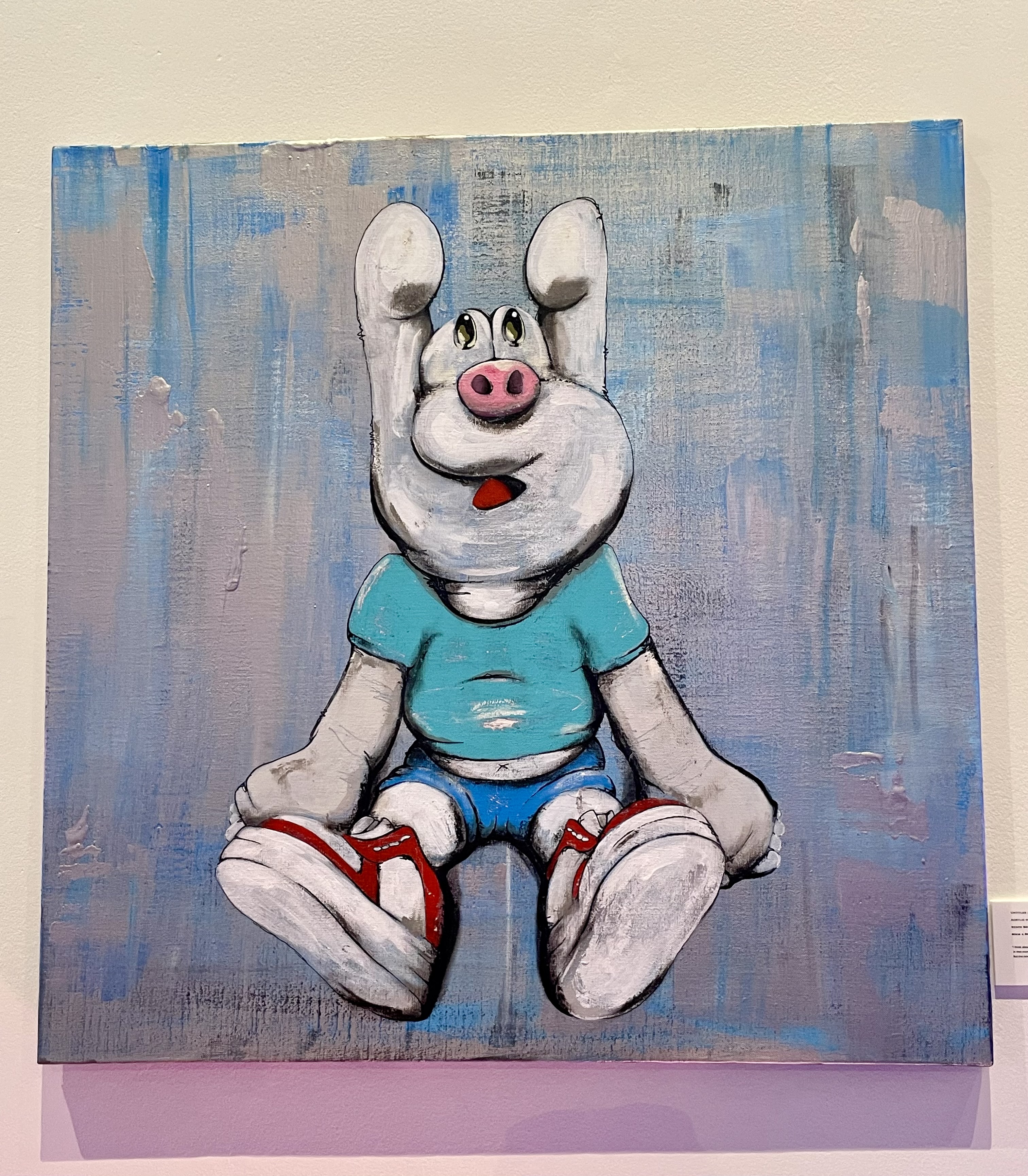
Inspired by choreography, his life as an idol, the human touch, and most of all his late grandmother, the project concentrates on FiNGA, a whimsical yet philosophical character symbolising connection and love, as Senga said, “There are characters named ‘MILO’ and ‘AIMEE,’ each with their own personality. MILO is a bit reserved and quiet, struggling to express his feelings openly. In many ways, he reflects parts of myself I don’t often show.”
Through paintings, digital art, sculptures, and 3D animation, Senga intertwines pop culture with contemporary art, giving audiences something extraordinary – characters that will make you smile as sculptures, sometimes cry when you look at the paintings (especially when you read the little messages next to them), and make you wonder when you watch the 3D animations.
Following exhibitions in Tokyo, Taipei, and Seoul, Senga brought FiNGAiSM to Europe for the first time. This October 2025, he presented his solo project at London’s iconic Saatchi Gallery as part of FOCUS Art Fair London 2025, securing a major solo booth in Gallery 4. The exhibition, titled “FiNGAiSM – Essence of Love,” revisits themes of connection and love. The large-scale figures, paintings, sculptures, and video installations, all in one room, and bonded by his vision of turning art into an emotional language that rises beyond the words.
While visiting the exhibition, I was privileged to meet Senga and discuss his work and the inspiration behind it.
My grandmother was someone I loved deeply. She was such a kind person. That kindness continues to play an important role not only in the way I create things, but also in how I connect with people.

View of the Arts: Your figures are often described as fashionable and cute, yet they carry a strong sense of individuality and soul. How do you find the balance between pop culture aesthetics and the sophistication of contemporary art?
Kento Senga: Yes, I think of it as something familiar and accessible, yet at the same time, something that fuses the refined presence of contemporary art and high luxury. I believe pop art itself can be luxurious, and within that space, I want my work to become a unique kind of bridge between the two worlds.
VOA: FiNGA has become the centerpiece in your work, from figures to animation and paintings. Could you tell me more about how this character brings your personal worldview to the masses and what emotions you think it will evoke in people?
KS: The main concept behind this character is love and memory, to love others, to share emotions, and to connect people. Through this character, I want to remind people of the warmth that comes from those feelings and the importance of emotional connection.
A finger is something everyone has, something you never leave home without. Through this character, I hope people can find happiness and connection – that by engaging with the figure, new relationships or moments of joy can be born. I want it to be a character that people carry with them, just like their own fingers, something always by their side. Through this character and my artwork, I want to connect people, to send love and share emotions between them. In that sense, London is a place that brings me great happiness.
VOA: You have said you want your figures to remain “an idol for the people who display them”. What does the idea of being an idol mean to you in today’s world, and how does it differ from the traditional sense of the word in Japanese pop culture?
KS: For Japanese artists, I might be considered something of an idol, and this worldview has evolved into a project called FiNGAiSM. It’s not just about the artwork itself, but about the atmosphere and world of FiNGAiSM as a whole.
Now, I try to stay more balanced mentally. Instead of reacting right away, I process those feelings within myself – I take in what people say or how they make me feel, let it settle, and then transform it into imagery. But let’s not forget, I also use my own feelings to [release tension, it’s a kind of catharsis for me].
VOA: Your grandmother played a key role in inspiring FiNGA. How did her influence shape not only the character’s design but also your creative values and motivation as an artist?
KS: My grandmother was someone I loved deeply. She was such a kind person. That kindness continues to play an important role not only in the way I create things, but also in how I connect with people. The gratitude I couldn’t express to my grandmother back then; that’s my vitality, my driving force. I want to keep creating works that remain in someone’s memory, that touch people so they, in turn, connect with others – spreading outward like ripples. From this single starting point of love, I’m creating an art project that allows that love to reach more and more people.
The biggest inspiration for me has always been my grandmother, especially when she was diagnosed with Alzheimer’s. When I was younger, I painted a lot of pieces and showed them to her. Even for just a moment, she caught a glimpse of her memories through my paintings – a little spark of recognition, a little piece of herself coming back. That experience stayed with me. Through my art, I want people to feel and remember that same sense of love. And I hope that this love can be carried forward, passed on to the next generation through the work I create.
VOA: You move between multiple medium, sculpture, 3D animation, and painting, all connected through a single character. How do these different formats allow you to express new sides of your story and expand the universe of FiNGA?
KS: Pop art usually starts with simple paintings, sculptures, and showing them to people. That’s the basic approach. But for me, it’s more than just the objects themselves. I want people to know the character’s personality, to feel the struggles they face, and see how they overcome them. Using animation, sculptures, and paintings, I can share the full story of FiNGA, not just the art, but the life and journey of the character.
I want people to connect with the character, to understand their story, their emotions, their growth, and the love they find along the way. My goal is for this character to become one of the most recognised in the world, and for people everywhere to know them – their personality, their story, and everything that they represent. I want people to know that. I want people to know that. I want people to know that. This is the heart of my work – to make sure that the story, the character, and their journey reach as many people as possible.
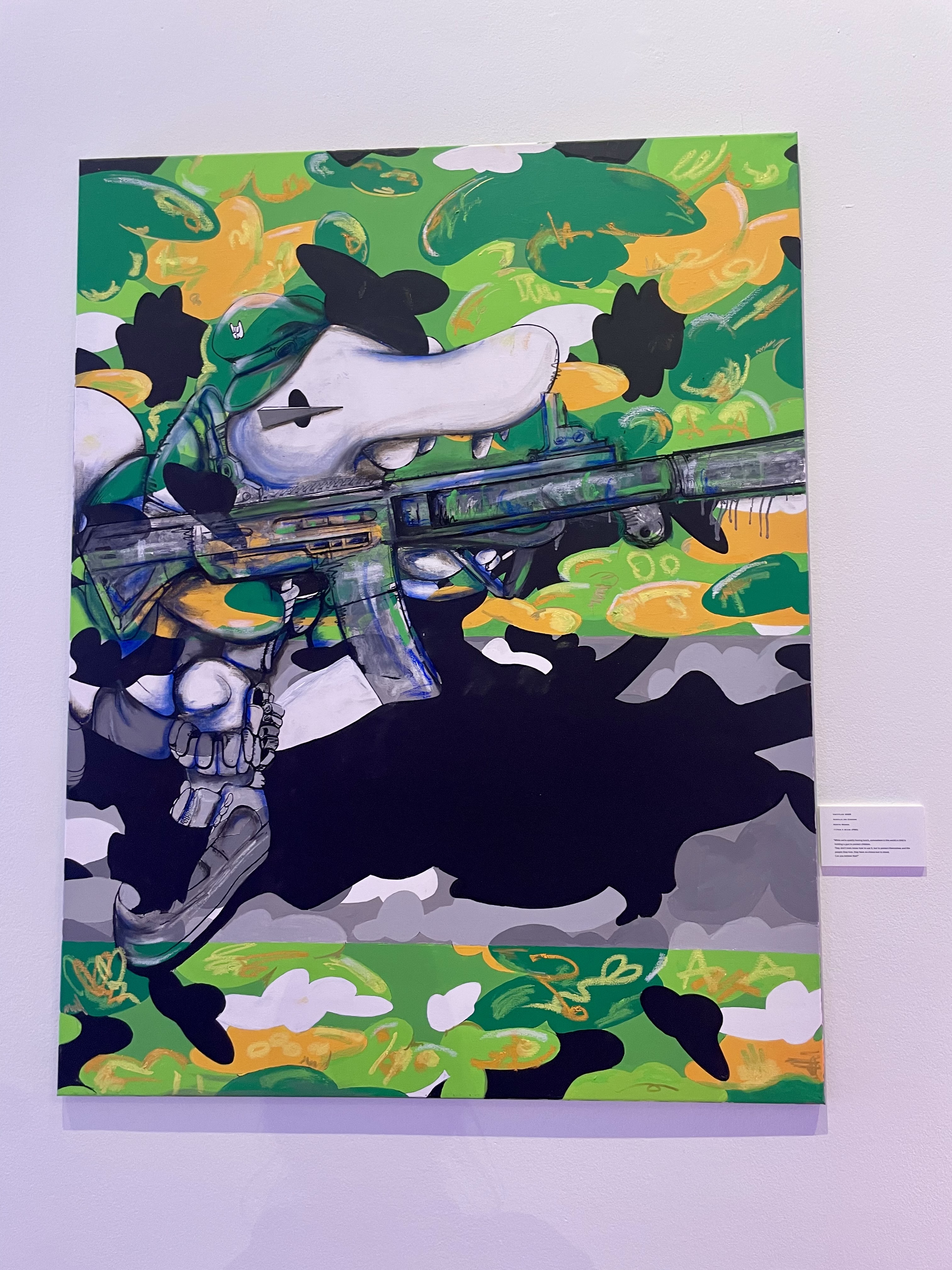
VOA: Those little notes next to the paintings are lovely; they feel almost like poetry. One image in particular left a strong impression on me: a distorted character holding a machine gun. And the caption next to is very powerful. What feelings inspired this message?
KS: I myself live in Japan, a peaceful country. But I also think about the people, especially children, on the other side, risking their lives to protect their families. I feel the distortions and imbalances in the world. This is not a balanced situation – it’s an imbalance. I hope that by sharing it, even one person can understand it and feel motivated to try to change things. I want people to know that this is reality.
I put into words my own philosophy in response to images, situations, or politics that shock me. This is not someone else’s words or philosophy; it’s mine. When I see a situation or a certain image, how do I feel? It’s not anyone else’s words; it’s my own reaction. Then I think about how I can convey that message, not just through words but in a form people can experience. My art is often seen as cute, but I want to embed deep meaning and communicate it clearly within that.
VOA: Your paintings seem to express a wide range of emotions; some feel gentle and hopeful, while others are more intense or melancholic. Do your works reflect how you feel in the moment, or are they inspired by the emotions of others around you?
Kento: I really connect with people – I can easily sense their emotions and often absorb them deeply. When I was younger, I used to be heavily influenced by what others said and felt; their words would directly shape my own emotions. That was something I struggled with. Now, I try to stay more balanced mentally. Instead of reacting right away, I process those feelings within myself – I take in what people say or how they make me feel, let it settle, and then transform it into imagery. But let’s not forget, I also use my own feelings to [release tension, it’s a kind of catharsis for me].
Written and interviewed by Maggie Gogler
Featured image courtesy of Embassy of Japan
*We would like to thank Premium Pages for their support in arranging this interview, and Kento Senga for taking the time to speak with us.
View of the Arts is an online publication dedicated to films, music, and the arts, with a strong focus on the Asian entertainment industry. With rich content already available to our readers, we aim to expand our reach and grow alongside our audience by delving deeper into emerging platforms such as K-pop and Asian music more broadly. At the same time, we remain committed to exploring the vibrant and ever-evolving global landscape of film, music, and the arts, celebrating the immense talent and creativity that define these industries worldwide.

 VIEW OF THE ARTS