
A music festival that brings together performers from different countries lets us experience far more than a succession of concerts. I truly appreciated that each artist comes with their own musical influences, cultural background and approach to performing, making it interesting to see how differently they connect with a crowd. Some need little more than a microphone and a strong voice to hold everyone’s attention. In contrast, others favour complex choreography, energetic dancers and powerful basslines that can be felt under your feet. Some manage to bring all these elements together while keeping their own style. The first edition of The A Festival in Paris welcomed artists from Myanmar, South Korea, the Philippines, Malaysia and Thailand for an afternoon and evening of performances; although a few unexpected technical difficulties interrupted the programme, they did little to overshadow the talent on display or the enthusiasm of the audience.
Oak Soe Khant, a singer-songwriter from Myanmar, was given the task of opening the evening’s concert programme. Representing a country whose contemporary music scene rarely receives the same international attention as those of South Korea or Thailand, his inclusion was welcome. Myanmar has its own developing pop and independent music culture, with artists drawing inspiration from international sounds while finding ways to express their own experiences and identities. His set also included his single “All I Got Left”, a beautiful song that gave the audience a chance to appreciate his music before the evening continued with much louder, dance-heavy performances from other artists. But before all of that, Jacob of The Boyz performed his own solo set.
When Jacob walked onto the stage with his guitar, the audience had the chance to see a different side of the singer, as he stepped away from the complex choreography and large-scale performances usually associated with the group and spent the evening performing his own music, sharing his personal musical tastes and enjoying the freedom of doing things a little differently, which was a real treat to watch. He opened his set with “Young and Confused”, from his solo mini-album j..
It was lovely to see him perform in a more relaxed setting, especially when we are so used to seeing him as part of THE BOYZ. He performed a French cover, bringing a local touch to the set, before revisiting THE BOYZ material, including “REVEAL” and “Escape”. Hearing songs associated with the group in a different performance setting showed that good material can take on a new character when approached from another musical direction. Jacob also treated the audience to an unreleased song, “Gives You Hell”, which brought a welcome dose of pop-rock to his set and, judging by how much he seemed to enjoy performing it, there is certainly a lot to look forward to as he continues to develop his own music outside THE BOYZ.
Unfortunately, just as the performance was approaching its conclusion, an electrical problem brought proceedings to an abrupt halt. It was a frustrating interruption, especially after Jacob had spent so much time and effort to be at the festival. The delay lasted approximately 35 to 40 minutes, leaving the audience waiting to see whether he would be able to finish; to his credit, he returned to the stage and completed his final song. Technical problems are every live performer’s nightmare, especially when they occur at such an awkward moment, yet Jacob handled the situation well. More than anything, his Paris appearance showed that there is a thoughtful and versatile musician behind the familiar K-pop idol image, and I would genuinely welcome the opportunity to see him perform a full solo concert in London.
Of all the acts scheduled to appear, ALAMAT were undoubtedly among those I was most curious about. The Filipino boy group has built their identity around something that deserves considerably more international recognition: the combination of contemporary P-pop with the Philippines’ diverse languages, cultural traditions and, above all, musical influences. I had high expectations, but I must admit that I was still taken aback when they began singing.
Some groups sound fantastic on their studio recordings, but when it comes to performing live, especially while tackling demanding choreography, maintaining that same vocal quality can be a challenge, and this is where ALAMAT genuinely impressed me; their voices remained strong and controlled throughout the performance, including beautiful harmonies.
One of my favourite moments was “Maharani”, a beautiful song that showed just how good ALAMAT are vocally, while another slower number gave us a chance to appreciate their individual voices without the distraction of demanding choreography. What I admired most, however, was how proudly the members represented their Filipino heritage; they spoke about their culture and traditions during the show, explaining how these influence their music and performances, something that became noticeable in their choreography, where traditional Filipino dance movements were incorporated into contemporary pop routines. ALAMAT have developed their own approach to P-pop, and it works remarkably well.

The Philippines has given the music industry many outstanding vocalists over the years, and ALAMAT certainly deserve to be mentioned among the country’s promising talents, not only because of their impressive singing skills but also because of the way they combine their cultural heritage into contemporary pop music without compromising their artistic identity. Having finally had the opportunity to see them perform live in Paris, I sincerely hope this will not be their last visit to Europe.
If ALAMAT impressed with their cultural influences and vocal perfection, Malaysian girl group DOLLA turned the venue into a full-scale pop party. Over the past few years, DOLLA have made quite a name for themselves in Malaysia, and although their performances share certain similarities with those of established K-pop girl groups, the members have found their own musical direction, and their appearance at The A Festival in Paris was special, as they proudly announced that this was their first time performing in Europe. And what a performance it was!
DOLLA certainly knew how to make an entrance, opening their set with “MWA” (originally featured Elva Suyan). Accompanied by backing dancers, the members delivered synchronised choreography and made excellent use of the stage, while the heavy electronic beats gave the performance plenty of energy. Their style reminded me somewhat of the earlier years of K-pop’s international expansion, especially when electronic dance music and choreography became increasingly popular among girl groups, although DOLLA bring their own Malaysian and international influences into the mix. “FIGHT”, their collaboration associated with Garena Free Fire, continued its punchy arrangement and impressive synchronisation, while “BAD” introduced Afrobeat-influenced rhythms that added some variety to the set. “UGLY” was another confident performance, with the members showing plenty of personality and excellent control over their choreography.
However, it was during the slower songs that I truly began to appreciate their vocal skills. Another song, somewhere between contemporary pop and R&B, reminded me of the American vocal group En Vogue, especially in the way the members handled their harmonies. Their singing was controlled and expressive, with strong vocal bridges and a lovely balance between their individual voices, proving that their talent extends well outside of their energetic dance performances.
IRONBOY was another performer who left me wondering how on earth he managed to maintain such an extraordinary level of energy throughout his set; it was Thai hip-hop at full speed. The young rapper belongs to a generation of artists helping bring the country’s contemporary hip-hop to wider audiences, and his appearance at The A Festival showed why the genre has become such an exciting part of Thailand’s music scene. With a sound that mixes heavy hip-hop beats, electronic dance influences, and an unabashed, confident performance style, IRONBOY took control of the stage immediately. His set included tracks such as “Daddy” and “City Boy”, alongside other energetic material that gave him plenty of opportunities to show his technical skills, and those abilities are considerable.
Rapping at speed is difficult enough when standing still, but delivering rapid Thai lyrics while moving across the stage, interacting with dancers and keeping perfect time with the backing track requires an entirely different level of concentration, and IRONBOY made it look super easy. His diction, rhythmic control and timing were impressive. At his fastest, he was delivering lyrics almost as quickly as the French were producing their morning baguettes, and somehow every phrase still came through exactly as it should. Female dancers brought attitude and visual excitement to the more electronic numbers, while a breakdancer introduced an element of old-school hip-hop culture that worked well with the heavier beats. His performance was loud and energetic and it was also technically accomplished.
After IRONBOY’s powerful show, TOBII brought a different musical world to the stage, drawing on R&B, contemporary pop and rhythmic influences that gave his performance a more sensual character. Supported by a DJ, live band and two female dancers, the young Thai singer presented a set that reflected his interest in the smoother side of modern popular music. At times, his music reminded me of the R&B I used to listen to in the late 1990s and early 2000s, which made his performance even more enjoyable.
“Sexy Girl” established that direction early on, combining a seductive groove with incredible stage arrangements. I was not entirely convinced by some of the distorted vocal effects used during the performance, as they occasionally took away from the natural quality of his voice. Nevertheless, TOBII handled it beautifully. “Banana,” with a rhythm-driven arrangement, let the dancers become a more prominent part of the show. Elsewhere, the music combined influences from ragga and dancehall, bringing a different musical influence into his R&B sound. His new single “Can’t Stop Won’t Stop” also featured in the set, showing his interest in mixing older musical styles with contemporary production.
What I liked about TOBII was his musical approach, which differs somewhat from what we have come to expect from many new T-pop performers, especially those whose shows revolve around choreography and some electronic arrangements. R&B plays a much bigger part in his music, especially in the rhythms, melodies and the way he approaches his singing, and I enjoyed hearing those influences throughout his performance, especially as they reminded me of the music I grew up listening to.
Of course, there are still aspects of his live performances that could benefit from further development, especially the balance between his natural vocals and the electronic effects used in some of the songs, which occasionally made it difficult to appreciate his voice fully. Nevertheless, he has a lovely vocal tone, an easy manner with the audience.
By the time Thai boy group ATLAS appeared, the audience had already experienced several hours of very different performances, a lengthy technical interruption and the sort of wet, miserable Parisian weather that could easily have dampened everyone’s enthusiasm and the boys clearly had no intention of letting that happen. Their entrance was excellent, quickly bringing a burst of colour and energy to the stage. The six-member group has become an increasingly recognisable name in Thailand’s T-pop scene, and honestly, seeing them perform live helps explain their growing popularity.
“MOVE YA BODY” was an effective way to establish the mood. Produced by NINO, the song has a lively rhythm, with the members taking turns singing and rapping while delivering some impressive choreography. The live delivery was strong, and their synchronisation was impeccable. Every formation change was carefully arranged and the performance never lost its sense of fun.
I also thoroughly enjoyed “โทรมาทำไม”, which was very good live, not least because of the members’ amusing exchanges and the way they interacted with the audience throughout the song. Their choreography was excellent, but I found myself paying just as much attention to the little moments between them, which brought plenty of humour and personality to the performance. “เป๊ะ” allowed ATLAS’s rappers to take centre stage, with confident delivery and well-placed rap verses that complemented the melodic sections rather than interrupting them.
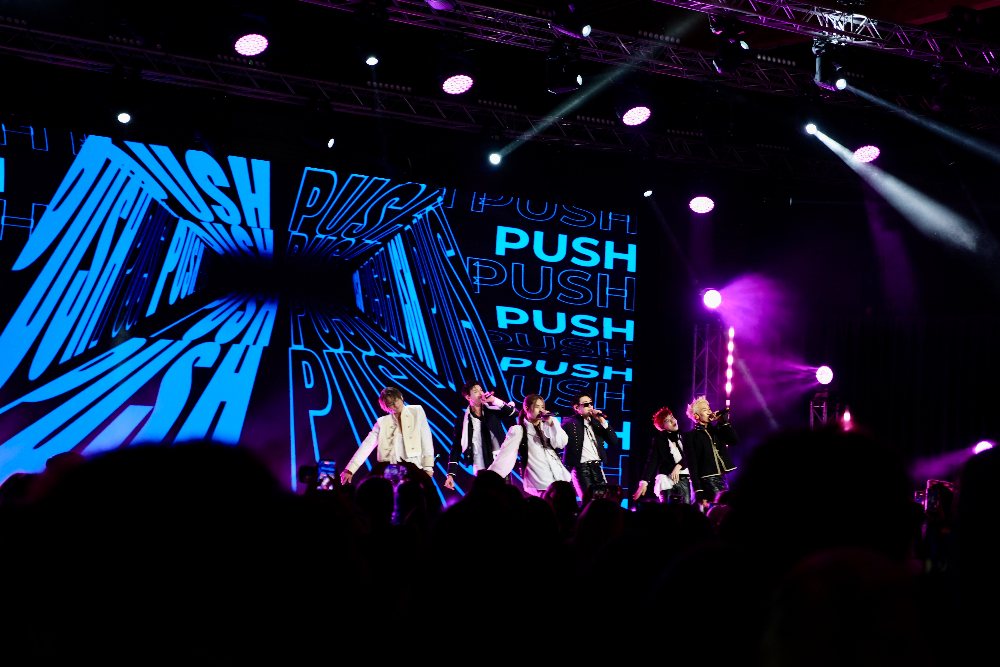
ATLAS also added “PUSH” to their setlist; produced by benlussboy, it was a musically inventive track whose shifting rhythms and unconventional arrangement made it considerably more interesting than the average boy-group dance number. I enjoyed the choreography towards the end, when the members suddenly moved in slow motion, creating a wonderful contrast with the music before the song reached its final climax. “LOLAY (โลเล)” was equally fantastic, with colourful background visuals accompanying another strong performance from the group.
For anyone discovering T-pop for the first time, ATLAS would be an excellent place to start, as they have the musical versatility, vocal ability and stage experience to compete comfortably on an international level. Their Paris show was thoroughly exciting, and I couldn’t have asked for a better conclusion to this part of the festival’s programme.
The A Festival’s first edition may not have been without difficulties, but the talent on stage gave us plenty of reasons to be excited about the future of Asian music in Europe. If anything, the evening left me wanting to see these performers return for longer sets, with more time to explore their catalogues and show European audiences exactly what they are capable of. And after several hours of music from so many different corners of Asia, I realised that there is an extraordinary amount of talent waiting to be discovered, and European promoters would do well to pay attention.
Written by Maggie Gogler
Featured image (ALAMAT) © Amran Mohamed for View of the Arts
View of the Arts is an online publication dedicated to film, music, and the arts, with a strong focus on the Asian entertainment industry. As we continue to grow, we aim to deepen our coverage of Asian music while remaining committed to exploring and celebrating creativity across the global arts landscape.


