
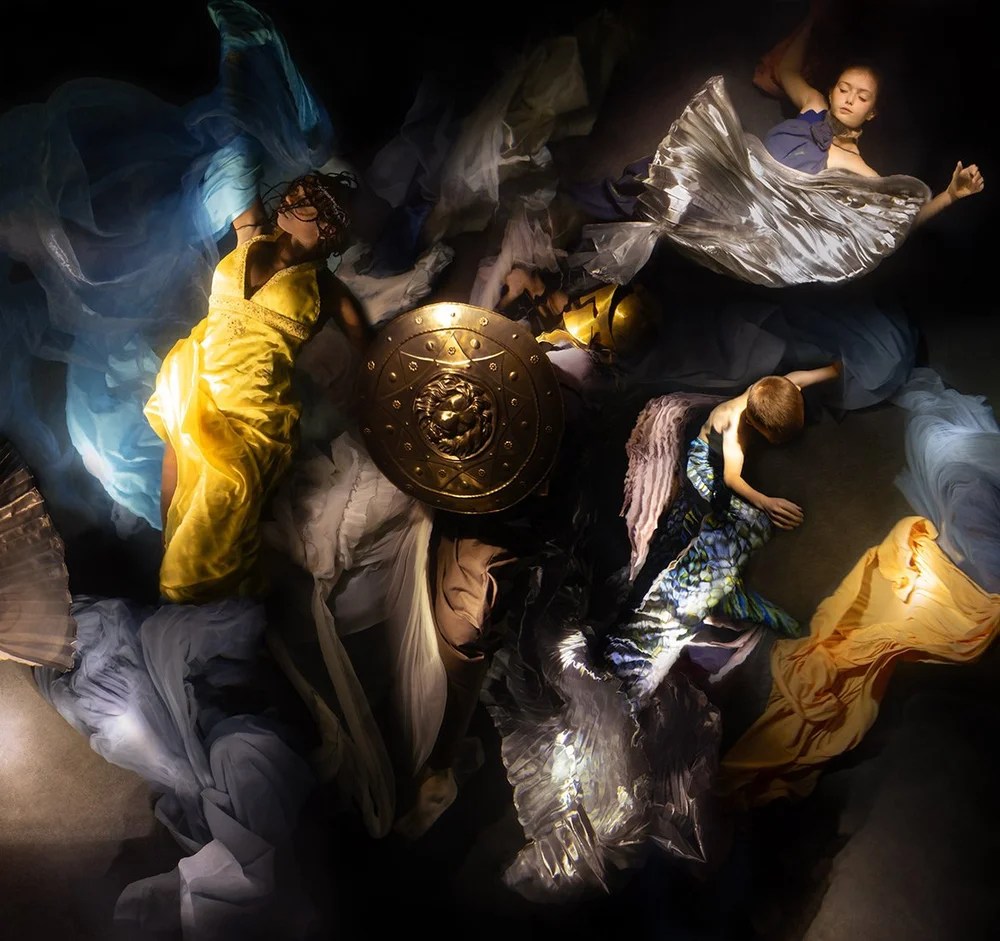
Christy Lee Rogers moves through the world like a storyteller suspended between centuries. Speaking with her in London, on the eve of her luminous new immersive exhibition, Myths and Legends, felt like entering one of her underwater worlds. Rogers has long been drawn to the place where human emotion meets the sublime, and in this new body of work, she dived into the symbolic language of myth. Her images – bodies twisting through currents of light, fabric blooming like celestial storms – hold the visceral force of Baroque painting and the timelessness of ancient storytelling.
Rogers spoke to us about finding the way in chaos and of using water as a threshold between worlds. Here, her archetypes breathe anew: warriors, seekers, lovers, angels, each transformed into something fluid and essential. And yet, in their strangeness, they feel uncannily familiar, as though she has not invented but uncovered the truths that live beneath our own surfaces. In a city moving at relentless speed, her images forced time to slow, offering a moment of calm.
Rogers’ collaborations with visionary figures like James Cameron and global studios such as Disney have only expanded the reach of her underwater universe, yet her artistic voice remains her own. These partnerships challenged and enriched her practice, inviting her to translate the delicacy of water and light onto monumental scales without sacrificing emotion. Still, it is in her personal work where her work feels most intimate.
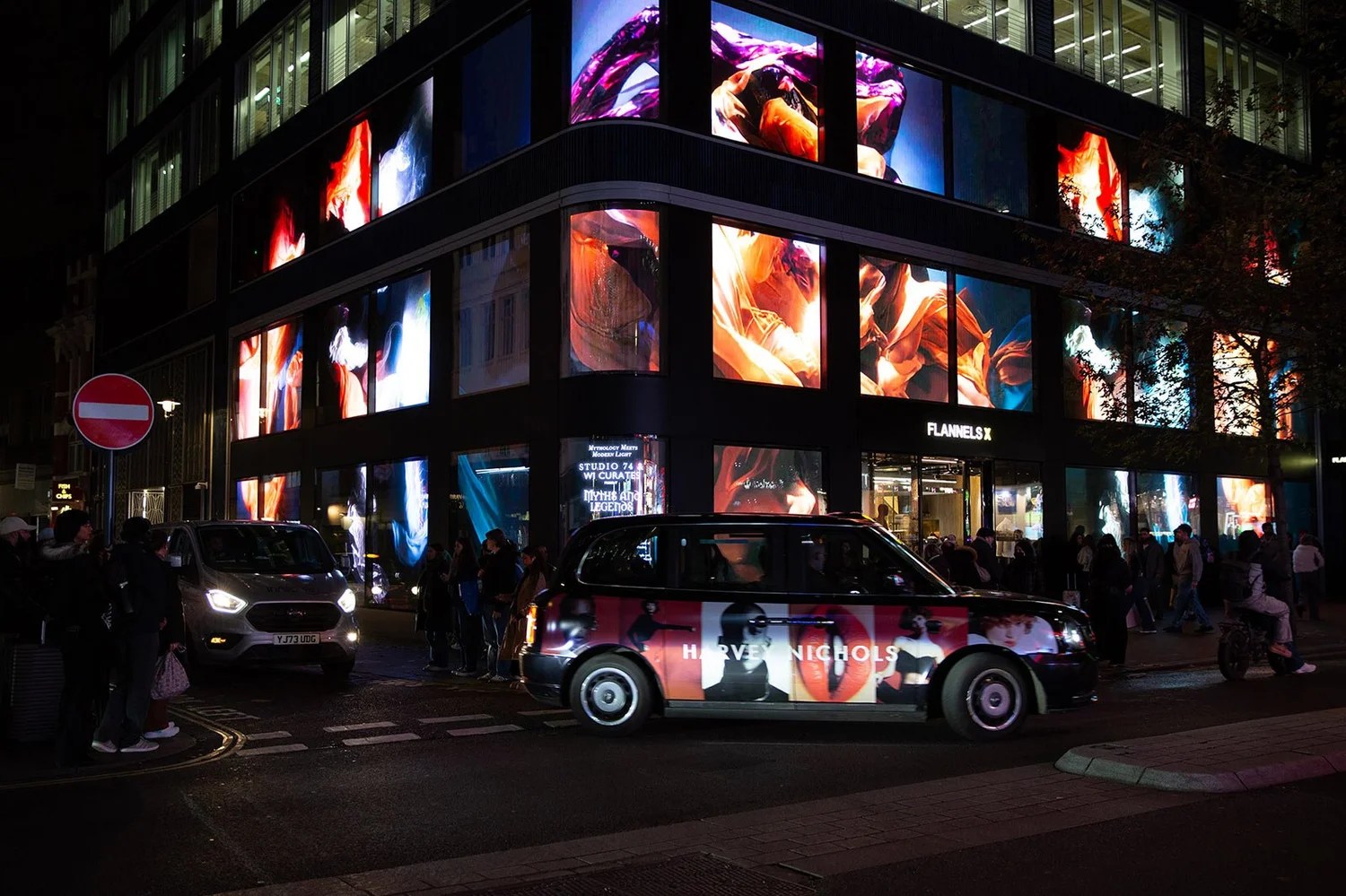
Whether she is illuminating Oxford Street with epic, myth-soaked tableaux or creating studies of human vulnerability, Rogers continues to change how we see the body, the story, and the space between breath and light. In conversation, as in her art, she reminds us that mythology is not something we have left behind; it is something we are still living.
View of the Arts: You just showed your work in London. How exciting! Your new exhibition reimagines classical mythology through the fluidity of water. What drew you specifically to mythological archetypes at this moment in your practice, and how did you approach translating these ancient narratives into an underwater visual language?
Christy Lee Rogers: Thank you so much! Mythological archetypes have always felt like the heartbeat of human storytelling – these ancient figures who carry our fears, our courage, our longing for meaning. In the last few years, with the world feeling fractured and turbulent, I found myself returning to those stories as a way to understand where we are now. Mythology gives us distance; it lets us zoom out and see the repeating patterns of humanity. And in that distance, there’s clarity, even comfort.
Water became the natural place to reimagine these narratives because it holds both chaos and grace. It distorts, transforms, and strips everything down to its essential movement. When I take these archetypes underwater, they stop being historical or fixed – they become alive again, fluid and searching, just as relevant today as they were thousands of years ago.
My approach was less about recreating specific myths and more about capturing the emotional truth inside them: the bravery of warriors rising through darkness, the sorrow of lovers drifting apart, the luminous hope of angels and guides. Underwater, those emotions reveal themselves in gestures, in flashes of light across bodies, in the weightlessness that allows the figures to lift out of the human world for a moment. The water becomes the bridge between the ancient and the contemporary – a place where the stories can breathe differently, and where we can see ourselves reflected back.
VOA: The installation on Oxford Street turns an urban environment into a theatre of light and movement. How does the public, monumental scale of this presentation influence the way you conceptualise or experience your own work?
CLR: Presenting the work at a monumental scale on Oxford Street completely reshapes how I think about it. In the studio, these images are intimate – born from moments underwater, where everything slows down, and the world above disappears. But when they rise onto a public façade in the middle of a bustling city, they take on a new kind of life. They become part of the rhythm of the street, meeting people who aren’t expecting art at all.
The scale forces me to think in broader gestures – how light travels across a body, how movement reads from a distance, how the emotional pulse of a piece can still be felt when you’re standing across the road or walking by in a hurry. It’s no longer just a photograph; it becomes an experience, a moment of pause or wonder in an everyday environment.
For me, that’s incredibly powerful. It reminds me that these works aren’t only meant for the quiet sanctuary of a gallery – they’re also meant to live out in the world, to surprise people, to interrupt the ordinary with something fluid and radiant. When I see them towering above the city, I experience them almost as if someone else created them. The scale reveals new details, new movement, new emotion. It’s like watching the work take its first breath in public.
VOA: You’ve said the world feels chaotic today, and that myth offered you perspective. Which myth or archetype resonated with you most during the creation of this series, and why?
CLR: The archetype that stayed with me the most during this series was the journeyer – the one who is pushed into the unknown and must navigate forces larger than themselves. You see this figure across so many myths: Odysseus on the open sea, Persephone moving between worlds, even the unnamed warriors and seekers who rise and fall in countless ancient stories. They’re all trying to find their way through chaos, guided by instinct, hope, or something divine.
That felt very close to how the world seems today. We’re all moving through uncertainty, searching for meaning in a time that can feel overwhelming. The journeyer became a mirror for that feeling. Underwater, that archetype transforms in a way that felt true—bodies drifting, fighting the pull of currents, rising toward light, surrendering and pushing forward again. There’s struggle, but also resilience. There’s fear, but also beauty.
It reminded me that chaos isn’t the end of the story. It’s often the beginning.
VOA: Your work is often compared to Baroque masters like Caravaggio. How do you reconcile the theatricality of Baroque painting with the unpredictability of the underwater environment?
CLR: The Baroque has always spoken to me – the drama, the tension between darkness and light, the emotional urgency in every gesture. But unlike the painters who could shape every fold of fabric and every beam of light, I work in a world I can’t fully control. Water has its own will. It resists choreography, and that unpredictability is actually what brings the Baroque spirit alive for me.
Instead of staging theatricality, I invite it.
Underwater, the light bends and moves in ways I could never script, turning a small movement into something operatic. Fabrics twist into shapes that feel sculpted by some unseen hand. A single breath or shift in the current can create a moment that looks like it leapt out of a Caravaggio canvas – raw, emotional, almost divine – yet it’s completely unrepeatable.
So the reconciliation comes from letting go. The Baroque painters sought heightened emotion and revelation through precision; I find it through surrender. I set the stage – intense contrasts, human bodies reaching or falling, color suspended in darkness – and then allow the water to shape the final drama. In that space between intention and chaos, the work finds its own truth, one that feels both ancient and completely alive.
VOA: Light behaves entirely differently underwater: bending, fracturing, and dissolving forms. What role does this distortion play in your storytelling, especially when working with mythological subjects?
CLR: Light underwater is its own kind of storyteller. It doesn’t just illuminate – it reshapes, erases, reveals, and deceives. That distortion becomes essential when I’m working with mythological subjects, because myths themselves live in that space between the seen and the imagined.
Underwater, a body can turn into something otherworldly; a simple gesture can dissolve into pure energy; a face can blur into a symbol rather than a person. The bending of light allows the figures to slip out of realism and into a dream world. They become less about individuals and more about emotions – courage, longing, surrender, hope.
I think that’s why the medium works so naturally with mythology. Myths were never meant to be literal; they were meant to help us understand the parts of life that feel too big or too mysterious to name. The distortion of light gives me permission to move into that poetic space, where the boundaries of the human form soften, where the divine feels close, and where a story becomes something felt rather than simply seen.
VOA: You’ve described water as a transformative force in your art. In Myths and Legends, what transformations – symbolic or literal – were you most interested in revealing?
CLR: For me, the most compelling transformation in Myths and Legends wasn’t about bodies changing shape, but about the inner shifts that happen when a person enters the water. Water strips away the noise of the world. It slows everything down, removes gravity, and reveals the raw emotion beneath the surface. That’s where the true transformation lives.
Symbolically, I was drawn to the moment when a character—whether a warrior, a seeker, or a lost soul—crosses a threshold. In myth, that threshold often leads to a test, a reckoning, or a glimpse of something spiritual. Underwater, those moments reveal themselves in the smallest expressions: a reach toward the light, a collapse into darkness, a body suspended between fear and release. I wanted to show those fragile in-between states, where someone is neither who they were nor who they will become.
Literally, water alters everything – the colour, the texture, the motion. Fabrics bloom like living creatures. Light breaks apart and turns a simple movement into something epic. These visual shifts echo the emotional journey, turning the figures into symbols of hope, resilience, and the quiet courage it takes to face the unknown.
VOA: Your subjects often appear as if caught in a single breath between drowning and ascension. How do you guide your models through that space physically and emotionally?
CLR: That space between drowning and ascension is incredibly delicate, and guiding my models through it is as much about trust as it is about technique. Physically, we work methodically. I never ask them to hold their breath for long or push past what feels safe. We practice simple movements – how to release the body, how to let the water carry them, how to rise calmly rather than fight the instinct to rush upward. Once they’re underwater, I watch their breath, their eyes, their comfort level. The moment they need to come up, we pause.
Emotionally, it’s about creating a sense of surrender. I tell them not to “perform” but to feel: the weightlessness, the quiet, the strange freedom that comes when the world above disappears. Many of the gestures you see, reaching, drifting, curling inward, come naturally once the mind lets go of control. I remind them that this isn’t about perfection; it’s about honesty. The water will shape the moment for us. That in-between breath you’re seeing isn’t something I force; it’s something that emerges when the model trusts both the water and themselves. It’s a place where vulnerability becomes strength, and where the images feel most alive.
VOA: You’ve spoken about seeking a “deeper perspective on humanity” through myth. What did this series reveal to you about human nature that your previous work had not?
CLR: This series deepened my understanding of how timeless and cyclical human nature truly is. While my previous work often focused on capturing moments of beauty, grace, and emotion, Myths and Legends allowed me to look beyond the surface, to the patterns that repeat through history, the archetypes that show up again and again in different forms.
What this series revealed is that beneath our modern chaos and complexity, there is a core of shared experience: struggle, hope, loss, and resilience. Myth gave me a way to step back and see those elements not as isolated moments, but as part of a larger human story that connects us across time and culture.
It also showed me the power of vulnerability and renewal—not just as personal experiences, but as universal ones. In portraying these ancient narratives underwater, I found a new way to express how fragile and fierce we are at the same time. That tension, that dance between light and darkness, became a kind of mirror to humanity itself—always searching, always changing, yet deeply rooted in something eternal.
VOA: You’ve collaborated with global figures like James Cameron, Disney, and high-profile performers. How did those experiences shape, or challenge, your artistic autonomy?
CLR: It has been both inspiring and challenging in beautiful ways. These experiences pushed me to expand my creative boundaries and adapt my vision to new scales, stories, and audiences without losing the core of what makes my work authentic.
At times, working within larger productions or with established brands required a delicate balance – honouring their vision while holding firm to my artistic voice. It taught me the importance of collaboration as a beautiful dialogue rather than compromise, where respect and trust allow both sides to elevate the work.
Ultimately, these partnerships strengthened my sense of autonomy because they challenged me to be clearer about what I want to say and how I say it. They showed me that staying true to my unique perspective is not only possible but essential, even amid bigger projects. And that conviction has carried back into my personal work, enriching it with new confidence and depth.
VOA: From developing film in a darkroom at 15 to creating massive LED installations, your practice has spanned analogue and digital worlds. How has your relationship with technology evolved, especially in translating underwater work to large-scale screens?
CLR: That journey feels like a natural evolution of storytelling tools, each with its own magic and challenges. Early on, working with analogue film taught me patience, attention to detail, and a deep respect for the unpredictability of the medium – qualities that still guide me today.
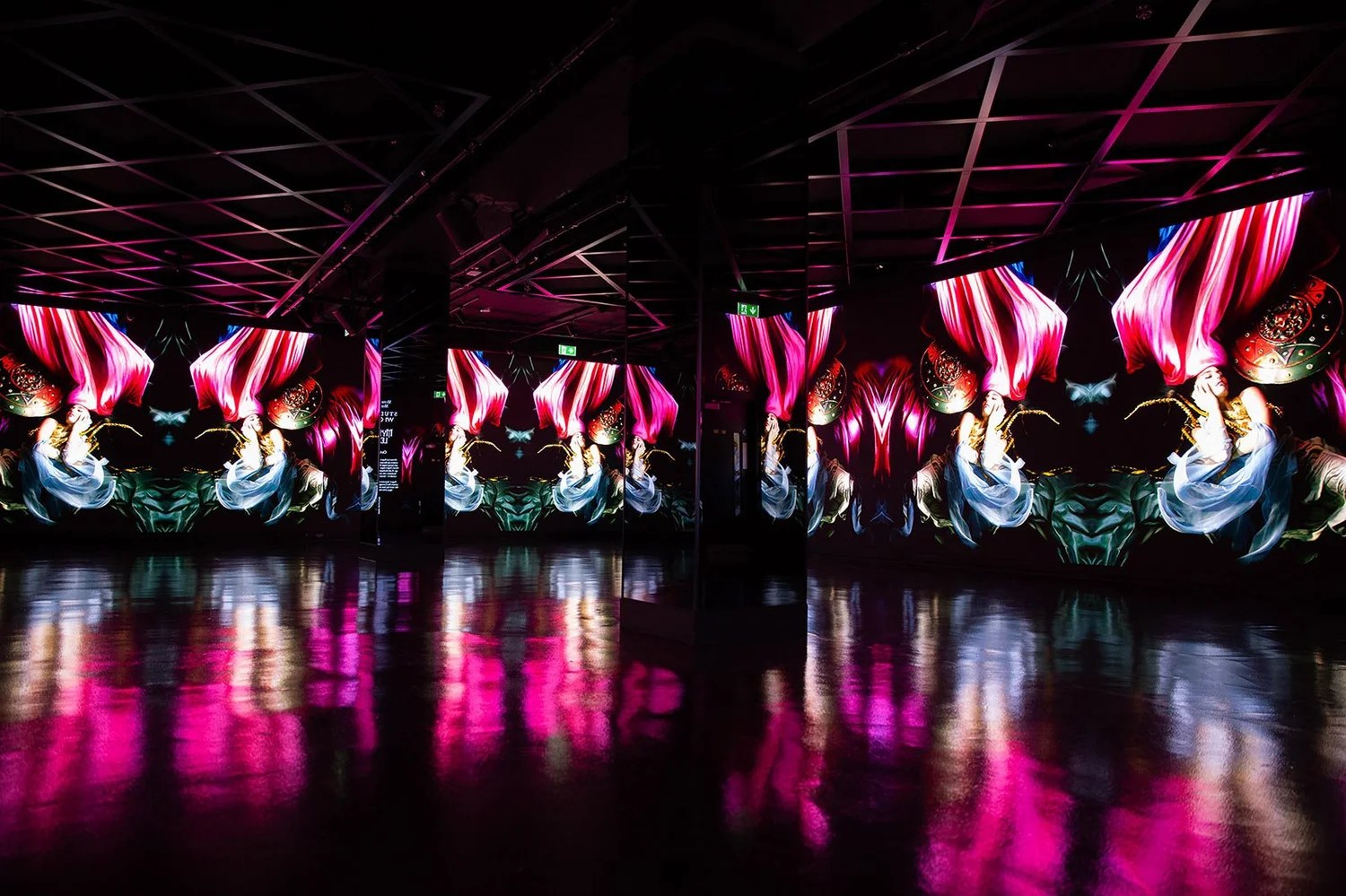
As technology advanced, I embraced digital tools because they opened new possibilities for how my underwater images could be experienced. Translating the subtlety and fluidity of water into massive LED screens requires a careful balance. The screens can amplify the scale and impact, making the work immersive, but they also demand a translation of color, light, and movement that stays true to the original emotion.
My relationship with technology is rooted in curiosity but always guided by intention. I see technology as an extension of my vision, not a replacement. Whether it’s film, digital capture, or LED displays, the goal remains the same: to invite viewers into a moment suspended between reality and myth, light and shadow, stillness and motion. Each new tool offers a fresh way to deepen that connection.
VOA: Do you see myth as a form of emotional truth-telling? How does that idea shape your approach to narrative in photography?
CLR: Absolutely. Myth, for me, is one of the oldest and most profound ways humans have told emotional truths – stories that reach beyond facts or history and tap into something universal and deeply felt. Myths speak in symbols and emotions rather than literal language, which allows them to carry meaning across cultures and generations.
That belief shapes my approach to narrative in photography by freeing me from the need to tell a linear or concrete story. Instead, I focus on creating images that evoke feelings and invite viewers to bring their own experiences and interpretations. I aim to capture moments that are poetic and open-ended, where light, movement, and color become vessels for emotion.
VOA: Your photographs often feel like scenes from a dream or a memory. Do you think of yourself as creating worlds, or uncovering ones already hidden beneath the surface?
CLR: I think it’s a bit of both. In many ways, I’m creating worlds, immersive spaces where light, water, and the human form come together to tell stories that don’t exist anywhere else. These worlds are crafted carefully, yet they feel alive and spontaneous because of the fluidity of water and the unpredictability it brings.
At the same time, I believe I’m uncovering something already there, hidden layers beneath the surface of our everyday reality. Water has a way of revealing what’s usually unseen: emotions, memories, myths that linger just out of reach. In my work, I’m trying to tap into that space, that quiet realm where dreams and history, the conscious and unconscious, overlap.
VOA: What remains unresolved for you – artistically or philosophically – that you hope future projects might continue to explore?
CLR: What remains unresolved is the constant tension between control and surrender, the push and pull between shaping a moment and allowing it to grow naturally. Artistically, I’m fascinated by how much I can guide underwater movement without taking away the unpredictable magic that water brings. Philosophically, I’m drawn to the question of how we find meaning and connection in a world that often feels fragmented and chaotic.
Future projects will continue to explore that balance: how to create work that feels both intentional and alive, precise yet fluid, intimate yet universal. I’m also deeply interested in diving further into themes of vulnerability, resilience, and the invisible threads that connect us – to each other, to nature, and to mythic stories that have shaped humanity for millennia.
VOA: If you could reimagine any myth or legend next, which story would you be most drawn to submerge in your underwater universe, and why?
CLR: If I were to dive into another myth for my underwater universe, I’d be drawn to the story of Perseus and Andromeda, as well as the legend of Atlantis. Perseus and Andromeda’s tale is rich with drama, heroism, sacrifice, and rescue, set against the vast, untamable sea. Their story captures that tension between danger and salvation, vulnerability and bravery, which feels incredibly alive underwater.
Atlantis, on the other hand, speaks to mystery, loss, and the fragility of civilizations. It’s a myth about a world submerged, both literally and metaphorically, a perfect metaphor for hidden histories and forgotten depths. Exploring Atlantis would allow me to explore ideas of the unknown beneath the ocean, and the power of water as both destroyer and keeper of secrets.
Written and interviewed by Maggie Gogler
Featured image courtesy of Christy Lee Rogers (source)
The physical collection is available to purchase via Studio 74 Contemporary Art
View of the Arts is an online publication dedicated to film, music, and the arts, with a special focus on the Asian entertainment industry. Alongside in-depth features on emerging and established musicians, we provide thoughtful coverage of cinema, from independent films to international releases, exploring the stories and work that bring them to life. Through interviews, reviews, and features, we connect our audience with the voices and visions driving the cultural landscape today.


