
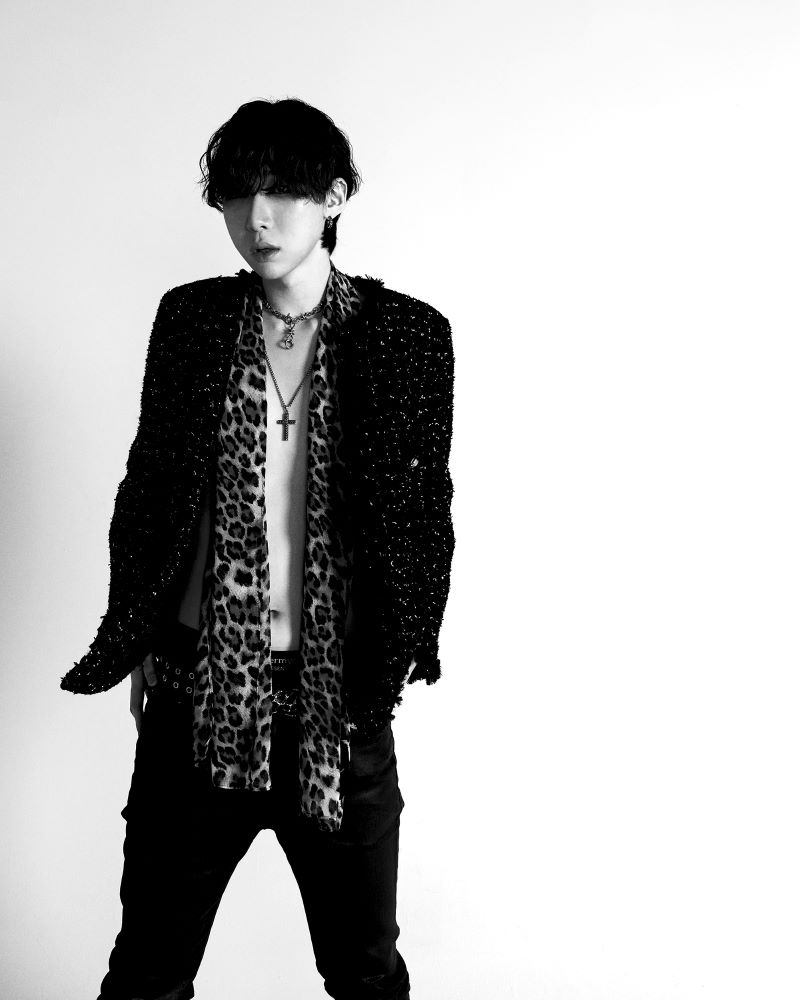
In our third conversation with Kris Main, the Korean artist reflects on a period of intense growth since our last interview. Over the past year, he has expanded his presence across multiple creative fields, collaborating with K-pop idols and rising hip-hop artists, performing at Korea’s largest hip-hop festival, and even stepping onto fashion runways. These experiences, inside and outside the music industry, ultimately became the foundation for his ambitious double EP project JANUS, which he describes as having the scale and depth of a full-length album.
The concept behind JANUS draws inspiration from the Roman god known for having two faces, symbolising duality and transition. For Kris, this idea reflects his own life as an artist, often judged by appearances. He explains that many people initially perceive him as a delinquent or someone unapproachable because of his aura or style. Through the two halves of the project – JANUS [Outside] and JANUS [Inside] – he contrasts that public image with the more vulnerable and sincere emotions he carries privately, turning years of misunderstanding into a creative statement.
While JANUS [Outside] embraces the swagger and energy people expect from him, JANUS [Inside] reveals a far more intimate side. Kris opens up about themes such as faith, love, emotional instability, and a longing for the innocence of his younger self. By dividing the project into two EPs rather than releasing a full album, he aimed to present these opposing sides as clearly as possible, giving us, the listeners, a deeper understanding of the person behind the persona.
Straight after the release of his double EP, I sat down with Kris for a frank and candid conversation.
A lot of people misunderstand me, assuming I’m a delinquent or a bad guy just by looking at me. I wanted to contrast this version of myself, defined by the eyes of others, with my honest and serious inner emotions and stories. So I chose “JANUS” as the theme, expressing that stark contrast through the concepts of “Outside” and “Inside“.
View of the Arts: It’s been some time since we last spoke, and it’s great to catch up with you again. Since our previous conversation, how have you grown both personally and creatively, and how did that journey ultimately lead to your new double EP project, JANUS?
Kris Main: I missed you, VOA! Since our last interview, I’ve worked with K-pop idols and rookie artists in the hip-hop scene, performed at Korea’s largest hip-hop festival, and walked runways. Through these various activities inside and outside of music, I wanted to roar out my rough exterior and my deep, honest inner self, which led me to create this double EP JANUS that feels like a full LP.
VOA: Obviously, as someone interested in ancient history, I was curious whether JANUS refers to the Roman god Janus, who is known for having two faces, one looking forward and one looking back, often symbolising duality and transition. If so, what inspired you to explore this idea, and how do the concepts of Outside and Inside reflect your own experience as an artist balancing public perception with your private reality? And if not, what inspired the title?
KM: A lot of people misunderstand me, assuming I’m a delinquent or a bad guy just by looking at me. I wanted to contrast this version of myself, defined by the eyes of others, with my honest and serious inner emotions and stories. So I chose JANUS as the theme, expressing that stark contrast through the concepts of Outside and Inside.
VOA: JANUS [Outside] explores the image of a rockstar as seen through the eyes of others. When creating this part of the project, were you reflecting on specific moments in your career where you felt defined by expectations rather than by who you truly are?
KM: I’ve lived my whole life a bit uniquely. Because people often perceive ‘different’ as ‘wrong,’ friends, teachers, and even parents judged me with prejudice and kept their distance since I was young. That flow has continued, and even now, many people judge me first by my aura or outfit and find me unapproachable. But I don’t hold any painful memories about this. Rather, I wanted to sublimate these misunderstandings into my own ‘swagger’ (coolness), and JANUS [Outside] is the result of that.
VOA: The opening track, “Part,” featuring Han Yo-han, hits you with a strong blend of rock and hip-hop energy. Han Yo-han is known for his distinctive sound and influence in the scene. How did this collaboration come together, and what made him the right artist to help introduce the Outside side of the project?
KM: When I was 18, I listened to Yo-han’s album every day, and I got a great opportunity to produce his album, which brought me very close to his music. Digging deep into his music for work, I highly appreciated the rough yet soft energy within it. Now, by combining the relaxed and rough coolness unique to ‘Han Yo han’, the godfather of rock and hip hop, with my rough and beautiful identity, I wanted to create a massive synergy.
S/O Han Yo-han.
VOA: Listening to “Don’t Freak Me,” there’s that incredible energy that almost recalls the spirit of early 2000s pop-rock bands like Busted. The vocal arrangements and musical structure feel very strong. Were there particular Western or Korean influences you were drawing from while making this track?
KM: Travis Barker of Blink-182. He is the true king of pop-punk.
VOA: “Bad Girl,” featuring SUNHO, brings another dynamic to the EP. The chemistry between your voices is superb. Could you tell us the story behind how this collaboration happened and what SUNHO brought to the song that made it special? And who is that “Bad Girl”?
KM: Around the time I was making this song, I was heavily into Netflix teen movies, so I remember writing it while completely immersed in those emotions. I thought SUNHO’s bright, shining voice, like sunlight reflecting on water, and his artistic identity would suit this song perfectly, so I asked him to collaborate.
S/O SUNHO.
VOA: “Forgive Me” takes a very different direction, shifting the tone almost completely with a softer sound. Why was it important for you to include a track that changes the emotional pace so dramatically within the Outside EP?
KM: I am a Christian. Many listeners might think this is a song about longing and regret for a past lover. But actually, this is a song confessing my unforivable sins to Jesus. If you listen to it with the understanding that the focus is not a specific person but ‘Jesus,’ you’ll be able to feel a much deeper and more diverse range of emotions.
VOA: “My Way,” featuring DumbAss, returns to a punchier punk-rock sound, and your voices complement each other surprisingly well. What drew you to this collaboration, and how did the two of you approach building the track’s energy?
KM: Need I say more? It’s DumbAss. Since he’s the undisputed punk rookie of South Korea, I immediately hit him up to work together. I produced a song for his album in the past, so I used that as an excuse to lightly coerce him into collaborating.
S/O DumbAss.
I believe that childhood immaturity is ‘innocence.’ I wrote this song [“I Miss Myslf”] because I missed my innocent ‘soul’ from those days, rather than the ‘object’ I passionately loved and craved, even at the cost of throwing myself away.

VOA: The closing song of JANUS [Outside], “Sharp Pillow,” has a strong early-2000s emo feel that many listeners will remember. What inspired this track, and why did you choose it to close the first half of the project?
KM: I wrote this song to capture the feeling of ‘constantly loving and craving something even though you know it’s ruining you,’ much like a drug addiction. I wanted to boldly show the catastrophic ending that others expect of me by finishing with ruin, which is why I placed it as the final track.
VOA: Moving to JANUS [Inside], the intro “Welcome to My Inside” lasts only 38 seconds but feels like a great gateway into a more intimate world. What was your intention with this short introduction, and how does it prepare listeners for the emotional shift that follows?
KM: I created this interlude track to express how difficult it was, even for me, to bring out and show my honest inner self that I couldn’t bring myself to share with others.
VOA: “I Step Forward”, featuring Anandelight, surprised me with its very different atmosphere compared to the first EP. How did this collaboration come about, and what kind of conversation did the two of you have when working on the song? And what’s behind the lyrics?
KM: Everyone has probably experienced discovering a side of themselves they didn’t know existed when they fall in true love. Of course, I had that moment too. I wanted to capture that overwhelming feeling, which went beyond just love, and express it in a sweet, mainstream way. At first, I planned to sing it alone, but the more I listened, the more I imagined how Anandelight’s warm yet refreshing voice and sensibility would fit. That’s why I reached out to him to finish it together.
S/O ANANDELIGHT.
VOA: Tracks like “Parasite” reveal a softer, calmer musical approach. After the energetic soundscape of Outside, what motivated you to explore a quieter tone on this part of the project? Let’s not count “Fashion Show” feat Kang Hyun, because that song totally threw me off the track with its sound. And why did you decide to close the EP with “Fashion Show”?
KM: There’s no grand meaning behind it. ‘Expressing my unstable emotions and mental state, where I tried to see the end of my life, with a calm and delicate emotional line’ I was simply doing one of the things I do best.
VOA: “I Miss Myself” is particularly striking as a concept. The title alone suggests self-reflection or even loss. Do you personally feel that you have changed in ways that made you “miss” who you used to be, and how did that idea influence the writing of the song?
KM: I believe that childhood immaturity is ‘innocence.’ I wrote this song because I missed my innocent ‘soul’ from those days, rather than the ‘object’ I passionately loved and craved, even at the cost of throwing myself away.
VOA: On “Good Bye,” featuring BIGONE, the R&B arrangement stands out as a surprising but very natural direction for you. What made you decide to explore this genre, and how did working with BIGONE help you find a new side of your musical identity?
KM: I grew up listening to music by Blackbear, Lauv, and The Chainsmokers since I was young. Naturally, I wanted to capture my sensitive and delicate emotions through R&B in this album. I thought BIGONE’s refreshing, pretty boy-like, delicate yet rough emotions would fit this track perfectly, so we ended up working together.
S/O BIGONE.
VOA: Looking at both JANUS [Outside] and JANUS [Inside] together, you essentially created enough material for a full studio album. What made you decide to divide the project into two EPs rather than present it as a single album, and how does this structure better communicate the story you wanted to tell?
KM: I wanted to intuitively contrast my opposing inner worlds – rough yet delicate and emotional – both visually and aurally. Also, since I believe I’ll continue to grow even bigger in the future, I felt it would be a bit of a waste to release it as a full studio album (LP) right now, so I chose to present the project as two separate EPs.
Written and interviewed by Maggie Gogler
Featured image courtesy of Kris Main
View of the Arts is an online publication dedicated to film, music, and the arts, with a strong focus on the Asian entertainment industry. As we continue to grow, we aim to deepen our coverage of Asian music while remaining committed to exploring and celebrating creativity across the global arts landscape.

 VIEW OF THE ARTS