
Originally conceived in classical Greek Mythology, nine muses were born from the union of Zeus and Mnemosyne, one for each night the couple slept together. However, it was Apollo and the nymph Eufime who raised them, thus literally and metaphorically giving birth to the association between the muses and the arts. While traditionally the muses are depicted as female, or aligned to the feminine part of the artist, muses are not necessarily gendered along the binary axis of privilege which collapses sex into gender. Indeed, Leonardo De Vinci’s Mona Lisa is said to have been modelled on his rumoured lover, Salai, and Peter Schlesinger inspired many of David Hockney’s paintings including Peter Getting Out of the Swimming Pool, which won the John Moores Painting Prize in 1967— and not forgetting George Dyer, a notorious East End criminal, who was the inspiration for over forty nightmarish portraits by Francis Bacon. Alternatively, the muse has been conceptualised as the anima (the feminine) to the animus (the masculine) in Jungian terms as well as the representative of the balance between yin and yan in Chinese cosmology.
MUSE is, of course, the title of Jimin’s sophomore album, his follow-up to the globally successful FACE (2023), and is used to refer to the source of the artist’s inspiration; here imagined in romantic terms with love being the genus of creative production. However, the muse, herself, is fictional, simultaneously everywhere and nowhere. The painful gestation of the EP is articulated through the seven tracks which range across a variety of genres including hip-hop, Latin, jazz, and big band music, articulating a type of resignation at the vagaries of life. Gone is the dark noir universe of a tortured artist facing up to his ‘self’, as an individual and not one of the youngest members of BTS and the IT boy of K-pop, and in its place we have a melodramatic, albeit romantic, picture of an artist whose future is not dictated by the past. While FACE can be seen as a metaphorical Pandora’s box, MUSE articulates the hope that remains when the difficulties and challenges of life have been faced up to, even if that hope is counterbalanced by a lack of effect. Consisting of seven tracks, including the digital single, ‘Closer Than This’, released as a fan song, dedicated to BTS’s fandom, ARMY, on 22 December 2023, after Jimin had begun his mandatory military service earlier that month, MUSE was released on 19 July 2024. The pre-release single, ‘Smeraldo Garden Marching Band’ (feat. Loco), which dropped on the 28th of June is the third track on the album. The other five tracks are in order: ‘Rebirth: Intro’, ‘Interlude: Showtime’, ‘Slow Dance’, ‘Be Mine’ and ‘Who’, the lead single. Musically the album explores different genres, drawing on old-school hip-hop with Latin-influenced beats and jazz-inflected music of the big band era. In terms of musicality, MUSE offers a very different Jimin to that of FACE, despite Jimin’s distinctive vocals.
The first track: ‘Rebirth’ (Intro) sets the tone, moving away from the despair that underpinned FACE to hope as expressed in the following lyrics “I want a real good love, good love, good love / I’m tryna find a love, good love, real love”. While his first album was a journey into the dark side of idol stardom, this sophomore EP reflects a different side of Jimin’s personae, the light-hearted and romantic one as evident here in the intro and as signified through the use of the word ‘Rebirth’. Here, Jimin expresses hope for the future which is connoted through an imaginary lover, who he is yet to meet. And while the message here is an individual one, the EP itself interweaves between the personal and public personas of Jimin. Indeed the search for the “one” here, could be interpreted as Jimin’s search for his muse, that which would give form to his artistry, in other words, to liberate his feminine anima, the source of creativity in Jungian terms.
‘Interlude: Showtime’ is a big band instrumental, introduced by the following words: “Ladies and gentlemen, please welcome to today’s show / Smeraldo Garden Marching Band!” Defined as a skit, which at one time was considered an essential component to rap albums, popularised by the UK group De La Soul, the track is used to contextualise the themes of the album as well as establish generic cues drawing from the big band era as well as from the Beatles’ seminal concept album, Sgt. Pepper’s Lonely Hearts Club Band (1967). At one level this is a metafictional reference to overt comparisons that have been made between BTS and the Beatles. An example of this is the appearance on The Late Show With Stephen Colbert (16 May 2019), where BTS performed ‘Boy With Luv’ after an introduction that riffed on the Beatles’ appearance on the Ed Sullivan Show on 9 February 1964. Further, the Beatles appeared in marching band uniforms on the cover of the album and fictionalised themselves in a performative act which paradoxically established their status as artists and not just a passing fad whose relevancy lay only in their appeal to ‘hysterical’ teenage fangirls. In a similar sense, MUSE can be understood as Jimin’s attempt to break with the conventions of idol music as well as critiquing the mechanisms with which K-pop is often described as embodying the worst attributes of popular music without the concomitant artistry afforded so-called real musicians.
The following track, ‘Smeraldo Garden Marching Band’, continues the intertextual referencing to the Beatles, while embedding within the title, a direct reference to the ‘Smeraldo’ flower which was first given life in 2017 just before the iconic Love Yourself series of albums and stands for ‘sincerity that could not be delivered’. In short, it alludes to the necessity of being true to yourself which is crucial to the authenticity of being. This can be seen in Loco’s rap: “I couldn’t say it face-to-face, but just for you I’ve / Made a band”. This echoes Jimin’s pre-chorus: “All the things we couldn’t say before / And your hidden feelings too / I’ll tell you everything now”. Perhaps, this honesty is only possible because of the distance that serving in the military affords the artist, through the ritualisation of coming of age for young South Korean men.
READ MORE: A Long Journey Into Night: Jimin’s “FACE” EP Review
The following track, ‘Slow Dance’ (feat. Sofia Carson), centres on romantic love using the slow dance as a metaphor for intimacy and closeness. However, the song acknowledges that youthful dalliances are often fleeting and come to a premature end, just as a slow dance does. The lyrics mark an attempt to turn this ephemeral experience into a perfect moment: “Slow dance / We’re caught up in a romance (Romance) / Oh, give into the tempo of our favourite song / In this moment’s where we belong”. The choice to feature Sofia Carson helps to solidify the romantic intentions of the song, as the actress/singer has appeared in Disney films including as Cinderella in the fourth instalment in the Cinderella series (2004-2021), A Cinderella Story: If the Shoe Fits (2016).
The fifth track ‘Be Mine’, with its sparse lyrics and use of repetition, can be understood as articulating a desire to maintain a loving relationship, effortlessly code-switching between English and Korean: “Lovers Come and Go / In and out of my heart / 빠져들수록 / 깊어만 가는걸 / 영원히 이대로 / 널 가질 수 있다면(The more I fall into it / It keeps getting deeper / Like this forever / If I could have you) / I want you to be mine / I want you to bе mine / I want you to be mine”. The use of structured repetition here builds an emotional connection between the singer and the listener, although Theodor Adorno, who was highly critical of popular culture including jazz and dance music, would have contended that the song’s use of musical and lyrical patterns as representing the very worst of popular culture. In opposition to this, repetition brings with it the pleasure of the familiar while foregrounding the dominant themes and meanings of the text. It also allows the listener to actively participate in the song, as a form of corporeal liveness, not just through recognition of repetition but through interpretation and/or reenactment of the meaning of that repetition.
‘Who’, the lead single, and the sixth track on the album, is the only English language song, the others utilise linguistic hybridity which is a fundamental feature of K-pop. Here we move away from the past of the previous songs and instead anticipate the future. ‘Who’ is a lament for a love not experienced, and a person, not met (or recognised) yet, as Jimin asks “Who is my heart waiting for?”. The romantic experiences as detailed in the previous songs have not led to anything long-lasting, but are merely fleeting encounters within the ephemerality of modernity, in a life lived fast within heightened sensibilities. Jimin asks whether this potential lover is: “someone that I see every day […] or is she somewhere a thousand miles away?”. The ‘Who’ of this song can also be seen as the reference to the muse that forms the album’s title and coheres to its message. The final track, and pre-release single, moves away from the intimate world of lived tactile relationships to the imaginary world of para-social ones. ‘Closer Than This’ is a fan song released just after Jimin started his mandatory military service. Here we find Jimin in a contemplative mood, wondering whether the fans will remain fans during the group’s hiatus. Traditionally in K-pop, once a male group starts their military service, they are replaced or are in the process of being replaced by a younger group. K-pop is a cyclical and cynical industry, continually replacing old with new, discarding once-popular idols as soon as their financial viability has been eroded. Jimin directly tells the listener that this will not be the case for BTS, promising to return: “I will never let you go (I will never let you go) / Never let you go (Never let you go)”. His memories of interactions with ARMY providing warmth to comfort him through the enforced hiatus: “더 크게 부르자 이 노래 / 다시 하나 될 수 있게 (Let’s Sing it Louder / So That we can become one again)”.
In many ways, the differences between the Jimin of FACE and that of MUSE can be best understood by reference to his sultry solo track ‘Filter’ on Map of the Soul 7 (2020) in which he tells the listener that he can be whatever they want him to be: “팔레트 속 색을 섞어 pick your filter / 어떤 나를 원해? / 너의 세상을 변화시킬 I’m your filter / 네 맘에 씌워줘 (Mix the colors in the palette, pick your filter / Which me do you want? / The one to change your world, I’m your filter / Overlay me in your heart”, except for here, Jimin is picking the filters through which he presents himself to the world. Sophomore albums are notoriously difficult, they can build or break your career. On MUSE, Jimin manages to consolidate his artistry, not necessarily in terms of pushing and breaking musical and artistic boundaries, but by producing a new filter through which he can be seen, thereby keeping the listener engaged and invested in both his musical and romantic journey. After all, hope in the future persists despite the challenges and difficulties inherent in making a life lived well, and that is a message that is needed now perhaps more than ever.
While FACE is a psychological thriller, MUSE is a romantic melodrama, leaving the audience wondering how many more personae will Jimin reveal in his subsequent work, both with BTS and on his own. Jimin is much more than a pretty face, something which is seen as integral to K-pop, but rather an artist whose journey to self-realisation has only just begun.
Rating:
Written by Dr Colette Balmain
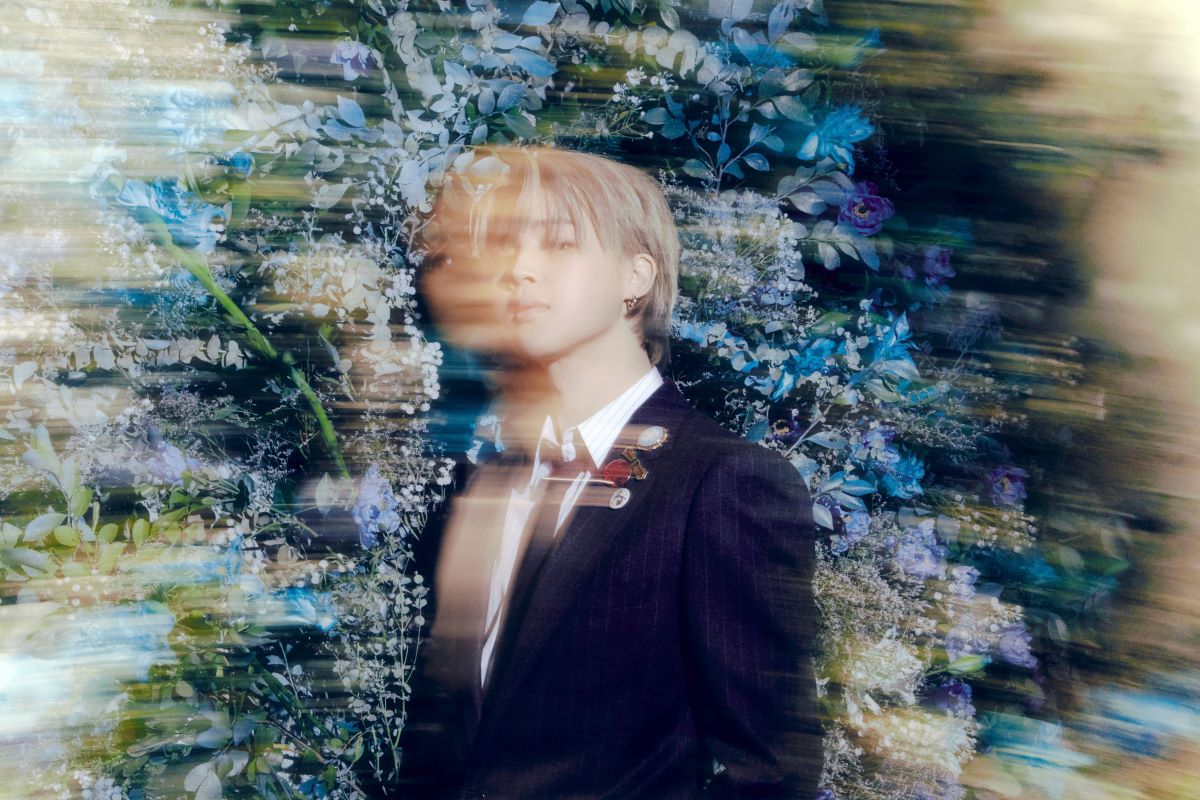
Featured image © BigHit Music
View of the Arts is an online publication that chiefly deals with films, music, and art, with an emphasis on the Asian entertainment industry. We are hoping our audience will grow with us as we begin to explore new platforms such as K-pop / K-music, and Asian music in general, and continue to dive into the talented and ever-growing scene of film, music, and arts, worldwide.

 VIEW OF THE ARTS