
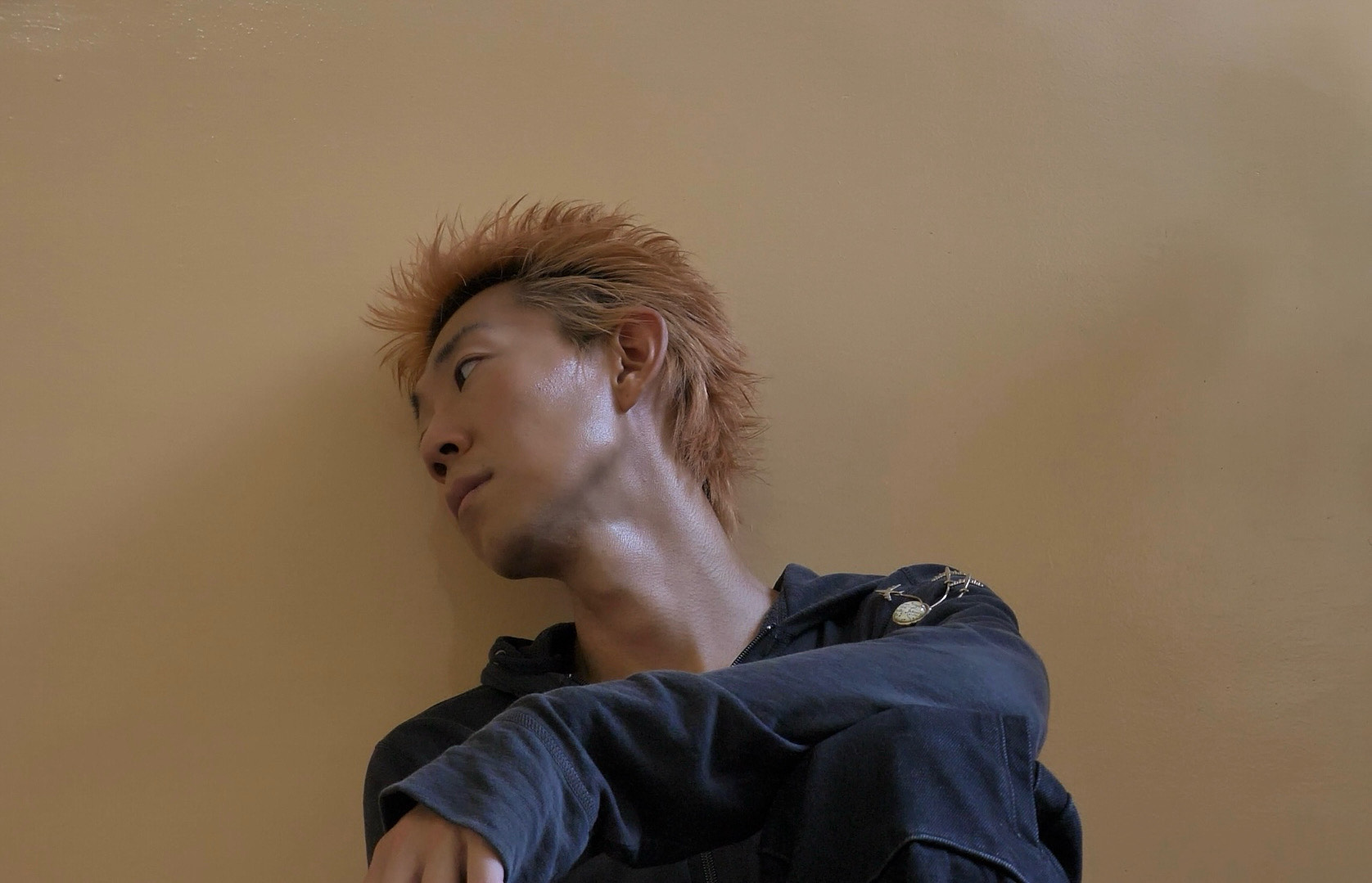
SIXX, a South Korean singer-songwriter, with his new release, SHIFT, takes us into a threshold space, a corridor between who we’ve been told to be and who we sense we are beneath all the external noise. Login isn’t a typical opening track; it is a consciousness switch – deliberate rupture. In my conversation, SIXX speaks about angels and demons not as fantasy but as inherited frameworks and moral binaries installed long before we ever had the chance to choose our “own language of self”.
At the centre of this dialogue is a refusal: a refusal to be authored by systems or anyone’s expectations. SIXX doesn’t describe rebirth as something granted, but something claimed, an internal origin point that exists before approval. The world of Login is intentionally unstable: rules bent and form disrupted. It’s a landscape built from the tension of anticipation and anxiety, where pressing “start” doesn’t mean escaping reality, but finally entering it without armour.
And when I spoke to SIXX, I realised that the artist traces that exact crossing. The way he describes his latest project feels like a philosophy in motion: music as self-authorship, distortion as honesty, and “logging in” as a return, not to a game, but to the self. Not only does it all sound philosophical, but also very poetic, if you ask me.
Every time I speak with such a talented and articulate artist, my perception of music shifts. Thank you, SIXX, for opening my eyes to a vast new sonic world.
While writing it, I tried not to adjust myself to external eyes or rules. Instead, I focused on revealing my instincts, my thoughts, my desires exactly as they are, letting the emotions originate from my inner world rather than from the outside.

View of the Arts: In Login, you use the idea of entering “a game-like world of angels and demons” as a metaphor for rebirth and self-definition, while also rejecting “predetermined rules.” Can you walk us through the philosophical core of the lyrics? How did this concept of internal origin, rather than external validation, shape the way you told the story in this track?
SIXX: The starting point of Login was the question, “Who gets to define me?” In the past, I tried hard to fit into the images and standards that others expected of me. But for this project, I wanted to break out of that frame completely. Even the title reflects this shift. Grammatically, it should be written as “Log in”, a verb phrase, something you do. But I chose to merge it into “Login,” deliberately breaking the rule. That’s why I brought in the imagery of a game-like world with angels and demons.
To me, even those characters are just external frames created by someone else, good vs. evil, light vs. dark. Those binaries felt like rules imposed from the outside, and I wanted to create a space where I could question them, choose for myself, and redefine everything from within.
On a personal level, I also wanted to capture the feeling of *pressing the “start game” button you’ve been waiting forever to hit; that moment of anticipation, a little anxiety, but also the spark of a completely new world opening up.
For me, Login symbolises that exact moment. So, the core philosophy of the track is: “The answer doesn’t come from outside – it begins within me.”
While writing it, I tried not to adjust myself to external eyes or rules. Instead, I focused on revealing my instincts, my thoughts, my desires exactly as they are, letting the emotions originate from my inner world rather than from the outside. In the end, Login isn’t a story about entering a new world; it is about peeling away all those external frames and logging back into the world of myself.
VOA: As the opening track of the EP, Login feels like a gateway not only conceptually, but sonically. How did you approach the arrangement to reflect the tension between uncertainty and anticipation? Were there specific sound design choices, rhythms, or transitions you used to sonically represent the idea of “logging in” and stepping into a new world?
SIXX: When I was making Login, the element I focused on the most was the FX sound. The sonic landscape of this track came naturally from my thoughts, experiences, and instincts – and a lot of it draws from the things I saw, heard, and felt when I was younger.
That’s why I ended up referencing sounds that represent a specific era. First, I layered in the sound of a CD drive spinning. That unique mechanical noise you hear when you insert a CD and the game starts loading always gives me the feeling that “a new world is about to open.” It aligned perfectly with the concept of “logging in,” so it became the foundation of the track. I also used glitch sounds as accents. I wanted to add more tension between uncertainty and anticipation, and that broken-or-reassembled digital texture felt like the best way to express the moment right before crossing into a new world.
The last key element was the sensation of dimensional movement. I think of the portal sound from Diablo II, and you’ll get the exact idea. I wanted to portray the moment you shift not into an external world, but into your inner world. So, I used a lot of textures that feel like a doorway opening into another space.
VOA: Loginas well as the rest of the tracks avoid predictable structures and sit between digital, alternative, and conceptual pop soundscapes. Why was it important for you to avoid a more conventional genre approach for this release, and how does this departure from familiar styles reflect your personal artistic “shift” during the making of this EP?
SIXX: When I was creating this EP, I didn’t pay much attention to genres or traditional structural rules. The core concept of this project wasn’t about following a set framework, but about focusing on the changes happening within me. For me, SHIFT wasn’t a question of “Which style should I choose?” but rather, “What sound does the emotion I’m feeling right now call for? What does the story itself demand?” Everything moved naturally based on those questions.
That’s why the tracks move between digital, alternative, and concept pop. It wasn’t about intentionally breaking genre boundaries; it was simply the direction that my world-building and emotions naturally flowed toward.
In the end, that genre fluidity itself reflects the personal SHIFT I experienced through this project, a process of redefining my own perspective and my own identity.
When I was creating this EP, I didn’t pay much attention to genres or traditional structural rules. The core concept of this project wasn’t about following a set framework, but about focusing on the changes happening within me.
VOA: The Korean music scene is highly trend-driven, often centered around formulaic hooks and commercial structures. How do you personally feel about the current direction of Korean music, and where do you see your sound – especially through your new music – fitting within or pushing against those trends?
SIXX: I think it’s true that the Korean music scene moves very quickly and is heavily driven by trends.
I understand the culture where professionally crafted hooks or trend-focused structures work well, and I also think there’s a lot of amazing music that comes out of that system. But personally, I don’t really feel pressured to follow that flow. For me, the most important question is: “What am I feeling right now? What am I thinking? And can I express who I am through music?” That’s the part I find the most meaningful. So matching trends was never my priority. Especially with SHIFT, the process was much closer to redefining my inner world.
Bringing in external formulas or standards felt like it would blur the direction I was trying to take. And to be honest, I wasn’t even sure if I could express Korea’s trend-focused structures in a way that felt musically authentic to me.
So I don’t really see my music as something that fits neatly within Korea’s mainstream trends. It’s not that I wanted to make music against the trends. It’s just that when I followed the direction my own emotions and stories were leading me, the sound naturally went elsewhere. In the end, rather than moving with the trends, I wanted to make music that speaks clearly from my own internal rhythm. And I think this EP is my first real attempt at doing exactly that.
VOA: How did your collaboration with Kigrain influence the EP’s depth, texture, and conceptual direction? And how did the collaboration come about?
SIXX: My collaboration with Kigrain played a huge role in shaping this EP. Since we grew up in the same era, we share the exact same memories, the screens we saw as kids, the sounds we heard, and the whole game-loading aesthetic. Because of that, we didn’t need long explanations to understand each other when talking about certain sounds or emotions.
For example, if I said something like: “I want a texture that feels like a CD drive,” “I want the glitch to feel slightly broken,” “I want spatiality like the Diablo II portal,” Kigrain would immediately understand and capture exactly what I meant. That kind of tension and instant understanding is only possible when you share the same generational experiences.
Thanks to that natural connection, the depth and texture of the EP became much stronger. It really helped me bring the sounds in my imagination to life. If you ask how the collaboration started, it wasn’t because of some dramatic event; it was more like we were naturally drawn to each other because we share a similar wavelength.
We had been listening to each other’s music for a long time, and as we realized that our workflows and emotional directions matched well, I eventually reached out.
VOA: Flash Back, Dress Code, Genie, what was the creative process for those songs like? And lyrically speaking, what inspired your work for this release?
SIXX: Although Flash Back, Dress Code, and Genie were created in completely different ways, I see them as scenes that show the emotions and moments I’ve experienced throughout my musical journey, each from a different angle. Before reaching Track 1, Login, I wanted the flow to feel like memories surfacing one by one, as if each song is another frame coming into focus.
Flash Back. This song was born from the sudden return of the overwhelming excitement and beginner’s passion I felt when I first started making music. That energy burst out as a melody, and the repetitive hook “Flash back” naturally formed from the feeling of pulling that emotion back to the surface. Sonically, I wanted to express the version of myself who kept running forward without stopping. I imagined the scale and momentum of a rocket shooting into space.
The lyrics also stem from the mindset: “I can’t go back, so I can’t stop either.”
[In terms of] Dress Code, this track initially started as a simple atmospheric dance song. But as I kept working, the emotions I’d felt while looking at the music scene naturally started coming out. If the music scene is one big “party,” there were times when everyone else seemed perfectly dressed for the dress code, and I felt like the only one who hadn’t been invited.
That sense of alienation, longing, and the quiet thought, “I want to be there too,” all wove themselves into the lyrics. So even though the sound stays bright and rhythmic on the surface. I wanted the lyrics to leave a subtle emptiness underneath. That gap between the exterior and the interior is the core of this track.
Genie began the moment someone said to me, “Just say the word. I’ll help you. What do you need?” That one sentence struck me deeply; it felt almost like a genie reaching out a hand. So, I made the vocal melody as soft as possible, kept the structure more intuitive, and aimed for the most accessible tone out of all the tracks on the SHIFT EP.
The lyrics came from the comfort and gratitude I felt then, and from the wish: “Someday, I want to be that person for someone else too.” For me, this song made me rediscover the warmth contained in the word “help.”
In summary, even though the three songs came together through different processes, their lyrics and emotions ultimately emerged from three places: beginner’s passion, alienation, and comfort. That’s why I think these three tracks are pieces that express the overall theme of the EP, SHIFT: the transformation happening within my inner world; each one revealing that shift in its own way.
In this EP, I experimented with much bolder and more adventurous sounds, and within that, my vocal colours also appeared in new ways. This kind of change was only possible because of the collaboration.

VOA: Although this EP explores a very different sound from your previous work, your vocals still carry that beautiful R&B texture – at least to my ears. I really love the tone and colour of your vocals; it sounds smooth, warm, and incredibly pleasing to listen to. Have you got any plans to go back to that smoother sound like Dunes, Fire man, Erip and Eternal? Or perhaps you would like to try something else?
SIXX: In this EP, I experimented a lot with new sounds and textures, but as you mentioned, the R&B quality of my vocals seems to remain instinctively. I really appreciate you noticing that. The tone and colour I have are things that have been a part of me for a long time, so they naturally come through regardless of the style I work in. I think a big difference between this EP and my previous works comes from my collaboration with producer Kigrain.
Working with him allowed me to explore sounds much more boldly and incorporate far more layers of information than when I work alone. As a result, compared to my previous projects, the sound has undergone a much clearer transformation. I feel that’s the biggest advantage of collaborating. Honestly, most of my earlier songs tended to be relatively minimal and mood-focused.
But in this EP, I experimented with much bolder and more adventurous sounds, and within that, my vocal colours also appeared in new ways. This kind of change was only possible because of the collaboration. Looking ahead, returning to a softer, more emotional R&B style like in Dunes, Fire Man, Erip, or Eternal, would also be a natural path for me.
It feels like a comfortable, familiar home space. That said, I really enjoyed exploring new territories in this EP, so I also have a clear desire to continue experimenting. Rather than sticking to a single genre, I prefer letting the sound naturally evolve in the direction guided by the emotions I’m feeling at the moment.
VOA: When do you feel the most creative while writing songs? For example, do ideas come to you more easily late at night, while walking, traveling, or during quiet moments alone?
SIXX: Surprisingly, I often feel most creative not when I’m quietly alone, but when I’m talking with others. When I’m in conversation, there are moments when emotions or thoughts I’m usually not aware of suddenly surface. In that process, ideas naturally open up, and as I express them in words, new melodies or images often emerge at the same time.
Even though the theme of this EP is about exploring my inner world, the moments that actually opened that inner space came more from conversations with people than from solitude. Through talking with someone, reflecting on myself, and sharing and confronting emotions, the voice that’s always inside me feels clearer. Of course, inspiration that arises in quiet, solitary spaces exists too. But more often, I experience my emotions opening and being organized in the unpredictable flow of a conversation. As a result, interacting with others plays a very important role in my creative process.
VOA: When you’re not making music, how do you like to spend your free time? Are there any hobbies or simple routines that help you relax or recharge your energy?
SIXX: When I’m not making music, I try to clear my mind as much as possible and recharge my energy through my own routines. I also try to work only within set periods of time, almost like turning a switch “off.”
I get a lot of strength from surprisingly simple things. Walking in the morning sunlight with a cup of coffee, then exercising afterwards, that becomes the perfect routine for me.
In the past, I used to cling to music until it was “done,” but that approach didn’t suit me. It often led to overthinking and drained my energy even more. At some point, I realised, “I need time completely separate from music.” Since then, I’ve naturally chosen to structure my days with routines that help me organise myself and maintain balance.
Time at home with my cat is significant. Just being in the same space without speaking calms my emotions and helps me find a peaceful rhythm again. So, the time I spend away from music doesn’t feel like just resting; it feels more like recharging. These small moments in everyday life feed back into my creativity, and in the end, that’s what helps me maintain the consistency I want. I’d like to make music for a long time.
VOA: Just for fun – If your life right now were a song title, what would it be – and would it be a ballad, a club banger, or complete chaos?
SIXX: If I had to describe my life right now with a song title, I’d say Grain of Sand. When you look at our lives on the scale of the universe, we’re all really just tiny grains of sand.
Thinking this way makes any situation feel a little less overwhelming and gives you a bit of space to view things more lightly. If I were to express it in terms of genre, it would probably feel like a minimal ambient track that captures the overall flow gently. But life is so unpredictable that sometimes, what starts as ambient could suddenly be interrupted by chaotic sounds for dramatic contrast. After all, a single song doesn’t have to stick to just one genre [smiles].
Written and interviewed by Maggie Gogler
Featured image courtesy of SIXX
View of the Arts is an online publication dedicated to films, music, and the arts, with a strong focus on the Asian entertainment industry. With rich content already available to our readers, we aim to expand our reach and grow alongside our audience by delving deeper into emerging platforms such as K-pop and Asian music more broadly. At the same time, we remain committed to exploring the vibrant and ever-evolving global landscape of film, music, and the arts, celebrating the immense talent and creativity that define these industries worldwide.

 VIEW OF THE ARTS