
To be an actor is to walk a fine line between reality and illusion, between self and character, and nowhere is this delicate dance more visible than in roles that challenge and stretch the frame of identity. The beauty of acting lies in the ability to entertain and in the subtle journey of transformation – an actor’s pursuit to breathe life into complex characters, often fractured, layered, and deeply human.
It is in these complex roles that the true art of acting reveals itself. A role that demands more than reciting lines or playing out scripted moments becomes a living, breathing entity. The actor must dig into the darkest corners of the human psyche, illuminating the pain, joy, sorrow, and contradictions that reside within us all.
In recent years, no cinema has embraced the beauty of complicated storytelling and acting quite like Korean cinema. Known for its unapologetic exploration of human depth, Korean films often present multilayered narratives rich with emotion, powerfully portraying societal and personal conflict.
At the heart of these films are actors who possess an extraordinary ability to bring characters that impress, scare, and, at times, resonate with the viewers. They can also express subtle shifts in emotion, their quiet intensity, and their effortless transformation into their roles that make Korean actors some of the finest in the world, and one of these actors is Um Tae Goo. With each of his roles, there’s a kind of poetry in watching him steer the storms of internal conflict, love, loss, and redemption, carrying the weight of a character’s burdens as if they were his own.
I always try to familiarise myself with the script first, regardless of the work, and I focus on the director’s directions on set. – Um Tae Goo

With a career that has steadily grown over the years, Um has impressed audiences through his performances in films such as The Age of Shadows and Night in Paradise, both of which gained international recognition, especially with their availability on Netflix. Known for his heartfelt interactions with fans, Um takes the time to connect with those who share a love for cinema. “Thank you for taking the time for this interview,” he expresses, revealing his sincere gratitude and warmth.
Um’s journey began in smaller roles in films like Epitaph and Sympathy for Lady Vengeance, where he first shows his ability to bring intense emotions. As he reflects on his craft, he emphasises the importance of understanding each character. “I try to thoroughly understand the script… I think about why the character thinks this way and why they act that way,” he explains, illustrating his method of immersion into the roles he portrays. For characters in Night in Paradise and My Punch-Drunk Boxer, Um meticulously prepared, even physically transforming himself to fit the roles he portrayed. “Externally, to dramatically portray Byung-gu from My Punch-Drunk Boxer, I practiced boxing, and for Night in Paradise, I gained weight. [In terms of My Punch-Drunk Boxer], it is a human comedy-drama. During that time, I prepared for the role of Byung-gu by boxing for about five hours a day for almost two to two and a half months. Since the body and emotions can’t be completely separated, I believe that the physical hardships somewhat influenced my emotional performance. However, rather than feeling the strain, I tried to express most of Byung-gu’s emotions with my body. I wanted to lay bare all of Byung-gu’s pent-up feelings on the final ring,” Um recalls.
Um’s adaptability shines through as he moves between intense and everyday characters, deftly balancing the difficulties of each role. “As I mentioned earlier, I always try to familiarise myself with the script first, regardless of the work, and I focus on the director’s directions on set. So, I tend to concentrate more on the preparation process, and once filming is finished, I detach from the character quickly, so I don’t have difficulties. After filming, if the work turns out well, I feel good, and if I see things I regret in my acting, I feel a bit disappointed,” he reveals.
[“My Sweet Mobster”] I wanted to express Seo Ji-hwan in love well. I acted diligently, not wanting to regret it later.”
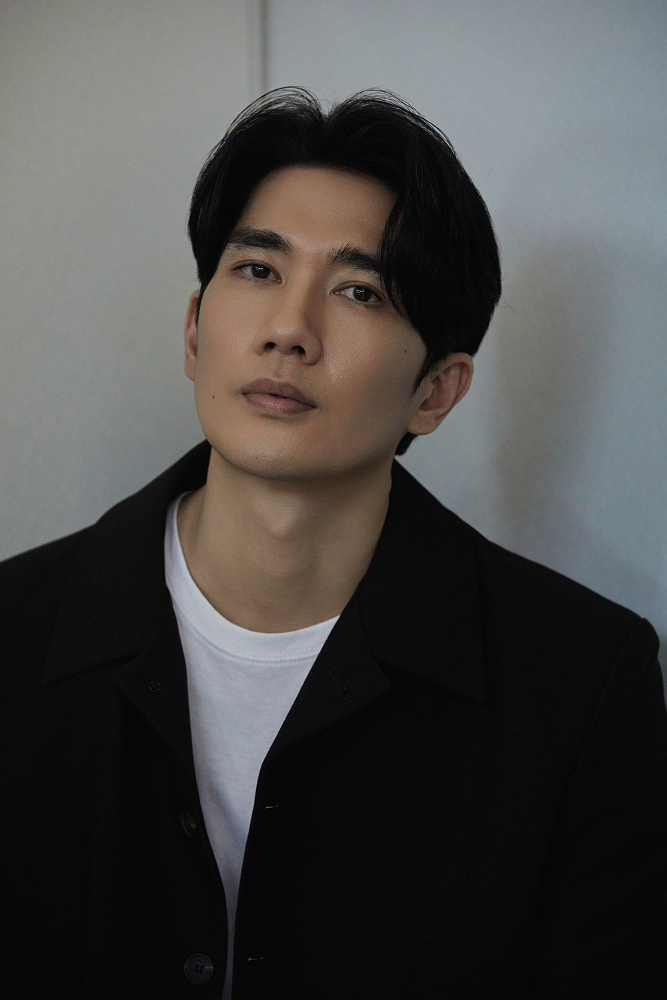
His latest work, My Sweet Mobster, shows a significant departure from his typical intensity, as he takes on the role of Seo Ji-hwan, a character grappling with a dark past while finding humor in a lighthearted setting. “It was a challenge. Since I don’t usually have a comedic image, performing in front of fellow actors and many staff members wasn’t familiar for me,” Um shares. However, he sees the value in the contrast between his character’s serious side as a CEO and his softer, romantic moments. “I wanted to express Seo Ji-hwan in love well. I acted diligently, not wanting to regret it later.”
In Night in Paradise, Um portrays Tae-goo, a mobster embroiled in betrayal and loss. He expresses his approach to such a troubled character with sincerity: “I focused on the script. I feel that acting is always difficult, but I tried to express what the character felt sincerely in each moment. I believe expressing those emotions is my role, and I think the director guides the extent of that expression, so I stay true to the directions on set. While my responses might seem similar, I don’t think, ‘I should express this delicately’ or ‘I should try to express this differently.’ I simply stay faithful to the character as written in the script and express it wholeheartedly.”
Having experienced both film and television, Um recognises the demands of each medium. “In films, the beginning and end are set, while dramas sometimes run without knowing the end. So, in a film, you create the story and characters within the running time, but dramas have a longer breath than that. From my perspective, aside from the longer scripts and more dialogues in dramas, these characteristics don’t impact my acting preparation. Regardless of the format, I always try to stay true to the script,” he explains.
Looking back on his evolving filmography, Um identifies his role as Seo Ji-hwan in My Sweet Mobster as a turning point in his career. “It was my first challenge in romantic comedy… I prepared very hard,” he recalls. As he looks ahead, he hopes to explore diverse genres and tackle new challenges, including melodrama. “I would like to greet the audience through diverse genres with interesting characters in the future, and I also want to try melodrama, like August’s Christmas,” he expresses with enthusiasm.
[“Night in Paradise”] I feel that acting is always difficult, but I tried to express what the character felt sincerely in each moment. I believe expressing those emotions is my role, and I think the director guides the extent of that expression. – Um Tae Goo

While Um has dabbled in various aspects of filmmaking during his college years, he acknowledges the challenges of directing. “I found directing to be a very challenging area, one I don’t believe I can handle,” he admits. For now, his focus remains firmly on acting, where his passion for storytelling and emotional connection can shine.
With a career that displays a beautiful blend of intensity, vulnerability, and humor, Um Tae Goo is undeniably a subline figure in both Korean cinema and television. He is a great actor, a storyteller, a vessel for the complexities of human emotion, and a beloved figure who continuously invites audiences into his cinematic world. As he grows and takes on new challenges, we look forward to the exciting stories he will tell next.
Written and interviewed by Maggie Gogler
Featured image © TEAMHOPE
View of the Arts is an online publication that chiefly deals with films, music, and art, with an emphasis on the Asian entertainment industry. We are hoping our audience will grow with us as we begin to explore new platforms such as K-pop / K-music, and Asian music in general, and continue to dive into the talented and ever-growing scene of film, music, and arts, worldwide.

 VIEW OF THE ARTS