
Indonesian multimedia artist and filmmaker Riar Rizaldi, known for his blend of documentary fiction and essay films, has recently completed his latest work, Monisme (2024). The film delves into themes of duality—human and non-human, nature and technology—while questioning their interconnectedness. Born from years of extensive research on Mount Merapi, one of Indonesia’s most significant volcanoes, Monisme explores Merapi’s dual role as both a crucial site for scientific study and a deeply mystical landscape woven into local folklore. Rizaldi also examines humanity’s enduring desire to predict, control, and influence the natural world. We spoke with Rizaldi about Monisme, his artistic practice, and his perspective on cinema – particularly his approach to blending cinematic forms and incorporating both local and colonial archives.
I believe cinema itself is a medium that explores and challenges concepts of duality – fact and fiction, machine and human, and so on – Riar Rizaldi

View of the Arts: Your latest feature film, Monisme (2024), explores the complex relationship between the human and non-human world, the interplay of nature and technology, and the presence of spirits within the natural realm. What initially drew you to this theme, and what sparked your decision to center the film around volcano Merapi? Can you take us back to the moment the idea first took shape?
Riar Rizaldi: My journey with Monisme began in 2012 when I moved from Bandung to Merapi in Yogyakarta. From the start, I was captivated by the diverse ways people relate to the volcano. For some, it is a looming threat, understood through a scientific and technological lens; for others, it is a sacred gateway, tied to mysticism and spirituality. Meanwhile, a capitalist perspective sees it as a source of livelihood through extractive industries like mining. The tensions between these worldviews fascinated me, with Mount Merapi itself standing at the center, almost like a mandala. At the same time, my personal connection to Merapi was shaped by Indonesian pop culture—particularly period-piece martial arts TV series and radio dramas like Misteri Gunung Merapi, which were low-budget yet rich with fantasy. Living near the volcano prompted me to rethink this relationship, moving beyond those fictionalized depictions to engage more deeply with the realities and myths surrounding Merapi.
VOA: Monisme employs a variety of filmmaking and shooting techniques to heighten sensorial experiences for the audience. Can you share some of the key methods you used and how they help immerse viewers in the world you’ve created?
RR: When we first began working on Monisme, our approach was largely observational – similar to cinéma vérité or direct cinema. We focused on documenting local residents’ activities, using the camera as a tool to observe how humans and non-humans interact with Merapi. However, we soon realized that this method felt limiting and somewhat detached, as if we were prioritizing a scientific perspective – treating the camera as an observational instrument – rather than collectively imagining what Merapi truly is. This approach also led many locals to perceive our work as journalistic, which was something we wanted to avoid. Recognizing these limitations, we shifted to a more intimate and collaborative process, based on the idea that people’s connection to the volcano is deeply personal. We engaged in discussions about cinema, exploring what kind of film could best unite our vision. Since most of the participants and crew come from rural areas, we discovered a shared cinematic language – horror films. Often dismissed as second-class entertainment, horror is one of the most widely distributed and accessible genres in Indonesia’s rural communities. Inspired by films like Lady Terminator (1988), The Warrior / Jaka Sembung (1981), and The Queen of Black Magic (1981), we embraced the aesthetics and narrative style of horror to create an immersive film that blurs the boundaries between fiction and reality, with a collectively written script.
VOA: Your artistic practice frequently goes beyond the conventional limits of documentary, fiction, and genre norms. How do you approach mixing these elements in your filmmaking, and what draws you to this fluid storytelling style?
RR: Fiction is at the core of my creative process, driven by my early fascination with science fiction literature and the horror films I grew up watching. I see genre filmmaking as a method of observing and interpreting phenomena. At the same time, documentary plays a key role in my work, not only because I’m drawn to the genre but also due to my interest in documentary theory – especially how early non-fiction and scientific films helped shape the history of cinema. Blending these genres allows me to explore how different filmmaking approaches reflect distinct worldviews, a concept I find deeply compelling. When these perspectives collide within a film, they create something unfamiliar – almost alien – which, to me, is one of the most exciting aspects of cinema.
What interests me most is cinema’s capacity to capture subtle elements in nature as well as human emotions – Riar Rizaldi
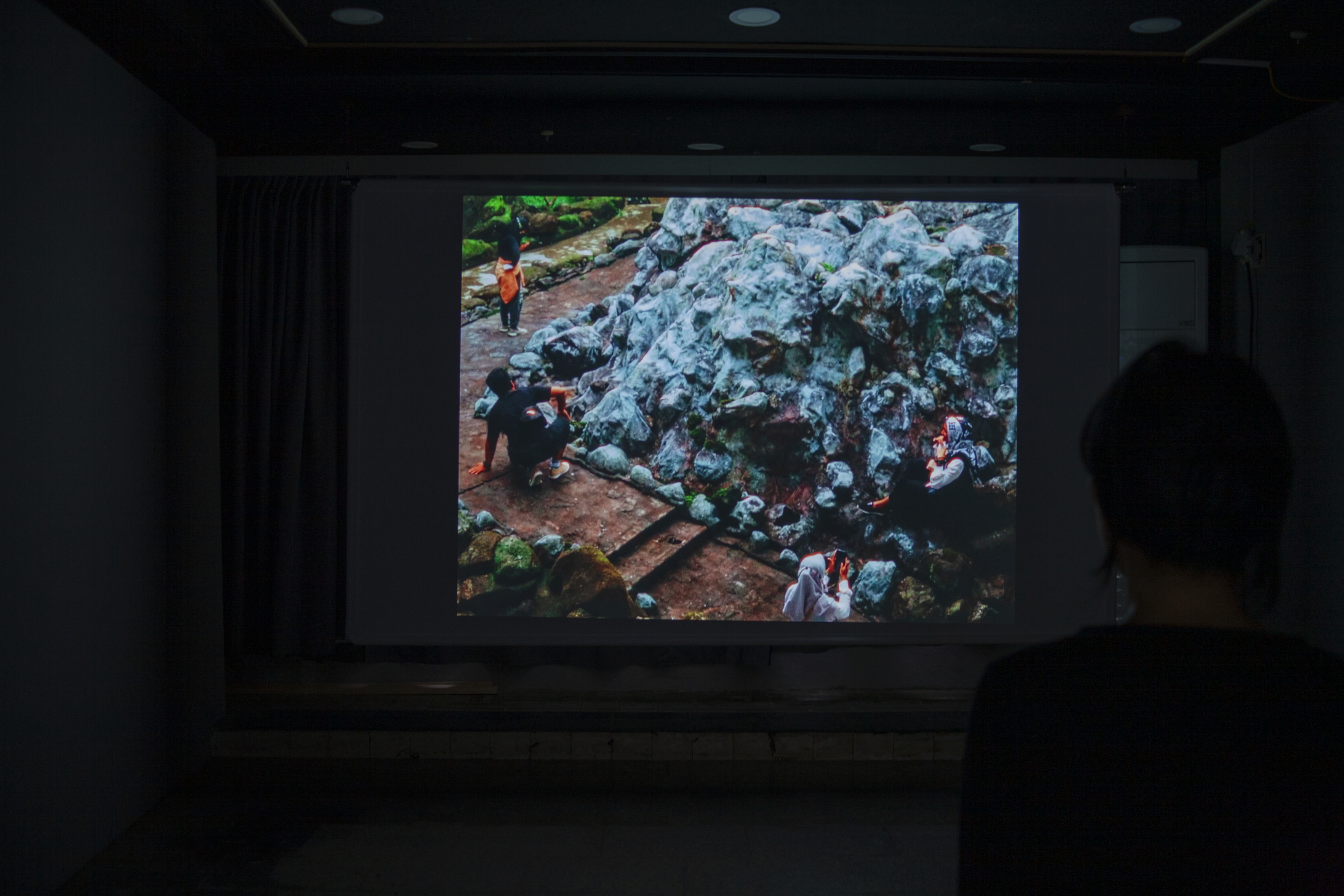
VOA: Pyroclates are Eloquent Storytellers, explores Merapi’s significance to the local population and serves as a prelude to your feature work, Monisme. How did this evolution from short to feature unfold? What aspects did you choose to expand, and how did the short film shape your approach?
RR: It took about eight years to work on Monisme. During that time, we collected hundreds of hours of footage as research archives and post-production material. When we began producing scenes that required dramatic elements, we faced many funding challenges – most of which involved hiring equipment and paying people properly. To help secure funding, I edited some of the footage I had accumulated over the previous six or seven years, creating a short segment of the larger project. Pyroclasts are Eloquent Storytellers functions like a research film or, in Pasolini’s genre, a “notebook film.” We showed it at various events, allowing people to see our progress on Monisme. Through Pyroclasts, I could also give film funders – who were supporting Monisme based on my installation works and earlier short films – a clear idea of what we were doing, which bolstered their confidence. In truth, Pyroclasts did not shape Monisme; rather, Pyroclasts is a result of Monisme.
VOA: Monisme explores the duality between science, technology, folklore, and mysticism in understanding natural phenomena. What cinematic techniques – through shooting, editing, or scriptwriting – did you use to reveal the interplay between landscape and human perception?
RR: I believe cinema itself is a medium that explores and challenges concepts of duality – fact and fiction, machine and human, and so on. Life on Merapi’s foothills naturally embodies the contrast between its serene landscape and the chaos it can unleash. This juxtaposition isn’t just visual – it mirrors the daily reality of living near the volcano, where life is shaped by constant uncertainty and unpredictability. In this context, regardless of which cinematic techniques are used, many dualities are exposed.
What interests me most is cinema’s capacity to capture subtle elements in nature as well as human emotions. For example, working with digital cinema allows me to film the volcano continuously without worrying about celluloid reel limits (instead, we worry about the soaring cost of hard drives). We film Merapi’s activity intensively, and between filming sessions, cinema can capture small eruptions that might otherwise pass unnoticed. Although these eruptions may be minor, they are crucial from a scientific viewpoint in predicting what may happen next. Hence, in the scientific tradition of volcanology, cinema has recently become important as an observational method, something we replicate in Monisme. Of course, editing, shooting, and scriptwriting are key processes. Interestingly, because the project is collaboratively undertaken across all stages – pre-production, production, and post-production – we constantly discover new layers in the relationship between those of us living around Merapi and nature’s subtleties. Cinema makes all this possible.
VOA: Your film explores prediction through both scientific and mystical lenses. How did you use cinematic techniques to portray this phenomenon and the human desire to control nature, despite its inherent unpredictability?
RR: In Monisme – and even more extensively in Pyroclasts – I explore the notion of prediction through the lens of science fiction, which often functions as a way to foresee the future. On a fundamental level, prediction is a survival strategy; humans seek reassurance that they will continue to exist. As I mentioned earlier, I see cinema as a medium that documents the tactics behind these predictions. In a scientific context, cinema also serves as an archive—a tool for observing recurring phenomena. At Merapi, for instance, volcanologists increasingly rely on visual recordings from cinematic apparatuses like cameras to predict eruptions. The more visual data available, the more precise these predictions aim to be – yet nature’s inherent unpredictability often challenges this approach. In a mystical context, however, prophecy emerges not from instruments but from lived experience – through continuous observation and direct encounters. This contrast between scientific and spiritual methods is central to Monisme. The film employs cinema both as a scientific tool for observing Merapi and as a platform for capturing embodied, lived experiences. As a result, this duality is not only reflected in the film’s final form but was also integral to its entire creative process.
VOA: Monisme explores how images of Merapi have been created, shared, and shaped collective imagination. How did you approach sourcing archival materials, and how did you weave them into a film already rich with diverse techniques?
RR: Monisme incorporates only a few archival materials, including photographs from the earliest Dutch colonial expedition to Merapi, images from the volcano’s massive 2010 eruption, CCTV footage from a resident’s yard during the 2012 eruption, and videos captured by locals in 2010. Additionally, we included footage of violence carried out by authorities and paramilitary forces in Merapi, displayed on an LED screen. I see these archival materials as equally significant as the images we created during the filmmaking process. Their presence serves as a reminder that Merapi is one of the most extensively documented natural phenomena – yet, despite this vast visual record, our understanding of it remains incomplete.
Written and interviewed by Sara Simić
Featured image courtesy of Dan Weill
View of the Arts is an online publication dedicated to films, music, and arts, with a strong focus on the Asian entertainment industry. With rich content already available to our readers, we aim to expand our reach and grow alongside our audience by delving deeper into emerging platforms such as K-pop and Asian music more broadly. At the same time, we remain committed to exploring the vibrant and ever-evolving global landscape of film, music, and the arts, celebrating the immense talent and creativity that define these industries worldwide.

 VIEW OF THE ARTS