
Much like the greyscale outlook of those with depressive disorders, sometimes cinema is so uninspired it seems like the entire industry has been lost to shareholders. But on one’s first watch of Florian Pochlatko’s How to Be Normal and the Oddness of the Other World, it’s like trying fudge after a lifetime of eating cardboard. It makes you feel something. Pochlatko utterly delivers one of the best takes on mental illness of all time, with a title so long it would be pretentious if belonging to any other feature: but certainly not this one. The film itself is, similarly, split into two directions, though blended seamlessly: Pia’s (Luisa-Céline Gaffron) restless battle for her sanity, and the untamed obscurity of her spiralling episodes.
We’re not given a substanceless hero tale of the pitiful melancholic that finds meaning again; How to Be Normal is a respectful and unembellished, yet striking portrayal of mental illness. Emphasis is not put on Pia’s specific disorders, though we do learn what some of these are and the handful of pills she throws back each morning as a result. Too many writers slap depression on a character and call it a day, satisfied at their noble effort to handle tough topics. Pochlatko’s remarkable debut feature painstakingly documents what is much more often the reality. Its point is crystal: mental health is not a list of checked boxes. It’s a fragile, contorting mass. Pia’s hushed narration resonates with all those who’ve felt entirely lost at some point: “I think I’ve fallen between the walls of the world.”
Such whispered words to her listener, whether that be an ex or us viewers, are pretty frequent in the film. It’s like she’s letting us in on a secret: something the “normies” wouldn’t understand. If you happen to fall into that–if we’re being honest–minority, the blurred lines of absurdism will be hard to decipher. Pia’s sheer exhaustion over her state and the recurring scenarios she finds herself in is exhibited in multiple forms, but the cleverest are the sequences in which her own mind takes over the scene. Exhibit A: She wears her signature Gouda cheese mask slumped in a chair; a therapist magics away her mental illness, and proceeds to dance to Haddaway’s What Is Love. Did we mention absurdism?
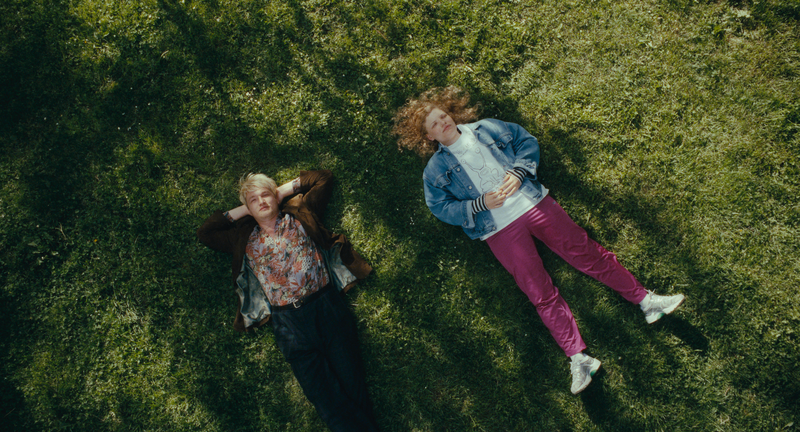
It appears to be shot on film: allowing vibrant colour to seep through and excessive grain to simulate the deterioration of the mind afflicted with mental illness. Slow, creeping shots and subtle rotations bring the viewer in on Pia’s downward spirals, and the ever-changing aspect ratio only reflects her instability. It’s not an A to B of events; narratives change, events come out of order and full circle, and there’s even a speedy flash-forward of the entire film in the first arc. It’s as if Pia is the ruler of her own unpredictable narrative.
Pia is charming, but she’s not perfect. She’s wonderfully peculiar. She sticks out like a sore thumb: she’s got untamed curls and a vivid stripey jumper, caged in a grey dystopia of copy machines. She’s easily irritable, and makes inappropriate jokes. The people around her reject her, to which she’s not entirely faultless. The gorgeous writing and Gaffron’s perfect performance seals the deal; anything else is a spoonful of delicacies atop a meal that was already satisfying enough.
In a quintessential sequence, Pia mocks her opponent, the world: “Be different, but like everyone else. Special, but the same. A unique shining star. A beautiful snowflake. In a world of boundless possibilities I have chosen to be sick.” Few films could ever be rewarded with a description of “It’s a perfect movie, just watch it.” But that’s what we’re giving it. Pochlatko is a director we will be keeping an eye on.
Rating:
Written by Maddie Armstrong
View of the Arts is an online publication dedicated to films, music, and arts, with a strong focus on the Asian entertainment industry. With rich content already available to our readers, we aim to expand our reach and grow alongside our audience by delving deeper into emerging platforms such as K-pop and Asian music more broadly. At the same time, we remain committed to exploring the vibrant and ever-evolving global landscape of film, music, and the arts, celebrating the immense talent and creativity that define these industries worldwide.

 VIEW OF THE ARTS