
Tetsuya Mariko’s Dear Stranger begins not with the disappearance of a child, but with the erosion of a marriage. Kenji (Hidetoshi Nishijima: Drive My Car, Serpent’s Path), a Japanese architecture professor in New York, and Jane (Gwei Lun-Mei: The Wild Goose Lake), a Taiwanese-American puppeteer who has put her art aside to raise their young son, move through daily routines already steeped in tension. Conversations are brief, silences drag on, and their love feels tired. When their little boy suddenly goes missing, the story avoids turning into a typical thriller. The disappearance is less a mystery to be solved than an x-ray of their lives – a way to expose the hidden fractures of a couple who have been slowly drifting apart. Mariko uses the search as a framework to explore displacement, the limits of language, as well as the fragile architecture of intimacy.
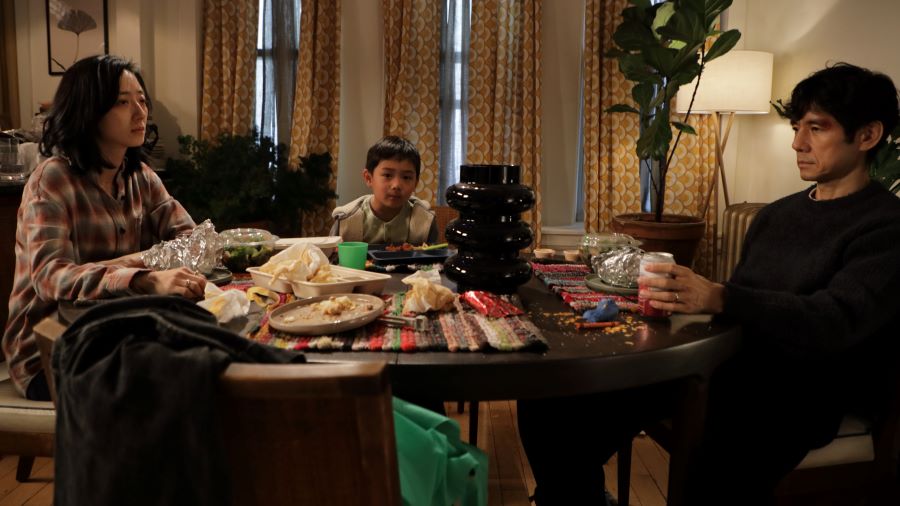
The story centers on two people whose lives have been shaped by migration and the ongoing challenge of finding their place. Kenji, absorbed in his research on ruined buildings and the myths of the Tower of Babel, approaches the world as a structure to be studied and contained. Jane, a performer by nature, feels stifled by domesticity and by the subtle exclusions of American life. Their exchanges slip between English, Japanese, and Mandarin, each language carrying its own tensions and unspoken grievances.
The performances support this delicate narrative very well. Hidetoshi Nishijima, still memorable from Drive My Car, portrays Kenji as a man who hides behind intellect and ritual. His English is careful, almost architectural – every sentence feels built brick by brick. Gwei Lun-Mei brings a restless physicality to Jane. Whether she’s silently preparing breakfast or slipping into the fluid movements of a puppet rehearsal, she reflects a hunger for self-expression that domestic life cannot satisfy. Together, they create a portrait of a marriage fraying in silence, their chemistry equal parts tenderness and pain. And then there’s Donny (Julian Wang), a character who, though not often on screen, plays an important role…

Veteran sound designer Tu Duu-chih (All Shall Be Well) captures New York’s acoustic life perfectly until the city itself becomes a kind of third character. Visually, cinematographers Yasuyuki Sasaki (Cloud, Strangers) and Rikuo Ueno (Drive My Car) create a nocturnal city of deep shadows and toned-down neon. Interiors are often half-lit, as though the walls themselves are withholding secrets.
Mariko, once known for the aggression of Destruction Babies, turns here towards what he calls “cold violence”: the harm done by silence, by emotional distance, by the slow wearing away of trust. His own years in the United States, in some ways, inspire every frame. The director avoids a straightforward immigrant story, keeping things uncertain and showing that belonging is not a destination but a constant negotiation, and love can both grow and fade.
By the final scene, Dear Stranger leaves us with questions rather than answers; nevertheless, in his slow-paced film, Mariko uncovers subtle beauty, showing that even in darkness, a delicate, enduring light remains.
Rating:
Written by Maggie Gogler
Featured image courtesy of Roji Films, TOEI Company, Ltd
View of the Arts is an online publication dedicated to films, music, and the arts, with a strong focus on the Asian entertainment industry. With rich content already available to our readers, we aim to expand our reach and grow alongside our audience by delving deeper into emerging platforms such as K-pop and Asian music more broadly. At the same time, we remain committed to exploring the vibrant and ever-evolving global landscape of film, music, and the arts, celebrating the immense talent and creativity that define these industries worldwide.

 VIEW OF THE ARTS