
Twenty years is a long time in pop music and it is surely an eternity in K-pop. When BIGBANG debuted in 2006, the industry they entered looked very different from the one that now fills stadiums thousands of miles away from Seoul. Social media had not yet become the engine through which Korean music travels internationally, streaming had not rewritten listening habits and the idea of a K-pop act taking over one of London’s largest stadiums would have sounded extraordinarily ambitious. BIGBANG grew up alongside those changes, but they also helped push some of them forward. Their involvement in writing and producing their own music, especially through G-Dragon, played an important role in how K-pop developed into what it is today, while also changing expectations around how much creative control K-pop artists could have over their own music.
There is always a danger when writing about a group with this much history that the anniversary itself becomes bigger than the concert, and suddenly everything is about legacy, influence, records and what happened ten or twenty years ago, rather than the artists who are actually standing on that stage now and what they can still do in front of an audience. But that was not what happened at Tottenham Hotspur Stadium.
BIGBANG’s London stop on their 2026–2027 WORLD TOUR XX COSMOS naturally came with twenty years of history behind it, but over nearly three hours, G-Dragon, Taeyang and Daesung gave the audience plenty of reasons to pay attention to who they are now rather than spend the entire night looking backwards. These songs may hold years of memories for the people who grew up with them, but the three were not treating them like something precious that had to be carefully preserved; the show was loud, physical, sometimes chaotic and incredibly entertaining, with a huge production designed to fill a stadium; and Tottenham was full.
Perhaps that says more about BIGBANG’s place in K-pop than another list of records or statistics ever could, because seeing thousands of lightsticks filling a stadium and hearing tens of thousands of people recognise a song within its first few seconds tells you immediately how much this music still means to the people who have been listening to it for years. The concert seemed to understand that too, and instead of spending the night constantly reminding everyone of the past, it let those songs and the audience’s reaction to them to speak for themselves.
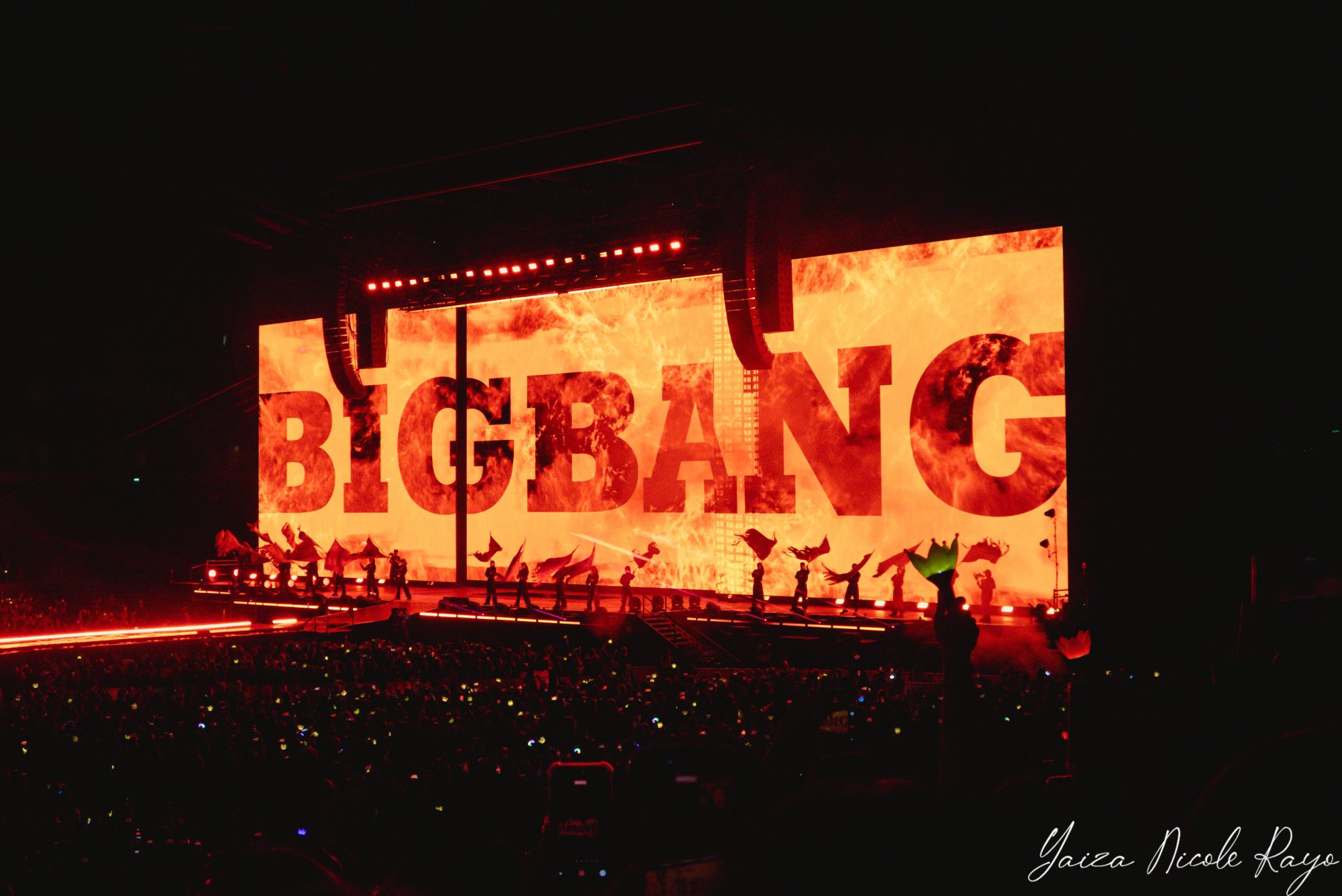
Opening with FANTASTIC BABY from their 5th mini-album Alive (2012) was almost ridiculously effective because there was no need to slowly ease the audience into the night when everyone inside the stadium already knew exactly what they had come for, and within seconds the whole place was on its feet. HANDS UP and TONIGHT were next, both sounding completely at home in a stadium packed with thousands of people singing and shouting along, despite being written long before BIGBANG were playing venues anywhere near this size.
For much of the night, almost everybody within sight was standing, and songs such as BLUE, LOSER and IF YOU showed why the BIGBANG catalogue works so well across a long stadium show. It is not simply a succession of maximalist hits. The emotional temperature can change dramatically without killing the momentum and after the initial explosion, those slower songs gave the concert a breather before BAD BOY, BAE BAE, Haru Haru and Lie brought the energy back up again.
Haru Haru and Lie are even more significant now, partly because so much time has passed since they were released and yet neither sounded like a song that belonged only to another era. Hearing tens of thousands of people singing along to music released in 2007 and 2008 was one of those moments when BIGBANG’s longevity did not need to be explained with numbers or records, because you could hear it all around you; some people in the stadium – as mentioned before – had grown up with these songs, others had found them much later, but for those few minutes none of that really mattered because everyone was singing them together.
The solo sections were important because one of BIGBANG’s strengths has always been how little G-Dragon, Taeyang and Daesung resemble one another as individual performers. Daesung’s section moved through Universe, WINGS, HANDO-CHOGUA and Look At Me, Gwisun, giving him room to move between vocal performance and the extroverted personality that has made his solo stages such an unforgettable part of BIGBANG concerts. Daesung seemed to be having an enormous amount of fun with the freedom of his solo section, singing with real power one moment and joking around with the audience the next, and the larger the crowd became, the more he seemed to enjoy finding ways to connect with it. And yes, we all loved the trot songs!
Taeyang brought a completely different energy with BAD, RINGA LINGA and LIVE FAST DIE SLOW, where his strong vocals were superb – obviously coming from years of performing and knowing exactly what works for him on stage. He is still an incredibly physical performer, but there is so much control in the way he moves that he never seems to be doing more simply because there are tens of thousands of people watching him.
But when G-Dragon got on stage, forget sitting down. With POWER, Crayon and CROOKED, he did not need complicated choreography or constant movement to keep tens of thousands of eyes on him, because sometimes all it took was the way he walked across the stage, stopped for a moment or looked out at the crowd. At one point, he simply sat down on one of the extended side stages, much closer to fans who had probably expected to spend most of the night watching him from across a huge stadium, and somehow even that small moment worked.
That use of the extended stages was one of the production’s smartest decisions. A stadium can make even famous performers look tiny, particularly to audiences seated along its sides and upper levels. BIGBANG used them throughout the evening, including during SOBER, constantly redistributing attention around the venue.
G-Dragon, Taeyang and Daesung made their way down towards the barricade several times, moving close to the fans gathered at the front and turning sections of an enormous stadium concert into something temporarily much messier. For everyone else, they were a reminder that BIGBANG have never been enthusiastic about spending an entire concert obediently standing where the production tells them to stand.
We also have to speak about the production itself, as none of that would have worked without the machinery surrounding them.
The XX : COSMOS production was designed on an enormous scale, with a huge mobile LED structure at its centre and a visual narrative moving through ideas of BIGBANG, chaos and cosmos. Dynamic graphics, planetary imagery and changing configurations gave the stage a sense of movement rather than leaving one giant screen sitting behind the artists for three hours. The technical team behind the tour has a massive task on their hands. The live band was led by Wow Jones, whose credits include work with Usher, Post Malone and Rihanna, while the wider creative team includes Mike Carson, director of the 2025 Super Bowl Halftime Show, and stage designer Es Devlin, whose work has included the London 2012 Olympic Closing Ceremony. The production also uses a 23-ton mobile LED structure designed to move and reposition itself during the performance.
The screens were large enough to serve people at the far end of the stadium, while lighting, lasers, video, dancers and the live musicians gave individual sections different identities. Most importantly, the production understood when spectacle needed to become genuinely excessive. Let’s not forget about the fire too.
Fire and fireworks are nothing unusual at a stadium concert, but with BIGBANG they simply made sense. During the louder and faster songs, flames shot across the stage and you could actually feel the heat if you were close enough, while from further back the fire made an already huge production look even bigger. It is very important to mention that underneath all of this was the live band.
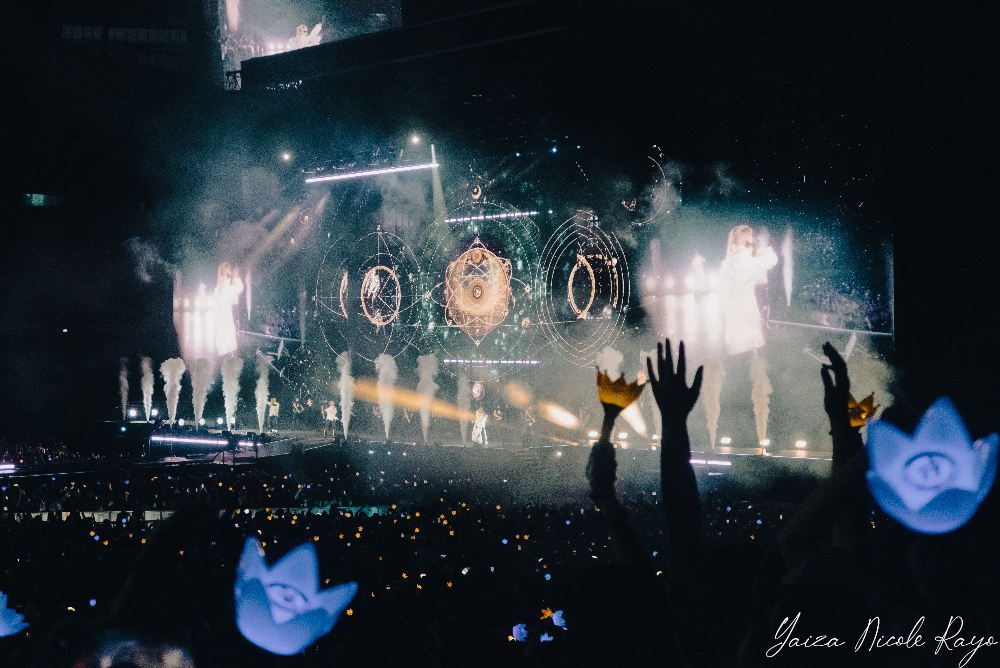
BIGBANG’s songs have always possessed strong rhythmic foundations, but live instrumentation gives them additional muscle. Electronic tracks become rougher around the edges, bass hits harder and songs that everybody has heard hundreds of times suddenly have space for musicians and performers to push and pull against one another. That is vital with material such as BANG BANG BANG, where simply reproducing the recording would be the least interesting option available.
By the time the three returned to group material with BANG BANG BANG, STUPID LIAR, SOBER and WE LIKE 2 PARTY, the concert had stopped feeling like a sequence of separate sections and become something considerably looser.
Anniversary concerts often depend heavily on past material, but BIGBANG had one important piece of new material to place among the history. BiiiG, released on their twentieth anniversary, performed before HOME SWEET HOME, and its significance went beyond adding another song. It represented the present tense of a group spending an evening surrounded by its past.
HOME SWEET HOME, with Taeyang and Daesung joining G-Dragon, brought the past and present together in a way that was especially right for a twentieth-anniversary show. Then, after twenty-six songs, came an encore that could practically have been another concert. Nearly half an hour was given over to My Heaven, Sunset Glow, LAST FAREWELL, FLOWER ROAD and STILL LIFE. This was where the anniversary finally became impossible to separate from the music.
LAST FAREWELL reaches all the way back to 2007, while My Heaven and Sunset Glow come from another early period in the group’s career. FLOWER ROAD followed in 2018 and STILL LIFE in 2022, each bringing the audience back to a very different moment in BIGBANG’s story. Hearing all of them together at the end of a twentieth-anniversary stadium show was like moving through years of their music in the space of thirty minutes.
Taeyang told London that it was the best crowd of the tour so far, and whether future cities attempt to steal that title is their problem; Tottenham certainly made a convincing amount of noise.
Watching the show from another part of the stadium, we came away thinking about something slightly different: how much of the performance still depended on the three men themselves. There were backing vocals, as you would expect from a production of this size, but we could clearly hear G-Dragon, Taeyang and Daesung singing over them, and because their voices are so different from one another, having only three members on stage did not leave the songs feeling empty in the way it perhaps could have. Daesung brought the vocal power, Taeyang had that smoother control while still dancing and moving constantly and G-Dragon remained himself, with a voice, rap delivery and way of carrying himself that can pull attention towards him without needing to fill every second with choreography.
What impressed us as well was the fact that the three still worked together so naturally, because at no point did it feel like watching three successful solo artists who had simply agreed to share a stage for the night. There were jokes, little reactions between them and moments that probably meant very little on paper but said quite a lot when you watched them together, especially after so many years of performing alongside one another. Their personalities are completely different, and perhaps that is precisely why it still works.
Twenty years after their debut, BIGBANG no longer need to prove that they were important to K-pop. That history exists regardless of what happens on a particular Saturday night in London. A stadium concert asks a more immediate question: are you still worth watching now? At Tottenham Hotspur Stadium, the answer was written less in the scale of the screens or the quantity of fire than in what happened whenever G-Dragon, Taeyang and Daesung stepped beyond all of it. They walked onto the side stages, sat near fans, came down towards the barricades and repeatedly turned an engineered stadium production into something that was mind-blowing.
Behind them were twenty years of songs and around them were tens of thousands of people who knew those songs, but in front of them was still somewhere to go.
Rating:
Written by Maggie Gogler and Nicole Rayo
Featured image © 2026 YG Entertainment (BIGBANG in Paris during their world tour)
View of the Arts is an online publication dedicated to film, music, and the arts, with a strong focus on the Asian entertainment industry. As we continue to grow, we aim to deepen our coverage of Asian music while remaining committed to exploring and celebrating creativity across the global arts landscape.


