
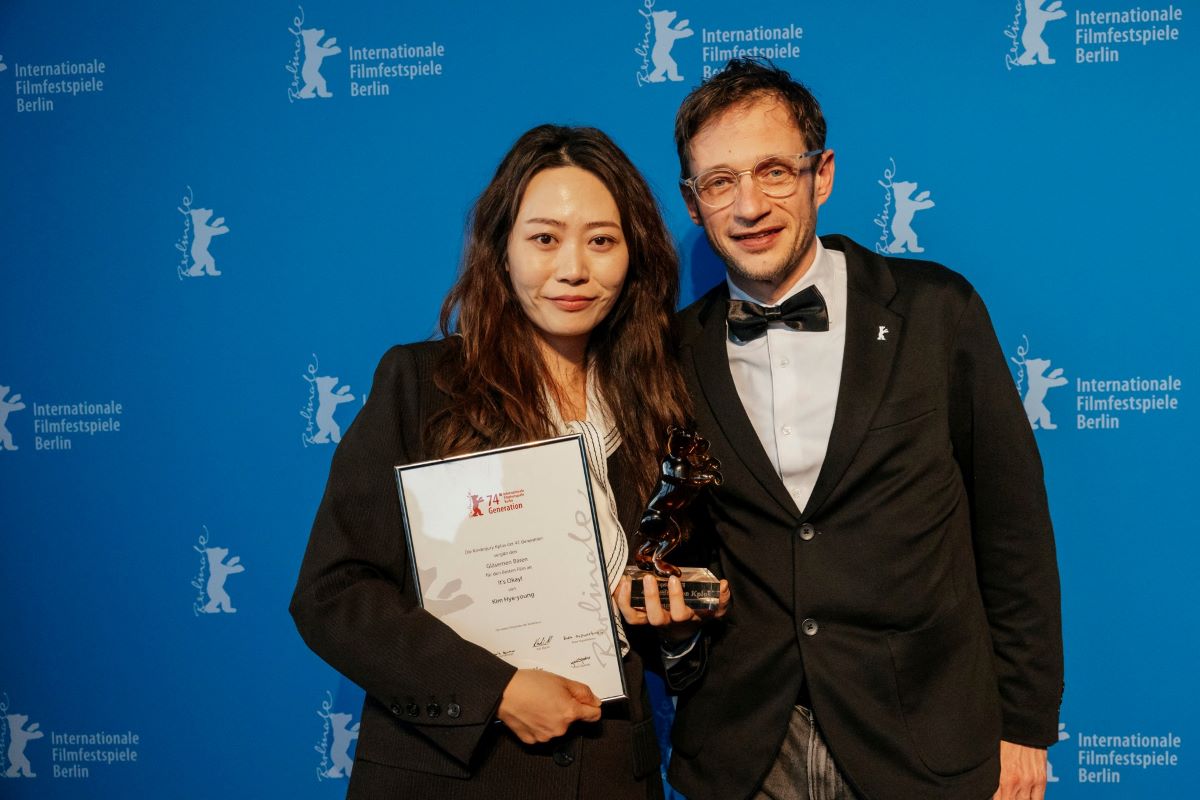
With the 19th London Korean Film Festival on the horizon, audiences will be able to experience many wonderful films, and one of those films is It’s Okay! (Also known as It’s Okay It’s Okay It’s Okay! – 괜찮아 괜찮아 괜찮아!), a tender coming-of-age story that presents Kim Hye-young’s impressive directorial debut. First premiering internationally on February 18, 2023, in the Generation Kplus section at the 74th Berlin International Film Festival, It’s Okay! received the Crystal Bear for Best Feature Film by the Children’s Jury in the Generation Kplus category – a reflection of its compelling storytelling and emotional depth.
In this heartfelt film, Kim depicts the themes of survival and self-discovery through the journey of In-young, a young girl who retreats to her art school’s basement in the wake of her mother’s death. There, she encounters Seol-ah, a strict art director with her own guarded emotions, and together, they go on an unexpected path toward mutual understanding.
Kim Hye-young’s creative process – guided by harmony and a nuanced approach to visuals – breathes life into the film, skillfully conveying the characters’ emotional depth and personal evolution. Ahead of the UK premiere, we engaged in an insightful Q&A with Kim to discuss her inspirations, artistic intentions, and the beautiful dynamic between her two central characters. Our conversation not only reveals the artistry behind It’s Okay! but also the significance of embracing life’s vulnerabilities and the quiet strength found in unity.
View of the Arts: As a first-time director, how did you approach shaping the overall tone and vision of It’s Okay!? Were there any significant influences or experiences that guided your directorial choices throughout the film’s production?
Kim Hye-young: It’s Okay! is a coming-of-age drama. The film portrays solidarity, influence, and comfort between people. The most important elements for me were the transformation through growth and harmony. I hoped that all visual elements, such as the ensemble of actors, space, costumes, colours, lighting, and choreography, would come together harmoniously. I believe “harmony” is the most crucial factor in delivering this story. Though living harmoniously is challenging, it provides comfort. At one point, I pondered questions like, “Why do conflicts and hatred arise?” and “Is it because everyone is so different?” I concluded that everyone is different and fiercely living their lives from their perspectives. As a result, greed and jealousy can arise, and situations may emerge where people’s hearts do not connect. However, I believe that when we acknowledge our differences, unite, and harmonize, we find comfort. I wanted to depict the characters’ processes of change. For example, Seola’s cold, barren, and colorless home gradually warms up as In-young’s belongings increase, and sunlight fills the space. All of this was possible through the cooperation of the actors and staff, as we exchanged opinions and worked together to complete it. I realised how essential collaboration with the actors and staff is and received much help as a debut feature film director. It’s Okay! is the result of the efforts of the actors and staff involved. Furthermore, I believe the circumstances and people around me positively influence me. For instance, the pharmacist character in the film was inspired by a pharmacy I frequently [go to].
VOA: The relationship between In-young and Seol-ah evolves beautifully throughout the film. How did you approach developing the dynamic between these two characters?
Kim Hye-young: In-young and Seol-ah have very different appearances and personalities. In-young is someone who smiles easily, while Seol-ah struggles to smile. However, they share the similarity of not being able to express their feelings honestly. Despite their age difference, they both want the same thing: to be good at dancing and, in the end, to be happy. As they unexpectedly begin living together, I wanted to portray how their lives start to influence each other, slowly bringing them closer. I focused on the subtle emotions that arise from their increasing concern for each other and the small, almost imperceptible ways they begin to care. I aimed to express how they gradually become important to one another, without them even realising it.
VOA: Casting the right actors is crucial to bringing these characters to life. Could you share your process for casting Lee Re as In-young and Jin Seo-yeon as Seol-ah? What specific qualities in their performances made them the best fit for these roles?
Kim Hye-young: I thought Ire’s bright and positive image would suit In-young well. Since the actor needed to express In-young’s emotions effectively, I believed Lee Re was one of the most talented young actors, with rich emotional expression. When we met for casting, I felt convinced by the positive energy she radiated. She also had this captivating aura, making you want to listen to what she said, with a smile that seemed ready to burst into tears at any moment. As for Jin Seo-yeon, while she has a strong image, I believe she is a warm person. I focused on how Seol-ah’s character would need to show changes – from being cold and emotionless to gradually finding her smile and softening with In-young’s influence. Jin Seo-yeon’s ability to express subtle emotions, even in her stillness, made her a perfect fit. I also wanted to highlight her warm and charming side, which is especially visible in her beautiful smile.
VOA: The film addresses, in a subtle way, themes of loss, grief, and survival. How did you want these emotions to manifest visually in the film, and how did you collaborate with your cinematographer to capture the characters’ inner world through visual storytelling?
Kim Hye-young: Each character has their own sense of lack. What they share is loneliness. Yet, none of them say out loud that they are lonely; they live pretending to be fine. When they are alone in their spaces, I wanted their true feelings to be revealed. I sought to capture moments of solitude, like sitting or walking alone, to express this. Even though it may be an ordinary day, and everyone seems fine, there’s a sense that only I am alone and feeling desolate inside. I aimed to show these characters within wide frames that emphasize the space around them, highlighting their loneliness without letting that emotion dominate the film. The characters experience loss and sadness, but they must survive. I wanted to prioritise the present and the future over the past. I used camera movements that matched the characters’ emotions, not just for sadness and survival but also for brighter, cuter moments. I thought the perspective should be from Inyoung’s point of view – an innocent child’s gaze – and collaborated closely with the cinematographer, discussing both technical aspects and how to express the film’s emotions and message.
VOA: In-young’s character, despite her grief, shows remarkable strength. How did you direct Lee Re to balance the vulnerability and resilience required for this role, particularly in her more emotionally complex scenes?
Kim Hye-young: In reality, In-young is not just strong but trying her best to be okay. That’s why she smiles. I asked Lee Re to smile often because I believe smiles contain both vulnerability and resilience. I sometimes requested a direct expression of emotions, focusing on making the expressions intuitive. Instead of having her act with a specific emotion in mind, I asked her to be honest with the situation and dialogue at that moment. Especially in more emotionally complex scenes, I thought that honesty was the truest expression. Lee Re did an excellent job embodying In-young’s gaze, speech, and even the smallest details like her footsteps.
VOA: The film culminates in the company’s 60th-anniversary performance. How did you want the choreography and dance sequences to reflect the internal struggles of the characters, and what was your collaboration like with the choreographers to achieve this?
Kim Hye-young: The practice scenes of the art troupe are preparations for the 60th-anniversary performance, where the choreography is shown in its completed form. In the practice sequences, mistakes happen, and the synchronization of the group dance isn’t perfect. However, as a result of their hard work, they eventually delivered a beautiful performance.
The characters initially struggle to accept each other’s differences, and sometimes they clash. But as they get to know and grow closer to one another, they learn to understand and accept each other. That’s when they finally start to smile. I thought that the characters’ evolving relationships were similar to the process of learning choreography and dance. Though it’s unfamiliar and difficult, if you persevere through that period, you reach joy and beauty. I wanted to express the characters’ evolving relationships through the way their choreography and dancing take shape over time. In the final group dance sequence, where they perform wearing one-piece dresses, the choreography was designed to express freedom and joy through movement. We collaborated with the choreographer and the members of the art troupe to create and complete the choreography. We also received significant guidance for the traditional Korean drum dance from the Little Angels Art Troupe. I am deeply grateful to everyone who worked together with me on this project.
VOA: As a debut director, working closely with the editor is crucial for shaping the rhythm and tone of the film. Could you share your experience collaborating with your editor, Lee Gang-hee, and how you approached the pacing of It’s Okay!, particularly in balancing the personal and professional lives of the characters?
Kim Hye-young: Although the film’s content could have easily turned dark, I wanted to maintain a bright and witty tone with a relatively quick rhythm. In my initial discussions with the editor, we focused on constructing the overall framework of the film. Later, we had in-depth conversations about emphasising the theme of “loss and deficiency.” Additionally, for the scenes depicting the innocence and cuteness characteristic of children, I aimed to present the film from a child’s perspective rather than that of an adult.
My main focus was on the concept of “perspective,” and this became a central theme in my conversations with the editor. Regarding rhythm and tone, we worked to maintain harmony between the characters’ situations and emotions, adjusting the pacing to suit these elements without disrupting the overall flow. Sometimes, we chose to speed up the rhythm, while at other times, we slowed it down. We approached each character by considering their traits and adjusting the pacing to reflect the emotional and situational changes. The characters’ personal and professional lives are not easily distinguishable in this film; they blend as the demands of their professional struggles affect their personal lives. This creates a sense of urgency, where even their desires for happiness are suppressed by professional pressure. To express this contrast, we used faster rhythms when they were grappling with these pressures, and slower rhythms when their emotions leaned towards fatigue and frustration. In moments of joy, both their personal and professional lives aligned, and we expressed this harmony through faster pacing. Ultimately, we focused on reflecting the characters’ emotions through the rhythm and pacing.
VOA: The film is filled with subtle moments that explore the emotional depth of the characters. How did you guide your actors in portraying these quiet but powerful scenes, especially when much of the story’s tension is conveyed non-verbally?
Kim Hye-young: I focused on the emotions present in each scene, paying particular attention to facial expressions and the gaze of the characters. I believe the gaze holds immense power within a scene. I directed the actors to concentrate on these aspects. The rest of the work involved collaborating with the crew on how to effectively convey this visually.
VOA: The relationship between In-young and Seol-ah gradually transforms from mentor-student to something deeper and more mutual. How did you structure their interactions to show the slow unraveling of their vulnerabilities and the eventual bond they formed?
Kim Hye-young: Both characters witness each other’s loneliness and empty spaces. In-young, despite her young age, knows how to do many things, whereas Seol-ah, as an adult, doesn’t know how to do certain things but becomes a solid support for In-young. Through their time together, they fill each other’s gaps. In a way, Inyoung acts like an adult, scolding Seol-ah in ways an adult might. They become a new form of family, living together in unity. Initially, they feel uncomfortable with each other and notice each other more out of irritation. But as they grow closer, they start to care for and understand one another. The curiosity stemming from their differences eventually turns into intimacy. I wanted to show how small and seemingly insignificant daily interactions gradually brought them closer. Both adults and children can make mistakes and need to grow, so I didn’t want to emphasise the difference between them too much. Instead, I wanted to portray them as equals.
VOA: The pressure Seol-ah feels as a head choreographer plays a significant role in her character arc. How did you shape this character’s struggle with perfectionism and its impact on her interactions with In-young and the other dancers?
Kim Hye-young: This story began with the idea that there isn’t much difference between children and adults. Both children and adults have their own deficiencies, and both can feel loneliness. Seo-lah, who feels immense pressure as the lead choreographer, has lived with this pressure since she was young. Now, this pressure has shaped her into who she is. Similarly, the art troupe members preparing for the performance also feel a certain level of pressure, but Seol-ah’s perfectionism amplifies it. This pressure ends up making everyone more tense and sharp. They want to enjoy what they love doing, but they end up finding it difficult. That sharpness leads to jealousy and dislike. Their initial good intentions – to do well – turn into negative emotions. They work hard to do their best, but they end up disliking others for it. Conflicts arise, but they also serve as stepping stones toward reconciliation. I saw all these emotions as interconnected, like a sequence of dominoes.
VOA: After being screened at Berlinale, It’s Okay! is now set to be shown at the London Korean Film Festival in November. How do you feel about the film reaching these international audiences, and what do you hope viewers at LKFF will take away from it?
Kim Hye-young: I am incredibly happy that this film will be shown to international audiences. It’s an honour to have Korean cinema screened in London, and I am deeply grateful for this opportunity.
Written and interviewed by Maggie Gogler
Featured courtesy of LKFF
The 19th edition of the London Korean Film Festival (LKFF) is organised by the Korean Cultural Centre UK (KCCUK) and supported by the Korean Film Council as part of the ‘Connect Korea Campaign’, which promotes Korean arts and culture across the UK.
View of the Arts is an online publication that chiefly deals with films, music, and art, with an emphasis on the Asian entertainment industry. We are hoping our audience will grow with us as we begin to explore new platforms such as K-pop / K-music, and Asian music in general, and continue to dive into the talented and ever-growing scene of film, music, and arts, worldwide.

 VIEW OF THE ARTS