
It’s Okay!, the directorial debut of Kim Hye-young, is a coming-of-age film centered around the trials and tribulations of In-young (Lee Re), who in a cruel twist of fate loses her mother and sole caretaker during a triumphant performance of a traditional fan dance by the Seoul International Arts Company. As the beat of the drums reaches a crescendo, cross-cutting captures the moment of the mother’s death, the music creating continuity between two disparate spaces, creating a binary opposition between life and death and joy and tragedy. This pivotal moment of happiness tempered by sadness forms the organising structure for the ensuing narrative of female friendship and rivalry which ends in female solidarity across the generations.
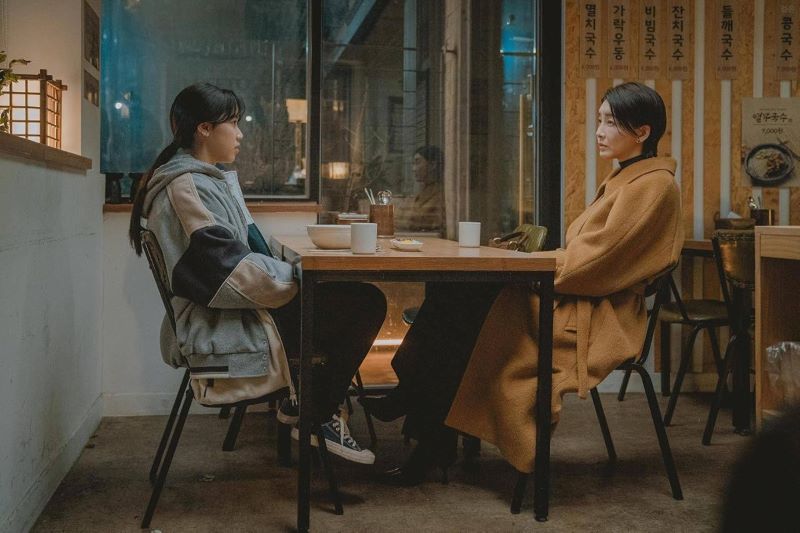
In-young finds unexpected refuge from the bitter rivalries at the dance company and the unwelcome attention of social services in the luxurious flat of Seol-ah (Jin Seo-yeon) the newly appointed artistic director of the Seoul International Arts Company who takes pity on the motherless teenager, recognising an affinity with the orphan. Men have little place in this feminist fable, except for pharmacist Dong-wook (Son Suk-ku), and her school (boy) friend, Do-yoon (Lee Jung-ha), who adopt paternal roles to the motherless and friendless In-young. Both provide In-young with comfort and empathy after her mother’s untimely demise, with Dong-wook becoming the father that she never had. However, despite attempts by In-young to formalise his role in the reconfiguration of the oedipal family with Seol-ah as the substitute mother, the film concludes emphasising the dyadic bond between mother and daughter. In many ways, the lonely pharmacist and the would-be lover are surplus to requirements, they end up becoming bit players in this tale of female coming of age which is constructed around the maternal rather than the paternal sphere.
According to film academic and critic Jinhee Choi’s concept of sonyeo sensibility, It’s Okay! is concerned with bonds between girls, wherein bitter rivalry to be the best causes conflict showing how quickly friendships can be shattered, while commenting on the prevalence of bullying in South Korean schools which is meted out by both the other girls at the dance company and its rigid creative director, Seol-ah with her exacting rules and regulations. Seol-ah’s own childhood and school trauma finds form with that of In-young, the tendrils of the past reaching into that of the present. Seol-ah’s apartment is beautiful but sterile, the fridge empty of all but green nutrition shakes/meal replacements. In the end, In-young’s youthful exuberance transforms the life of the emotionally crippled Seol-ah, whose obsession with perfection is reflected both in her work and personal life. Just as the rivalry between the girls for centre at the end-of-year showcase dissipates once the dancers stop competing against each other, Seol-ah finds herself able to embrace the vagaries and uncertainty of life and accept the presence of joy through relationships with others, becoming In-young’s ‘mother’. Her white antiseptic flat which is only broken by the earthy green of the nutrition drinks she lives on becomes cluttered and homely, with the fridge and cupboards full of nourishment which does not come ready to be shaken.

The everydayness of In-young’s life, work, school, and dance, is counterbalanced by fantasy sequences whose spectacular and often grotesque content, which weave a rich gothic tapestry marked by pain and trauma, points to the co-existence of happiness and sadness which as suggested earlier in this review is a structuring feature of the film. In these scenes, the director makes intertextual reference to other stories of female subjectivity including Hans Christian Anderson’s The Red Shoes (the dancer, Karen, who cannot stop dancing until her feet are cut off and even then, continues to do so with her new wooden feet) and Charles Dickens’s Great Expectations (the spinster who lives alone, waiting for a wedding that will never happen, consumed by memories of the past). By doing so, the film provides commentary on the rigid boundaries of patriarchal ideology and the heteronormative prescriptive with In-young as an iteration of Karen, and Seol-ah, Miss Havisham. By the film’s conclusion, both women have thrown off the shackles of appropriate femininity which dictate that women’s identity is only valid in relational terms to that of men’s. Joy has replaced sadness and warmth sterility, as shown in the final scene in which the dyadic bond between mother and daughter is foregrounded.
It’s Okay! is a vibrant celebration of the persistence of memory and the significance of connections with others. The cinematography is exceptional, painting a rich canvas of female solidarity through bodily performance and haptic identity. The camera lens sculpts time and space to provide a commentary on female subjugation, through the juxtaposition between the everyday (school, work, home) and the spectacular (the fantasy and dance sequences) as well as a mechanism of overcoming societal oppression as marked on and through the female body. The cast is outstanding, Lee Re, who played the traumatised child in Hope (Lee Joon-ik, 2013), demonstrates her ability to emotionally connect with a role and by doing so, provide emotional resonance for the viewer. Jin Seo-yeon, as the uptight and repressed Seol-ah, is also excellent in her nuanced depiction of a professional woman whose life is barren and sterile, until her encounter with the traumatised but vivacious teenager, In-young.
Rating:
Written by Dr Colette Balmain
Featured image courtesy of Berlinale
Tickets can be purchased here.
The 19th edition of the London Korean Film Festival (LKFF) is organised by the Korean Cultural Centre UK (KCCUK) and supported by the Korean Film Council as part of the ‘Connect Korea Campaign’, which promotes Korean arts and culture across the UK.
View of the Arts is an online publication that chiefly deals with films, music, and art, with an emphasis on the Asian entertainment industry. We are hoping our audience will grow with us as we begin to explore new platforms such as K-pop / K-music, and Asian music in general, and continue to dive into the talented and ever-growing scene of film, music, and arts, worldwide.

 VIEW OF THE ARTS