
Hyper Japan is always full of surprises, but THE SIXTH LIE never needed one. The Japanese rock band walked on stage, played the first song and straight away had the audience with them. Whether fans knew every lyric or had only discovered them through anime, everyone seemed equally caught up in the performance.
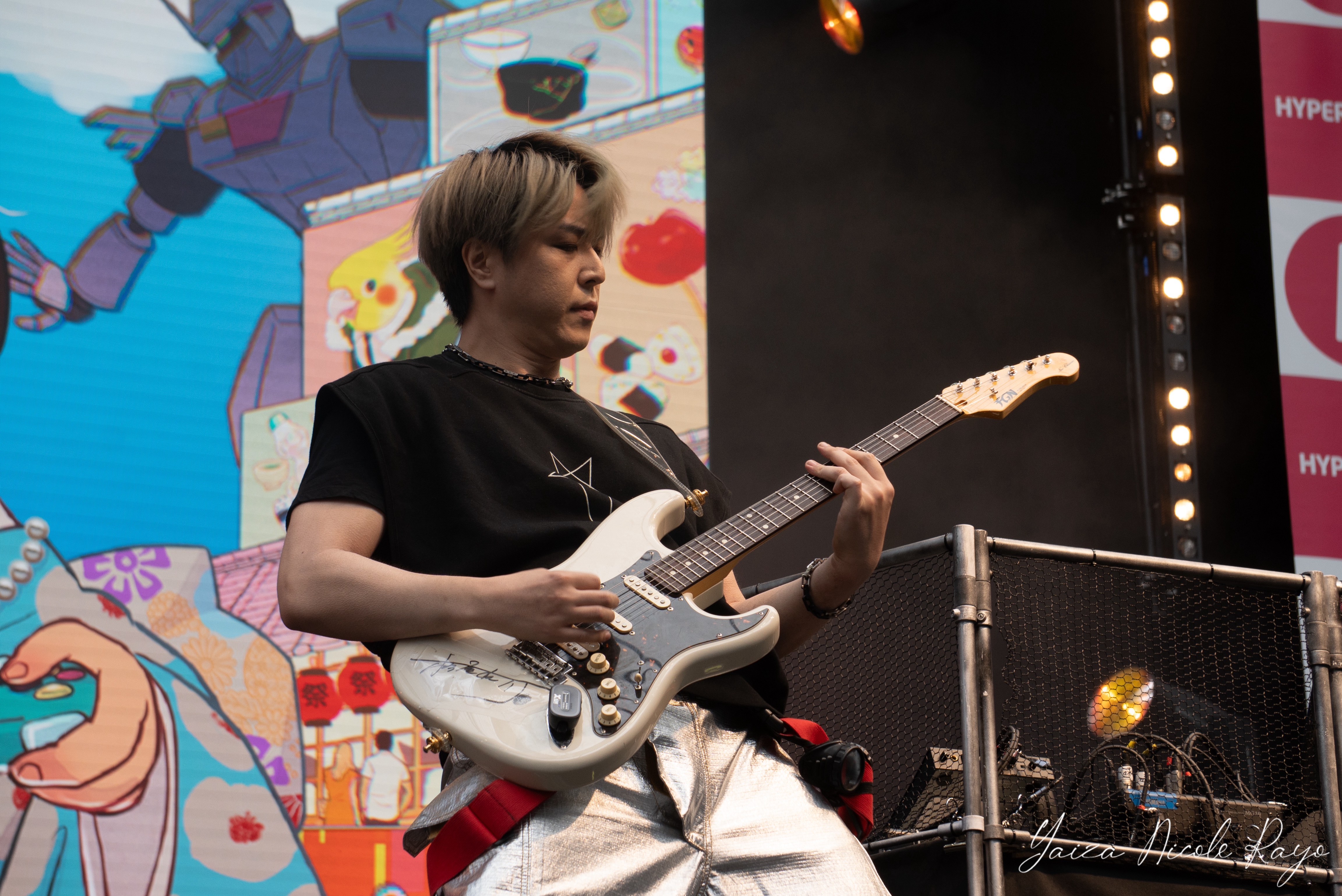
While the performance was short, the band delivered exactly what I expected them to deliver: a great rock show. Although drummer Ray was absent from the London performance, vocalist Arata and guitarist Reiji never allowed the energy to drop. If anything, the stripped-back line-up showed just how much chemistry exists between the two musicians, with Arata’s superb live vocals and Reiji’s great guitar work.
It seemed like many in the audience already knew them through anime themes for series including Golden Kamuy and A Certain Scientific Railgun T. Others had discovered them through streaming services or previous European tours. Regardless of how they arrived, everyone seemed to understand that THE SIXTH LIE occupy a very different corner of Japanese rock.
Since forming in Tokyo in 2015, the trio has mostly stuck to the music they like. Their sound combines alternative rock, electronic music and cinematic soundscapes. Science fiction, futuristic cities and emotional storytelling have become recurring themes throughout their catalogue, creating a sound that is equally suited to concert halls, anime and, perhaps one day, video games.
Shortly after leaving the stage at Hyper Japan, we sat down backstage, with two other journalists and Arata and Reiji. Relaxed despite the exhaustion of several consecutive European shows, the pair reflected on London’s audiences, songwriting, anime, British music and the journey that has taken them from Tokyo rehearsal rooms to international stages.
For Arata, returning to London also meant revisiting familiar memories. Near the band’s hotel, he discovered something that immediately caught his attention.
“Near our hotel, there was a residence for Chelsea Football Club players,” he smiled. “I really enjoyed visiting it.”
There was another place, however, that he hoped to see again before leaving.
“I visited Big Ben about eight years ago, and I’d love to go back and walk around the area again to see how much it has changed.”
Reiji had a different perspective. Having travelled through France and Germany before arriving in Britain, London immediately reminded him of somewhere much closer to home.
“Compared to the cities we visited there, London feels much more like Tokyo,” he explained. “It’s a large, convenient city, and being here has made us feel more at home and much more settled.”
Their affection for London only grew after stepping onto the Hyper Japan stage. Asked how the performance had gone, Arata laughed before admitting the obvious.
“It was a lot of fun, but it was also incredibly exhausting.”
Touring across Europe had clearly taken its toll.
“Our costumes were especially hot this time, and after performing in France, Germany and now the UK, the fatigue has really caught up with us. Right now, all I want to do is go home and relax in a nice hot bath.”
Reiji’s answer revealed something different. Rather than speaking about ticket sales or crowd size, he focused on the people standing in front of the stage.
“I think a lot of the people who come to see us aren’t just fans of anime or video games,” he said. “They’re genuinely interested in Japanese culture and really love music.”
That distinction matters because of that audience, he explained; the band never felt like they were performing as an “anime band.”
“It felt like we were able to perform as a rock band first and foremost, rather than simply as a rock band that happens to play anime-related music.”
Having toured internationally for several years, one of the journalists asked whether overseas audiences feel different from crowds back home in Japan. For Arata, language has surprisingly become one of the least important aspects of performing abroad.
“I think the biggest difference is the language barrier,” he admitted. “But in the end it doesn’t seem to matter.”
Music, he believes, communicates on its own.
“People genuinely connect with our music regardless of the language. You can feel it in the way they move along to the songs, sing with us and express their enthusiasm. That kind of reaction has its own unique energy. It’s different from what we experience with audiences in Japan, and it’s something we really appreciate.”
Reiji smiled as he remembered another difference.
“For me, one of the biggest differences is that overseas fans tend to make themselves heard during the quieter moments of a performance.”
Not during the loudest choruses, not during the biggest breakdowns or during the silence.
“For example, during instrumental sections they’ll call out to us or cheer loudly. I always find that really interesting because they’re so expressive, even when the music becomes quieter.”
Watching Hyper Japan, it was difficult to argue with him.
Every instrumental passage was met with cheers and every guitar solo drew applause. Japanese music has enjoyed remarkable growth overseas over the past decade, with artists regularly selling out venues across Europe and North America. When our colleague asked why Japanese music continues to resonate with international audiences, Arata paused before answering.
“That’s a difficult question,” he laughed. “I’m probably not the best person to explain the technical side of music.”
After a moment of reflection, he offered a surprisingly thoughtful answer.
“I think one reason is that, for better or worse, Japanese music has stayed true to itself.”
Unlike some parts of the Asian music industry that have increasingly embraced global trends, Japanese artists have largely preserved their own musical identity.
“It still has characteristics like faster tempos and classic chord progressions. Because it hasn’t changed too much, I think there’s something about that familiar style that continues to resonate with people around the world,” Arata said.
For many international listeners, THE SIXTH LIE are the band behind some of anime’s most well-known theme songs. It’s an association they’re proud of, but one they never allow to describe them.
When View of the Arts asked how they balance their own musical identity with creating songs for anime, Reiji explained that they never approach a soundtrack with a fixed formula. Instead, every project starts with a single question: What does this story need?
“We’re actually a bit different in the way we approach anime songs,” he explained. “We tend to treat each anime soundtrack as its own separate project.”
When writing music for Golden Kamuy, the band quickly realised their signature electronic sound didn’t belong in the series’ world.
“For example, when we wrote for Golden Kamuy, we felt that electronic sounds wouldn’t suit the series’ world, with its Ainu culture and historical setting. So for that song, we deliberately avoided using electronic elements and focused on creating a pure rock track.”
One of the things I admire most about THE SIXTH LIE is their willingness to put the story first. Rather than forcing their own sound into every project, they create the music that best serves the world they’re writing for.
“It’s not really about wanting to include electronic sounds or not,” Reiji continued. “What matters most to us is the overall sound quality and what best serves the work.”
He pointed to Yusetsu, written for Golden Kamuy Season 3, as another example of that approach.
“We placed a strong emphasis on orchestral arrangements and how they blended with the band. We always prioritise creating the sound that best matches the atmosphere and world of the story.”
It’s a surprisingly selfless way of writing; instead of asking how an anime can fit THE SIXTH LIE, they ask how THE SIXTH LIE can fit the anime. That attention to detail also explains why their songs never sound interchangeable. Whether they’re writing a heavy rock song or something more cinematic, every decision begins with the same principle: serve the story first.
When asked about his songwriting process, Reiji revealed that lyrics are never the starting point.
“The music always comes first. Sometimes an idea comes first as well, but for me, I usually start by creating the track before anything else.”
But when I asked whether he meant the melody or simply a rough musical idea, he smiled.
“The whole composition. I usually build the instrumental track first, and then I write and add the melody afterwards.”
For Reiji, however, finishing a song on a computer is only part of the creative process and the real test comes when it leaves the studio.
“I always try to imagine how the song will feel when it’s performed live—how we’ll play it on stage and how the audience will respond. Of course, the song must sound good when people listen to it on streaming services, but what matters even more to me is hearing it live in a venue and seeing how it makes the audience feel. I pay close attention to their emotions, how they react, and how excited they get during the performance.”
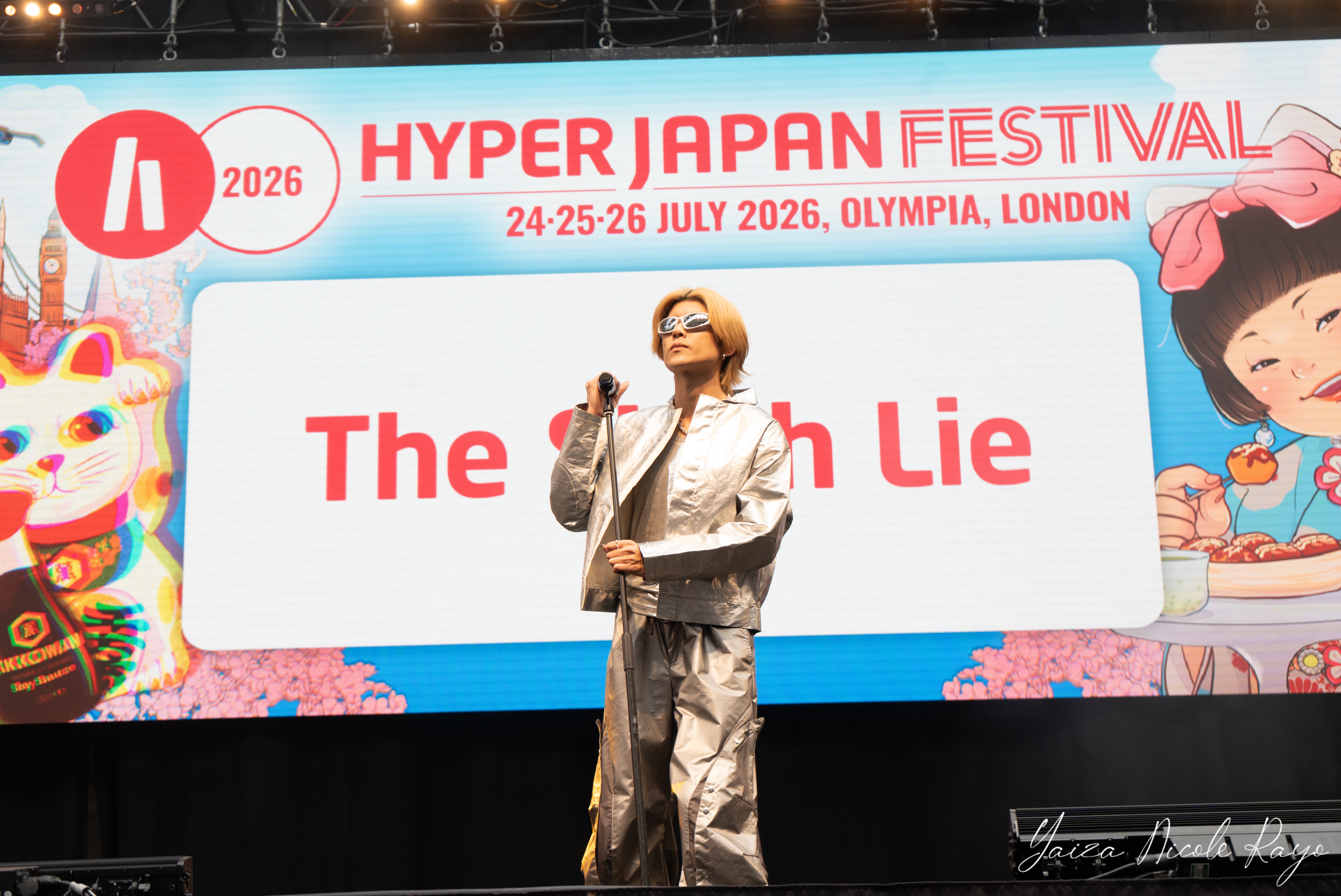
Watching THE SIXTH LIE at Hyper Japan, it was easy to understand exactly what he meant. Every chorus, every guitar break and every moment became part of a conversation between the band and the audience.
Looking back over more than a decade together, both musicians reflected on the moments when they felt the band had reached a new stage in its evolution. Their answers couldn’t have been more different.
For Arata, the breakthrough wasn’t a sold-out concert or a successful release; it was surprisingly personal.
“Personally, I measure my own progress by the quality of my singing. Interestingly, about a year ago I intentionally gained some weight, and after that I noticed my vocals became much more stable. That really made me realise how important physical condition is for singing. So for me, that was the moment—about a year ago.”
When asked if he really meant his body weight, he laughed.
“Yes, my body weight. After I gained weight, singing actually became much easier for me.”
Reiji’s answer was more about the band’s identity.
“I started feeling that way about seven or eight years ago, when we began performing overseas. Within the J-rock scene, I think our sound has always been somewhat closer to European and Western rock. We’ve always existed in a rather unique space between traditional J-rock and Western rock music.”
While anime introduced many listeners to THE SIXTH LIE, he believes the band’s original material tells an even bigger story.
“Our anime songs tend to have a more classic, old-school rock style, and those songs have introduced a lot of people to our music. But when we perform material that sits somewhere between Western rock and J-rock, I feel we’ve found something that’s truly our own. It’s not quite Japanese rock, but it’s not Western rock either. Discovering that unique musical space is what I believe has become our greatest strength.” Here’s a more natural, magazine-style summary:
Through our conversation with Arata and Reiji, I realised that every song they create is driven by thoughtful storytelling. After seeing them at Hyper Japan, one thing is for sure: this band deserves to be experienced on a much bigger stage. Hopefully, it won’t be long before THE SIXTH LIE return to the UK for a headline show, where their music can truly be appreciated in the setting it deserves.
Written and interviewed by Maggie Gogler
Featured image © Nicole Rayo for View of the Arts
View of the Arts took part in a roundtable interview with THE SIXTH LIE following their performance at Hyper Japan.
View of the Arts is an online publication dedicated to film, music, and the arts, with a strong focus on the Asian entertainment industry. As we continue to grow, we aim to deepen our coverage of Asian music while remaining committed to exploring and celebrating creativity across the global arts landscape.


